Winneburg: A Medieval Hilltop Castle in Germany


Site at a Glance
- Rating
- 4.7
- Popularity
- Low
- Country
- Germany
- Primary era
- Medieval
- External website
- Open
- Eras represented
- Medieval
- Civilizations
- Holy Roman Empire
- Site type
- Military
- Remains
- Castle
On this page12 sections
History
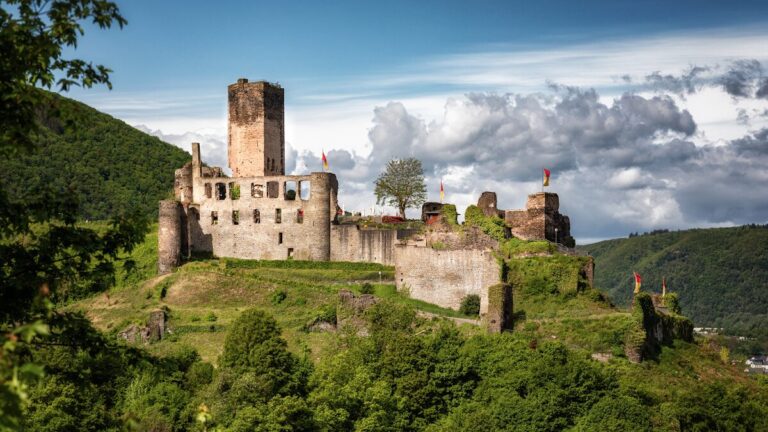
Winneburg is a ruined hilltop castle in Germany, near Cochem, built in the second half of the thirteenth century around 1300 as the ancestral seat of the Lords of Winnenberg. Its medieval origins and later expansion shaped a fortified complex that remained in the family’s possession for several centuries.
Foundation and the Lords of Winnenberg
Winneburg, also known as Winnenburg, was first mentioned in 1304. At that time, Wirich von Winnenberg held the castle from the Archbishop of Trier under a feudal grant. The Lords of Winnenberg continued to own the complex, enlarging it over the following centuries.
Change of ownership and destruction
The Winnenberg family became extinct in 1637. Ownership then passed to the von Metternich family in the middle of the seventeenth century. In 1689, during the War of the Palatine Succession, a European conflict fought from 1688 to 1697 between France and a coalition of opposing powers, French troops besieged and captured Winneburg before blowing it up. The castle was never rebuilt and remained a ruin.
Later history
Klemens Wenzel Lothar von Metternich, an Austrian statesman and diplomat, purchased the ruin in 1832 but did not reconstruct it. Winneburg has belonged to the city of Cochem since 1932. Restoration work in recent years has helped protect the extensive remains from further deterioration.
Remains
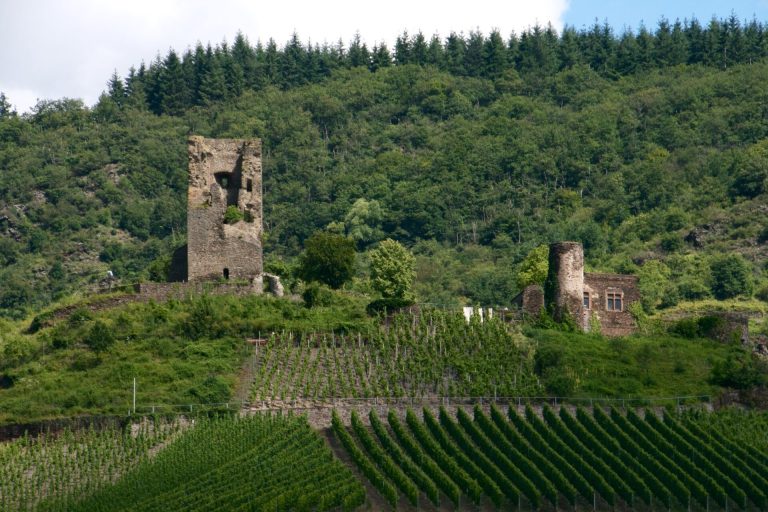
Winneburg occupies a rocky spur in the Eifel, more than 80 metres above the valley of the Endertbach. The stream reaches the Moselle about 2.5 kilometres southeast of Cochem. The surviving castle is arranged across the elevated rock and includes defensive works, residential buildings, service areas, and an outer bailey.
Entrance and defenses
Round fortified tower
A round fortified tower dominates the ruin. It rises approximately 22 metres and measures about 8.5 metres in diameter, standing steeply above the Endertbach valley and visible from the Moselle valley. Towers of this kind served chiefly as defensive strongpoints and places of refuge rather than as the lord’s permanent residence.
Bridge and ditch
From the north, the castle is reached by a bridge crossing a partly refilled ditch. The extensive grounds also retain sections of the surrounding curtain wall, which enclosed the principal castle area.
Residential and working areas
Residential hall
The ruins include prominent remains of the residential hall, the principal representative and domestic building of the castle. Its surviving fabric forms part of the larger complex that developed through repeated expansion after the medieval foundation.
Outer bailey and service buildings
Additional residential and service buildings survive alongside the outer bailey, an area that contained supporting buildings and working spaces. Together with the curtain wall and tower, these remains preserve the broad organization of Winneburg’s fortified grounds.
Castle rock and surroundings
Grapevines covered the castle rock until the second half of the nineteenth century. The site is now surrounded by dense mixed woodland, while the elevated rocky setting remains an important physical part of the surviving ruin.