Dagstuhl Castle: A Medieval Hilltop Fortress in Germany


Site at a Glance
- Rating
- 4.4
- Popularity
- Low
- Country
- Germany
- Primary era
- Medieval
- External website
- Open
- Eras represented
- Medieval
- Civilizations
- Holy Roman Empire
- Site type
- Military
- Remains
- Castle
On this page8 sections
History
Dagstuhl Castle is a medieval hilltop castle in Germany, in Dagstuhl, now part of Wadern in Saarland. Built around 1270 by the knight Boemund of Saarbrücken, it was first documented in 1290. The castle may have been founded for Bohemond I von Warnesberg, Archbishop of Trier. It served as a forward position of Kurtrier, the territory and political authority of the Electorate of Trier, against the Lords of Schwarzenberg. Its position at the confluence of the Wadrill and Löster with the Prims gave it strategic value.
Joint lordship and medieval alterations
After the Dagstuhl knightly line died out, the castle became joint property in 1375 of the families of Fleckenstein, Brücken, Kriechingen, and Rollingen. It therefore became a Ganerbenburg, a castle jointly owned or administered by several hereditary families after inheritance by multiple heirs. Nikolaus Vogt von Hunolstein captured it during a feud in 1404. Alterations followed between 1466 and 1472.
From noble residence to ruin
In the first third of the seventeenth century, Trier’s Elector Philipp Christoph von Sötern bought the castle and its lordship from the co-heirs. He made the complex the seat of a family fideicommissum, an inheritable estate arrangement intended to keep property together within a family. The residential hall was rebuilt during this work.
Through marriage, the castle passed to the Counts of Oettingen-Baldern in 1696. It survived the wars of the sixteenth and seventeenth centuries largely undamaged, and in 1674 it served as winter quarters for the French Marshal Turenne and his troops. Turenne was the title of Henri de La Tour d’Auvergne, a leading French marshal of the seventeenth century.
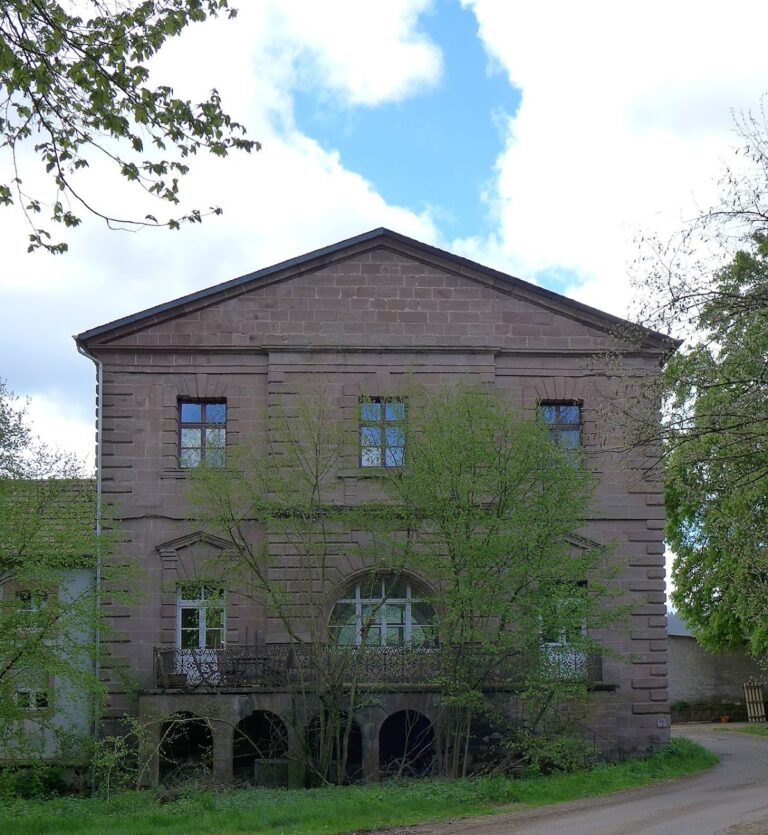
At France’s urging, the fortifications were destroyed in 1717. The complex was then held in trust by Trier’s Archbishop Franz Georg von Schönborn and administered by Wolfgang Anton von Langemantel. Its buildings were systematically dismantled between 1726 and 1759. Their stone was reused in 1760 to build Schloss Dagstuhl, the new family residence of Count Joseph Anton von Oettingen-Sötern in Dagstuhl, in the valley below the castle ruins.
Archaeological recovery
The foundations were cleared in the 1980s, making the castle’s ground plan recognizable again. Systematic archaeological excavations have taken place under the supervision of the Saarland State Heritage Office since 1999, and the ruins were improved for public access in 2004. Dagstuhl Castle is a protected monument.
Remains
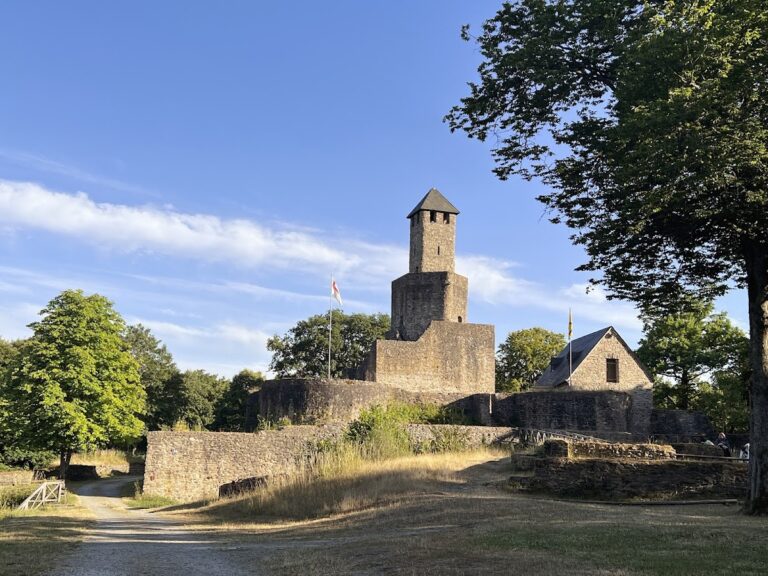
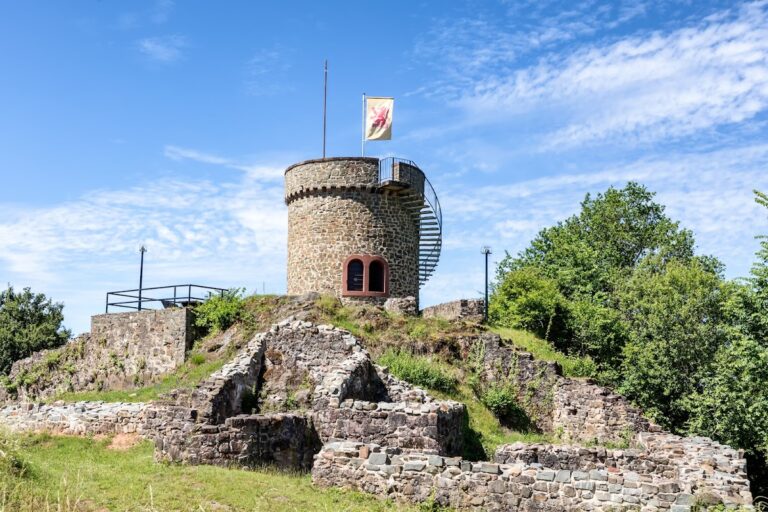
The ruined castle occupies the summit of a hill at approximately 332.1 metres above sea level, overlooking Schloss Dagstuhl in the valley below. The hilltop complex extends for about 300 metres and consists of a core castle, a northern outer bailey, and a southern outwork. Its foundations, exposed through modern clearance and archaeological work, make the overall ground plan visible.
Surviving structures and defenses
Castle tower
The most striking surviving feature is the partially ruined castle tower. Apart from this tower, the visible remains consist primarily of foundation walls. The tower forms the principal standing element within a complex whose other structures are represented mainly by their exposed bases.
Outer defenses and foundations
Two modern wooden bridges cross the neck ditches separating the northern outer bailey from the remainder of the hill. The foundations define the relationships between the core castle, outer bailey, and southern outwork, allowing the former extent and organization of the hilltop complex to be read from the surviving remains.