Burg Neukastel: A Medieval Hilltop Castle in Germany


Site at a Glance
- Rating
- 4.7
- Popularity
- Low
- Country
- Germany
- Primary era
- Medieval
- External website
- Open
- Eras represented
- Medieval
- Civilizations
- Holy Roman Empire
- Site type
- Military
- Remains
- Castle
On this page8 sections
History
Burg Neukastel is a medieval hilltop castle in Germany, above Leinsweiler, probably built by the Salian dynasty during the twelfth century, around 1100 to 1200. The Salians were a German ruling dynasty that provided several kings and emperors of the Holy Roman Empire. Associated with the Counts Palatine, the castle was known as Neukastell or Nicastel. Its name means “new castle,” probably indicating that it replaced or supplemented an earlier structure.
Origins and Imperial Possession
The castle first appears in written evidence in 1123, in connection with Heinrich von Neukastel. In 1246, Isengard, the wife of Imperial Seneschal Philipp I of Falkenstein, transferred it to King Conrad IV. The transfer was connected with the imperial regalia held at nearby Trifels Castle. These were the ceremonial insignia associated with the kingship and emperorship of the Holy Roman Empire. Neukastel then functioned as an imperial castle, a stronghold held directly for the king or emperor, and helped protect Trifels.
In 1252 or 1253, Ludwig von Schüpf adopted the castle’s name. He had served since 1232 as Landvogt of the Speyergau, a high-ranking administrator responsible for a wider district. Nikolaus of Speyer received Neukastel as a fief in 1307. Two years later, King Henry VII transferred the castle and the Speyergau bailiwick to Count George I of Veldenz. George was required in return to invest 1,200 pounds of Heller from the Jewish tax in Landau and the customs revenue at Germersheim in Trifels and Neukastel. The Heller was a small medieval and early-modern German coin.
Palatine Rule and Destruction
In 1330, Emperor Louis the Bavarian pledged Neukastel, along with numerous other properties, to the Counts Palatine Rudolf II and Rupert I for 6,000 marks of silver. A mark of silver was a medieval weight and accounting unit, not a single coin. In 1353, the imperial fief was divided within the Palatine family and further subpledged. During the division of the Palatine administrative seat in 1410, Neukastel was assigned to Duke Stephen, who founded the Palatine-Zweibrücken line.
The German Peasants’ War, a series of uprisings in the German lands during 1525, caused serious damage to Neukastel. The dukes of Palatinate-Zweibrücken rebuilt parts of the castle, but a planned artillery rondel, a rounded defensive structure for firearms, was never built. In 1555, the upper administrative district moved from Neukastel to Bergzabern Castle.
Neukastel suffered further heavy damage during the Thirty Years’ War, the prolonged European religious and political conflict fought from 1618 to 1648. French troops finally destroyed it in 1689 during the War of the Palatine Succession, a European conflict of 1688 to 1697 in which French forces operated in the Palatinate. The castle has remained a ruin since that destruction.
The Estate at the Foot of the Mountain
The Neukasteler Hof at the foot of the mountain had served as the castle’s agricultural and economic farm. It too was destroyed in 1689. In 1828, it was rebuilt on the existing foundations as an estate. Slevogthof Neukastel still stands on the property, preserving the location of this former part of the castle complex.
Remains
Hilltop Setting and Upper Castle
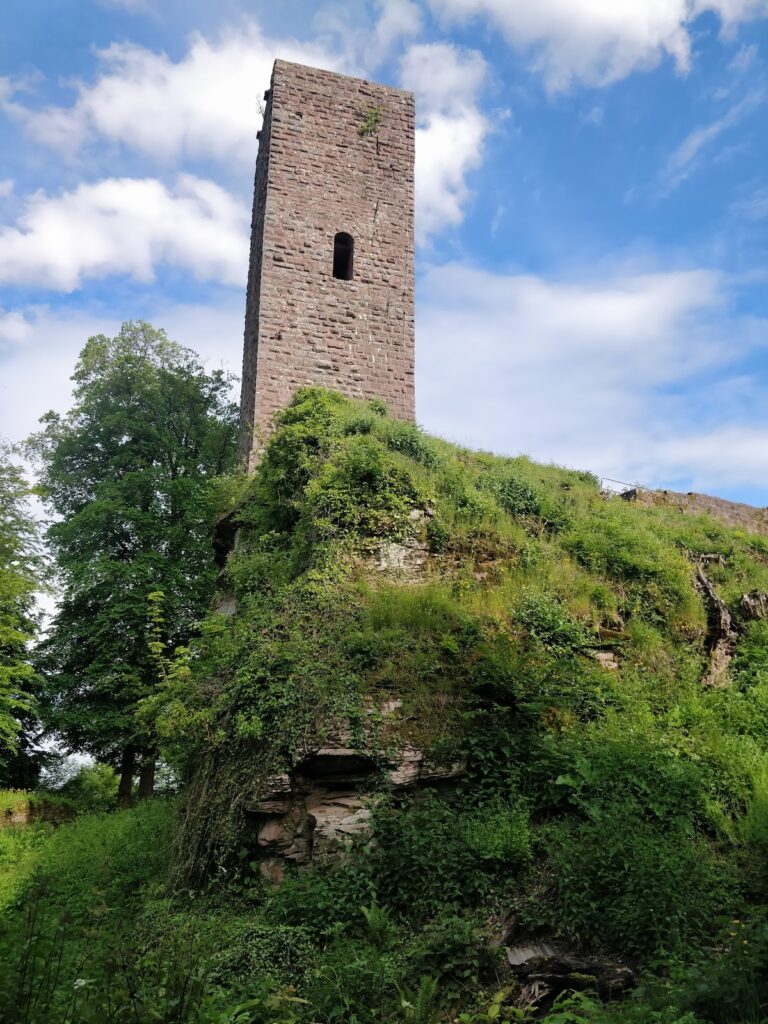
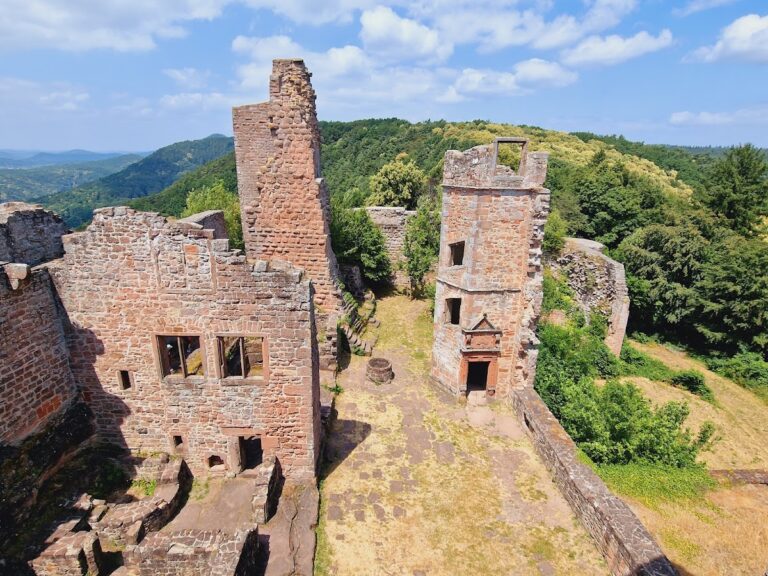
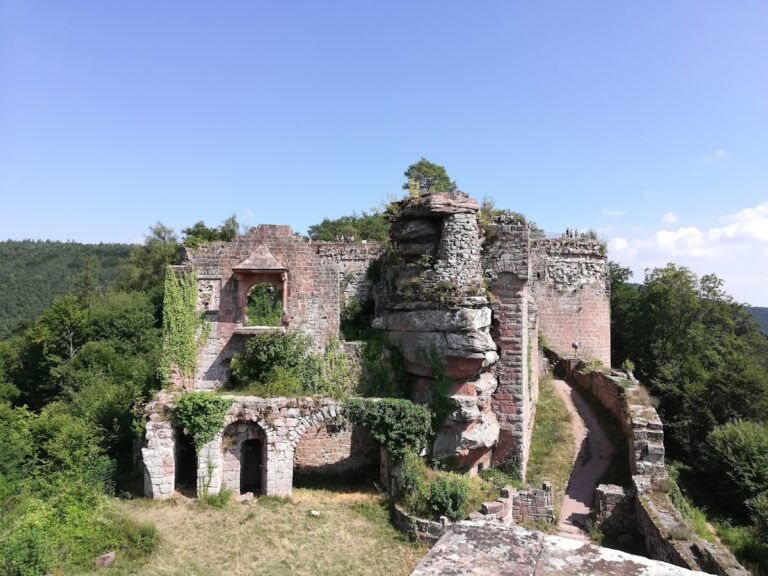
Burg Neukastel stands 459 metres above sea level on the eastern spur of the Föhrlenberg, at the eastern edge of the Wasgau, above the municipality of Leinsweiler. The surviving upper-castle remains occupy a sandstone rock and include a viewing platform. Only a small amount of masonry survives, so the physical evidence is concentrated in the rock-based remains and their immediate structures.
Lower Castle Defences
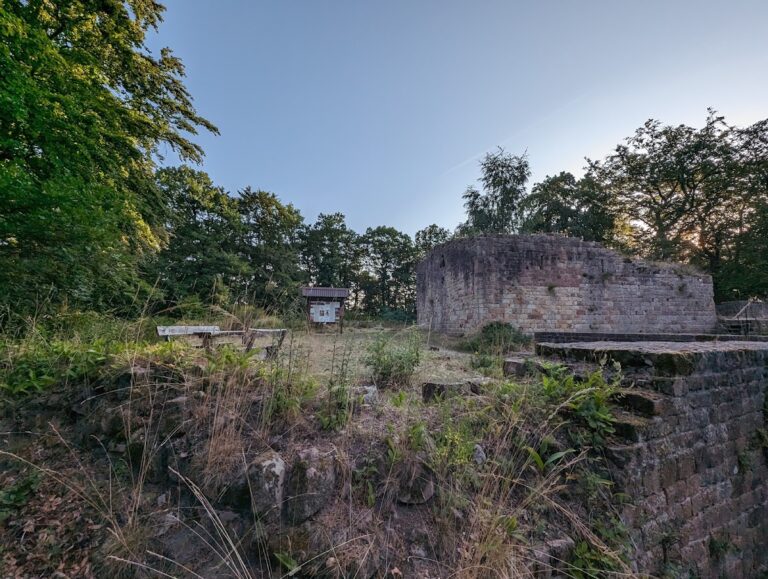
The lower castle preserves features associated with a rock cave and a neck ditch. A neck ditch is a defensive trench cut across the narrow approach to a fortified height. Together, these remains identify elements of the lower defensive area and its relationship to the rocky hilltop position.
Former Economic Courtyard
At the foot of the mountain, the former Neukasteler Hof occupies the foundations of the castle’s destroyed economic courtyard. Rebuilt in 1828, the estate remains represented by Slevogthof Neukastel, linking the later property to the agricultural and service area that supported Burg Neukastel.