Neuscharfeneck Castle: A Medieval Hill Castle Ruin in Germany


Site at a Glance
- Rating
- 4.6
- Popularity
- Low
- Country
- Germany
- Primary era
- Medieval
- External website
- Open
- Eras represented
- Medieval, Early Modern
- Civilizations
- Electoral Palatinate, Holy Roman Empire
- Site type
- Military
- Remains
- Castle
On this page12 sections
History
Neuscharfeneck Castle is a medieval hill castle ruin in Germany, standing in the Palatine Forest of Rhineland-Palatinate above Ramberg and Dernbach. Its construction is generally assigned to the thirteenth century, although the exact date is uncertain. The castle began as a Hohenstaufen-period stronghold, a phase associated with the Staufen dynasty that ruled the Holy Roman Empire and the Kingdom of Sicily during much of the twelfth and thirteenth centuries. It later became the principal seat of the Scharfeneck-Metz family and the centre of the lordship of Scharfeneck.
Origins and the Scharfeneck Family
The Scharfeneck-Metz family descended from a collateral branch of the older Scharfeneck family. That earlier line built Alt-Scharfeneck at the entrance to the Hainbach valley near Frankweiler in the early thirteenth century. When the main line died out around 1250, the Scharfeneck-Metz knights inherited Alt-Scharfeneck. Neuscharfeneck gradually became their principal residence, while the older castle declined.
The Scharfenecks belonged originally to the imperial ministerial class. Imperial ministerials were dependent administrative and military retainers who served the emperor or powerful territorial lords. Their association with Trifels helped establish the family’s early position, but the end of Staufen rule weakened their independent standing. They subsequently attached themselves to the electors of the Palatinate, the rulers of the Electoral Palatinate.
In 1363 the elector obtained the right to open Neuscharfeneck and received the castle as a fief from the Scharfenecks. The family consequently became service and feudal dependants of the Palatine electors. Financial pressure during the fourteenth century also led them to pawn parts of the castle to the Knights of Kirrweiler and the Bishopric of Speyer. Members of the family frequently served the Palatine rulers in military and administrative positions.
Expansion under the Palatine Electors
Friedrich von Scharfeneck, the last member of the Scharfeneck-Metz line, died in 1416. Neuscharfeneck then passed to the Wittelsbach electors of the Palatinate. Elector Frederick I the Victorious substantially enlarged the stronghold. During his rule, the outer bailey, the massive shield wall, and a large residential building were constructed. The new residence replaced the smaller knight’s house on the castle rock, which was demolished to make way for it.
In 1469 Frederick I granted the lordship of Scharfeneck, with Neuscharfeneck as its centre, to his son Ludwig, who had been born from his relationship with Clara Dett of Augsburg. Ludwig ruled Scharfeneck from 1477 to 1523. In 1488 he received the town and castle of Löwenstein and became Count of Löwenstein, founding the later princely house of Löwenstein-Wertheim.
War, Destruction, and Preservation
During the rule of Ludwig’s son and successor, Count Frederick I of Löwenstein, the castle was burned in 1525 during the German Peasants’ War. This was a widespread revolt of rural communities and other lower-status groups across the German lands in 1524 and 1525. The Nussdorf contingent captured Neuscharfeneck without major difficulty because the castellan had failed to provide enough gunpowder. After the conflict, compulsory labour was used to rebuild the castle as a palace complex.
The castle remained with the Löwenstein-Scharfeneck line until the Thirty Years’ War, the European conflict of 1618 to 1648 that caused extensive destruction in the German lands. In 1633 Swedish forces probably blew up Neuscharfeneck with gunpowder. The castle has remained a ruin since that destruction.
After the division of the Haingeraiden communal forest commons in 1828, the ruin passed to the municipality of Flemlingen for use as a quarry. King Ludwig I of Bavaria issued a prohibition on demolition, helping to preserve the surviving fabric. Organized conservation began on 30 August 1961 through the Landau branch of the Palatinate Forest Association. During the winter of that year, vegetation was cleared with assistance from students of Heidelberg University, although deterioration continued.
The Scharfeneck Association was founded in 1971 and leased the castle for its preservation. By 2016, it had invested more than 260,000 euros and extensive volunteer labour in the ruin. Neuscharfeneck is listed as a monument zone of Flemlingen and recognized as a cultural monument. Because its structural condition had seriously worsened, the castle was closed in October 2019. Securing and conservation work began in spring 2022. Further federal support assisted work on the shield wall in 2024, while work on the tower and entrance was completed in February 2025.
Local legends also surround the ruin. Several versions describe a knight called Einaug of Scharfeneck as a cruel lord who imposed tithes, compulsory labour, and dues on the peasants of the Ramberg valley. The stories also portray him attacking merchants and clerics and abusing his authority. One version says that his own servant accidentally killed him during an attempted murder at Ramburg, after which he was condemned to haunt Scharfeneck for 700 years. Another tells of an unsuccessful effort to release his ghost using a golden rose and a black chest in a supernatural reconstruction of the castle.
Remains
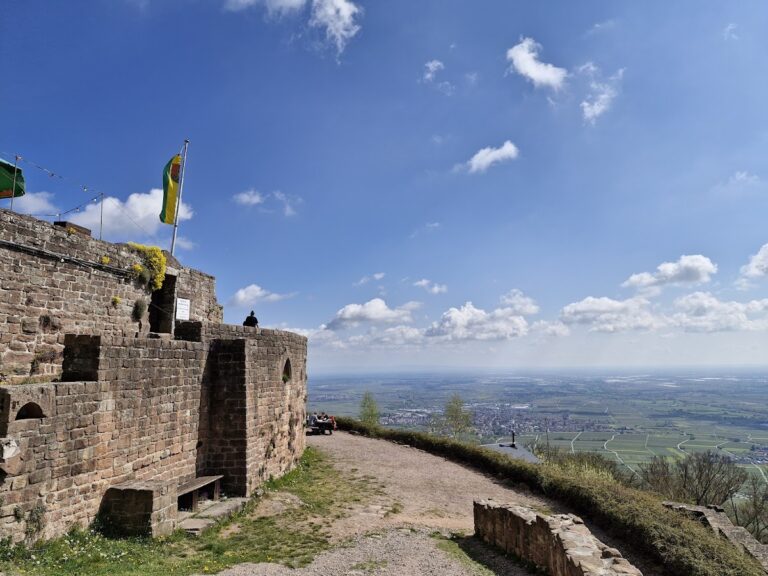
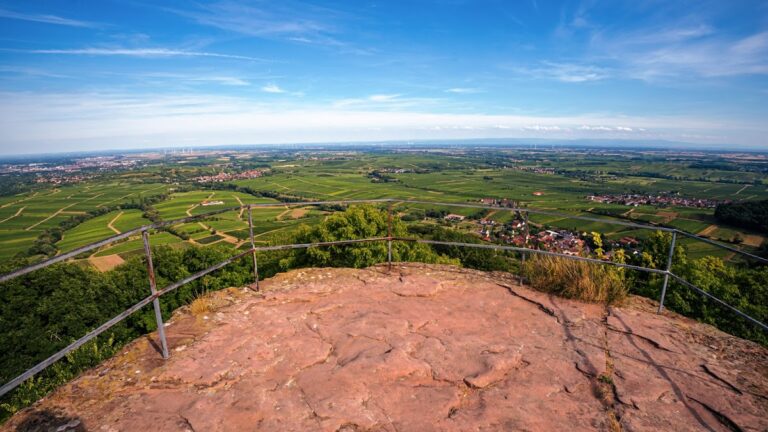
Neuscharfeneck stands at approximately 499 to 500 metres above sea level on the western foothills of the Kalkofenberg in the eastern Palatine Forest. The forested complex lies near the Zimmerplatz, an area associated with the castle’s construction period, where the Landauer Hut is located. The complete castle measures about 150 by 60 metres and is considered the fourth-largest castle complex in the Palatinate. The thirteenth-century castle was substantially smaller than the later complex, which grew through successive military and residential expansions.
Defensive Works
Shield Wall
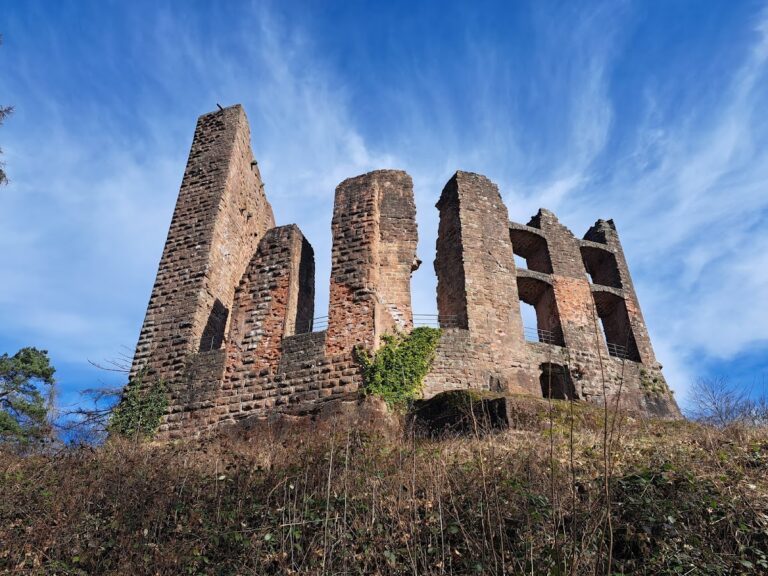
The principal defensive feature is the shield wall, a particularly massive wall placed to protect the castle’s most vulnerable side. Built approximately between 1212 and 1232, it was enlarged in 1470 and again in 1530. The wall is 58 metres long and 12 metres thick. It contains walkable passages, chambers, and casemates, which are enclosed defensive rooms used for protected movement, storage, or weapons. Its main purpose was passive protection for the castle behind it. A gun platform formerly stood on top, but it no longer survives.
Gate and Water Supply
The original entrance passed through the shield wall over a drawbridge. A partially preserved gate building and its flanking tower remain part of the entrance area. Four basins cut into the rock during the thirteenth century served as cisterns. They collected rainwater and, from the sixteenth century, could also receive water from a spring on the Roßberg, approximately two kilometres away. Clay pipes and hollow-tree conduits carried the additional supply to the castle.
Upper Castle and Residential Buildings
Early Castle Rock
The earliest Hohenstaufen-period phase survives only in fragments. Bossed ashlar blocks with drafted margins, clamp holes, and masons’ marks provide evidence of the Romanesque castle. On the central rock, the upper castle contained a first residential building constructed approximately between 1212 and 1232. It was about 30 metres long, but the building itself no longer survives. An inaccessible rock-cut chamber, stairs, and the well structure remain.
Later Residential Building
A later principal residence, known as a palas, was erected around 1470. A palas was the main residential and representative building of a medieval German castle. Around 1530, this structure was transformed into a palace-like complex. Its double latrine shaft has a clear width ranging from 0.75 to 2.75 metres, reflecting a development from earlier medieval latrines built as open-bottomed projections.
A passage through the palas leads to chambers within the shield wall. A cellar beneath the building was uncovered and made accessible in 1891. The remains of the kitchen and forge also survive. The collapsed gable was rebuilt in 1978 and 1979, and later conservation work has addressed the deteriorating fabric of the palas and the wider complex.
Garden and Memorials
Rare herbs were cultivated in the castle garden, including white henbane, Ingrau, and abbey hyssop. In the rock face opposite the shield wall, the Landau section of the German Alpine Club carved a memorial to members who died in the two world wars. The memorial includes an edelweiss motif and names, with a bronze plaque reproducing its text. A second bronze plaque commemorates the Scharfeneck Association.