Trifels Castle: An Imperial Castle in Germany


Site at a Glance
- Rating
- 4.6
- Popularity
- Medium
- Country
- Germany
- Primary era
- Medieval
- External website
- Open
- Eras represented
- Medieval
- Civilizations
- Holy Roman Empire
- Site type
- Military
- Remains
- Castle
On this page13 sections
History
Trifels Castle is a medieval rock castle in Germany above Annweiler am Trifels, probably built in the eleventh century. It became an imperial castle, held important prisoners including Richard the Lionheart, and housed the ceremonial regalia of the Holy Roman Empire, the central medieval political order of much of central Europe.
Origins and the Salian period
Trifels first appears in the historical record in 1081, when it belonged to the nobleman Diemar. He came from the Reginbodonid family, which was associated with the Ufgau in present-day Baden. After retiring to Hirsau Abbey, Diemar transferred the castle to Hermann of Salm, the anti-king who opposed Emperor Henry IV.
Diemar’s possession of Trifels and nearby Madenburg was linked to his marriage to a sister of Johann von Kraichgau, bishop of Speyer. The Speyer annals identify Johann’s mother as a sister of Henry IV. These family connections helped make ownership of the two castles part of a wider dispute involving noble inheritance and imperial authority during the Investiture Controversy, the conflict between rulers and the papacy over the appointment and authority of bishops and other church officials.
In 1112, Emperor Henry V came into conflict with his former chancellor, Adalbert of Saarbrücken, archbishop of Mainz, over Trifels and Madenburg. Adalbert claimed hereditary rights through his family. Henry V forced him to surrender Trifels in 1113, and the archbishop remained imprisoned until 1115, spending part of that time at the castle.
Imperial stronghold and dynastic centre
From 1113 until probably 1310, Trifels held the status of a Reichsburg, or imperial castle held directly for the emperor rather than by a local feudal lord. It was involved in the history of the Salian and Hohenstaufen dynasties, followed later by the Wittelsbachs and the rulers of Palatinate-Zweibrücken. Its greatest political importance came during the twelfth and thirteenth centuries.
Between 1125 and 1298, the imperial regalia were kept at Trifels on several occasions. These ceremonial objects, including the crown, orb, and sceptre, represented the authority of the elected ruler of the Holy Roman Empire. They were generally brought to the castle during an interregnum, a period between rulers or during a vacancy of the imperial throne, or when an emperor was away from Germany. Cistercian monks from nearby Eußerthal Abbey guarded the objects and carried out religious services at the castle.
Richard the Lionheart and other prisoners
Trifels is particularly associated with the imprisonment of the English king Richard I, known as Richard the Lionheart. Richard was captured in 1192 while returning from the Third Crusade, a campaign by western European rulers and armies in the eastern Mediterranean, and was handed over to Emperor Henry VI in 1193.
Richard’s detention lasted nearly two years, but his presence at Trifels is securely established for only three weeks, from 31 March to 19 April 1193. He may have remained at the castle for almost a year. Henry VI released him on 4 February 1194 after receiving a vast ransom said to have reached 150,000 silver marks. The emperor used the money to finance a campaign in southern Italy.
A later story associated with the singer Blondel turned Richard’s imprisonment into a heroic rescue, but the tale has not been historically authenticated. Another high-ranking prisoner, Bruno of Sayn, archbishop of Cologne, was held at Trifels by King Philip of Swabia in 1206 and 1207 before being transferred to Alt-Ems in Vorarlberg. Noble prisoners were probably kept under supervised residence or internment rather than confined continuously in the dungeon cut into the natural rock, although they could not choose where they stayed.
Decline, destruction, and conservation
Trifels lost importance toward the end of the Hohenstaufen period. From 1410, it belonged to the Wittelsbach duchy of Palatinate-Zweibrücken. A lightning strike caused a fire in 1602 that destroyed most of the castle. The ruins offered refuge during the early Thirty Years’ War, the seventeenth-century conflict that devastated much of central Europe, but the site was finally abandoned after plague broke out in 1635.
The chapel apparently remained usable for much longer. In 1786, Baron Joseph von Laßberg was knighted there by his uncle. Later, local builders quarried the ruins for stone. The Kingdom of Bavaria, which had ruled the Palatinate since 1816, began conservation work in 1841. The Trifels Association, founded in 1866, helped prevent further removal of stone from the remains. The castle also received monument protection in 1862 and is protected as a monument zone and as cultural property under the Hague Convention.
Twentieth-century reconstruction and interpretation
Reconstruction began in 1938 under the Nazi regime. Earlier excavations had not recovered enough reliable evidence to establish the castle’s medieval appearance, so the architect Rudolf Esterer created a largely free reconstruction influenced by southern Italian Hohenstaufen castles. The project functioned as a nationalist memorial and presented the regime as heir to the medieval Holy Roman Empire rather than providing an historically exact restoration.
Work stopped toward the end of the Second World War and resumed in 1954, continuing into the 1970s. Trifels is now a museum with a permanent exhibition titled Power and Myth, which addresses the castle’s construction, reconstruction, and political interpretation. This modern history forms an important part of how the site is understood today. A Hohenstaufen stele, a commemorative stone monument associated with the dynasty’s memory, was inaugurated in the Vorburg, or outer bailey, on 4 October 2008.
Remains
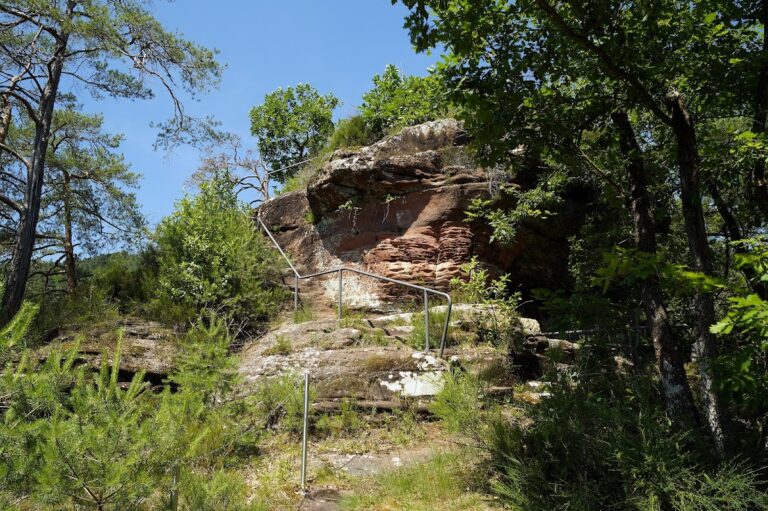
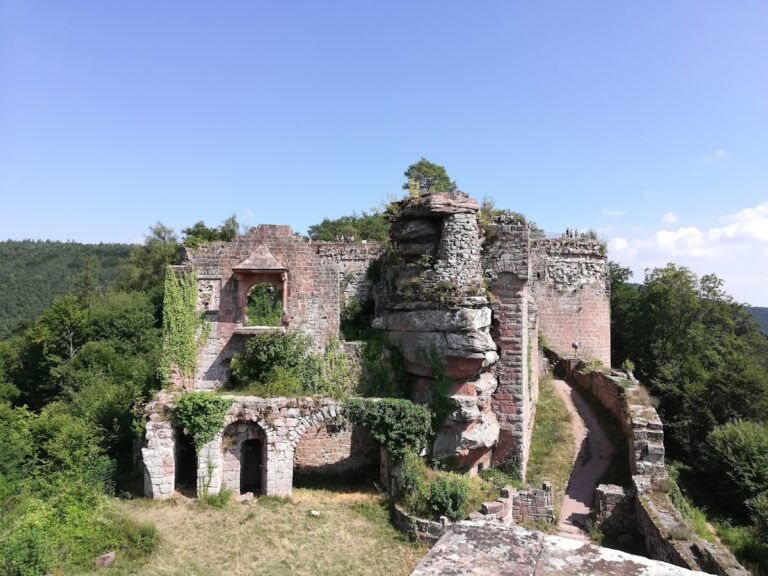
Trifels stands on the summit of the 479-metre Sonnenberg, a flattened mountain typical of the Wasgau, the region formed by the southern Palatinate Forest and the eastern Northern Vosges. The castle occupies a three-part Buntsandstein rock formation, a red sandstone geological formation common in parts of the Palatinate Forest. The foundation is approximately 145 metres long, 40 metres wide, and 50 metres high, and the name Trifels refers to this threefold rock.
The ruined castles of Anebos and Scharfenberg, also called Münz, occupy two nearby summits immediately southeast of Trifels and form the Trifels group. Annweiler lies roughly 300 metres below the castle in the Queich valley. The Bindersbach rises west of the group and runs for about 2.5 kilometres, draining an area of 2.3 square kilometres. To the east, the Trifelsbach runs for about 2.9 kilometres and drains 2.8 square kilometres. Both streams flow north into the Queich, a left-bank tributary of the Rhine.
Castle layout and water installations
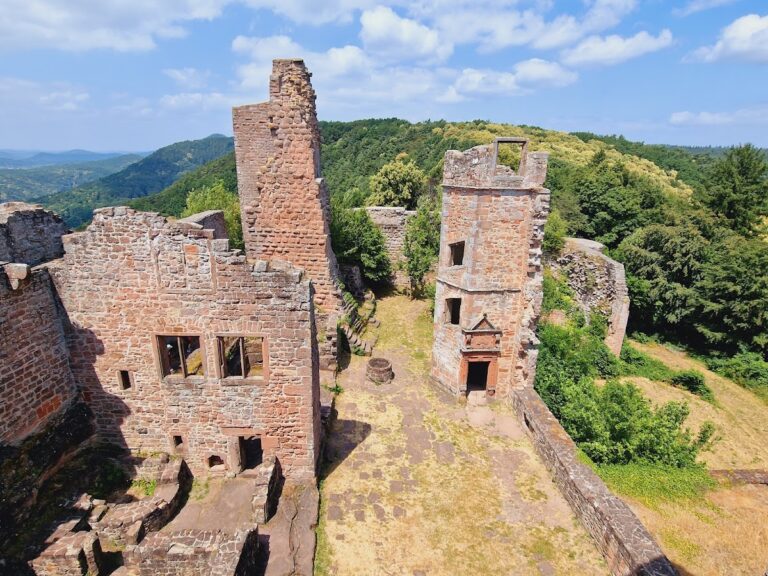
The surviving complex is only partly restored and was rebuilt largely without strict fidelity to the medieval original. Stairways, interior rooms, window openings, and the knights’ hall form part of the present arrangement. Water management is represented by well troughs, a Salian-period cistern, and a Hohenstaufen-period well tower linked to an arched bridge. A cistern is a constructed reservoir used to collect and store water, while a well tower combines water access or storage with a fortified tower.
Towers and principal rooms
Main tower
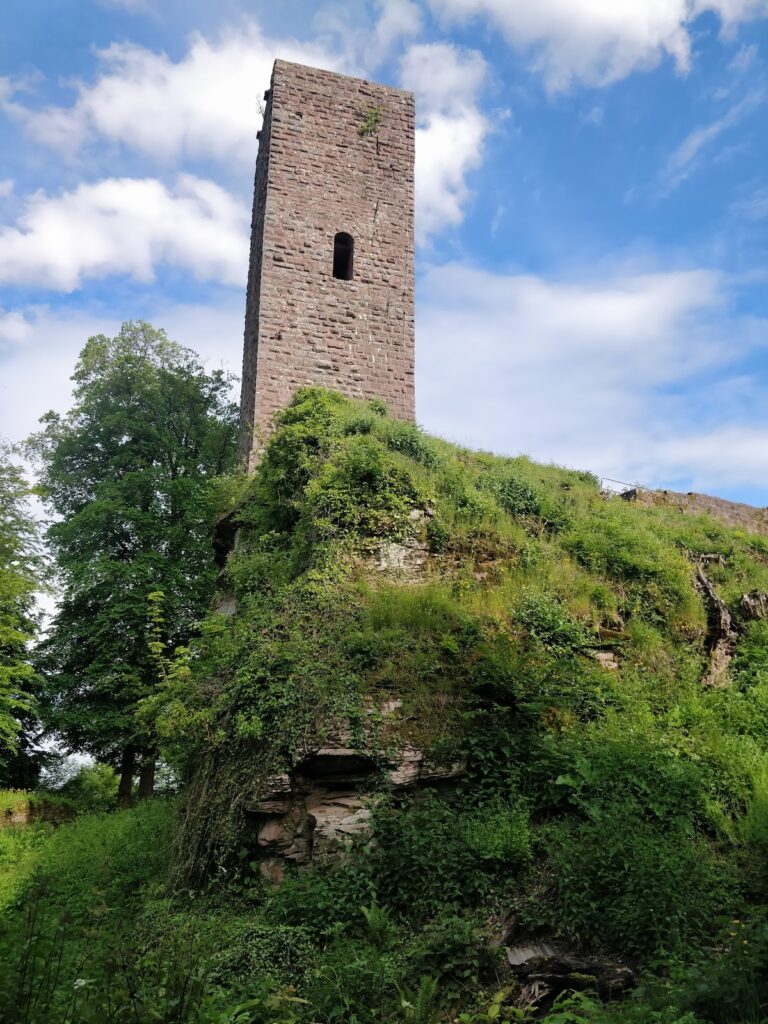
The main tower received a new upper storey in 1966, bringing its total height to 32 metres. Two separate internal stairways lead through the tower. Its present form therefore combines the reconstructed appearance of the monument with a surviving vertical element that expresses the castle’s elevated position on the rock.
Imperial Hall
The large two-storey Imperial Hall, or Kaisersaal, is a modern reconstruction and did not exist in this form in the medieval castle. Much of the surrounding complex likewise reflects Esterer’s twentieth-century reconstruction rather than surviving medieval buildings.
Chapel and rock-cut dungeon
A chapel formed part of the castle complex and remained usable into the late eighteenth century. The site also includes a possible dungeon cut into the natural rock. Its association with the castle is clear enough to preserve the tradition of a prison space, while the use of this chamber for noble prisoners remains uncertain.
Regalia displays and outer bailey
Replicas of the imperial crown, orb, and sceptre are displayed at Trifels. The original regalia are held in the Imperial Treasury of the Hofburg at the Kunsthistorisches Museum in Vienna. In the Vorburg, the outer bailey adjoining the main castle, the Hohenstaufen stele was inaugurated in 2008. A rock terrace provides views across the Palatinate Forest and the Rhine valley.
Nearby sites