Burg Kürnberg: A Late Gothic Hilltop Castle in Germany


Site at a Glance
- Rating
- 4.8
- Popularity
- Low
- Country
- Germany
- Primary era
- Medieval
- Eras represented
- Medieval
- Civilizations
- Holy Roman Empire
- Site type
- Military
- Remains
- Castle
On this page7 sections
History
Burg Kürnberg, also known as Kürnburg or Kirnberg, is a late Gothic hilltop castle near Stamsried in Germany. Medieval nobility built it on the 571-metre-high Haidberg after Dietrich der Kürner received Stamsried as a fief from Count Palatine Ruprecht II in 1346 and secured permission to construct the castle. Its listed construction date is 1354, and Dietrich thereafter adopted the name Kürner von Kürnberg. The castle was a noble stronghold and later became part of the estate of Stamsried.
The Kürner family and the Bamberg fief
After Dietrich’s death in 1360, Kürnberg passed to his sons Marquart, Hans, and Dietrich. In 1367, Ulreich der Tanner was recorded as living at the castle while serving as court-mark judge for the Kürnberg and Stamsried estates under Marquart der Kürner. This office connected the castle with the administration of the surrounding lands.
When the younger Dietrich Kürner died in 1406, his widow married Hermann Hertenberger and lived with him at Stamsried. Their sons Marquart, Hans, Degenhard, and Dietrich retained Kürnberg. On 16 January 1422, Hans der Kürner issued Bishop Friedrich of Bamberg a feudal acknowledgment concerning the free male fief of Kürnberg and the bailiwick of Roding. The document confirmed that the castle was held as a Bamberg fief, meaning property granted under feudal obligations to a superior.
Changing noble holders
Ulrich Warberger purchased Kürnburg with the consent of Count Palatine Johann on 12 September 1429. His son Christoph held the castle in 1452. In 1467, Balthasar Warberger issued a further feudal acknowledgment and requested that the fief be granted to Hans von Plankenfels. Hans was also listed in the oldest Landsassen register in 1488. Such a register recorded members of the landed nobility and their estates. In 1489, he joined the Löwlerbund, a late-medieval noble association in Bavaria.
In 1499, the castle passed to the knight Ludwig von Habsberg. His son Ulrich and grandson Hans Wolf followed as holders, with Hans Wolf recorded in the Landsassen register in 1530. Georg von Murach held Kürnberg in 1539, and his son Andreas Georg von Murach was its feudal holder in 1580. The Murach family later combined Kürnberg with Stamsried, after which the castle followed Stamsried’s ownership history.
Destruction and conservation
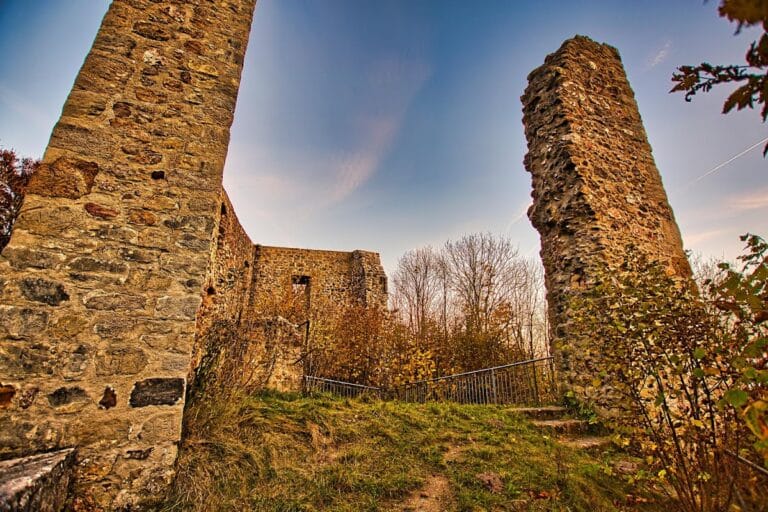
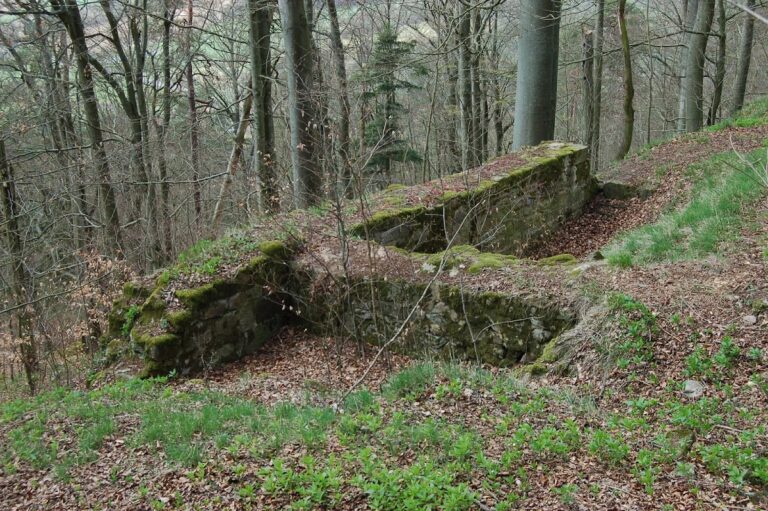
During the Thirty Years’ War, the major European conflict of 1618–1648, Swedish forces besieged Kürnberg. The castle was destroyed in 1634 and subsequently fell into ruin. Comprehensive conservation and renovation took place in the late 1970s. The ruins are protected as a listed architectural monument in Kürnberg and are also recorded as an archaeological monument because of the surviving remains of the medieval castle.
Remains
Castle layout and defenses
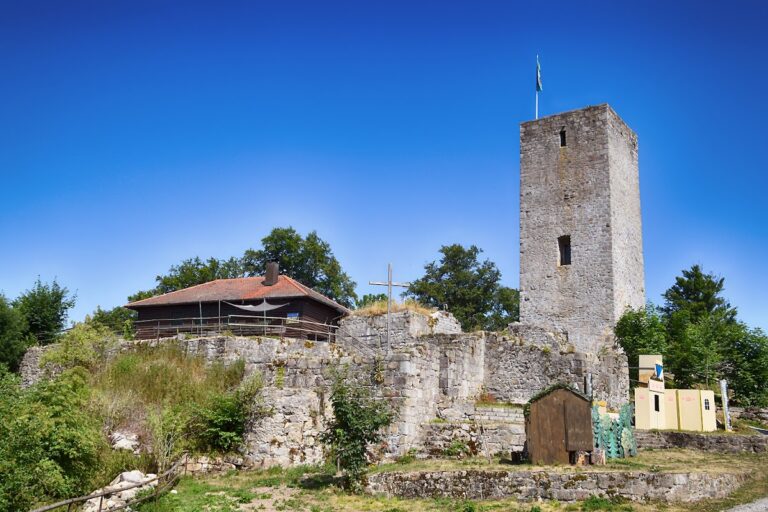
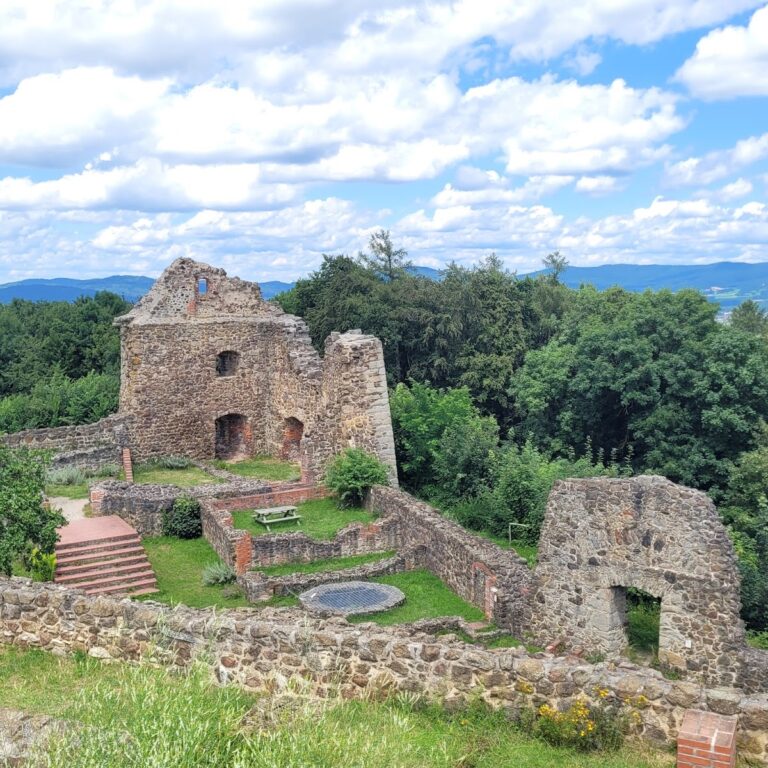
The surviving complex is an extensive late Gothic hilltop castle on the summit of the Haidberg, about one kilometre northeast of Stamsried. It includes the main castle, an outer bailey, and a zwinger, an enclosed defensive area between lines of fortification. Substantial wall remains define a layout with three castle courtyards, two gate structures, and a broad moat along the western side. Several partly semicircular towers strengthened the defenses, including a large battery tower.
Residential building
The palas, the principal residential and representative building of a medieval castle, survives as a tower-like rectangular structure with a basement. Its upper storey projects about 25 centimetres beyond the lower wall on corbel-like stones. Kürnberg had no bergfried, the independent main defensive tower found at many castles. The surviving walls and courtyards therefore convey a fortified arrangement organized around several defensive and residential elements rather than a separate central keep.