Obernburg: A Medieval Hilltop Castle Ruin in Gudensberg, Germany


Site at a Glance
- Rating
- 4.6
- Popularity
- Low
- Country
- Germany
- Primary era
- Medieval
- Eras represented
- Medieval, Early Modern
- Civilizations
- Holy Roman Empire
- Site type
- Military
- Remains
- Castle
On this page10 sections
History
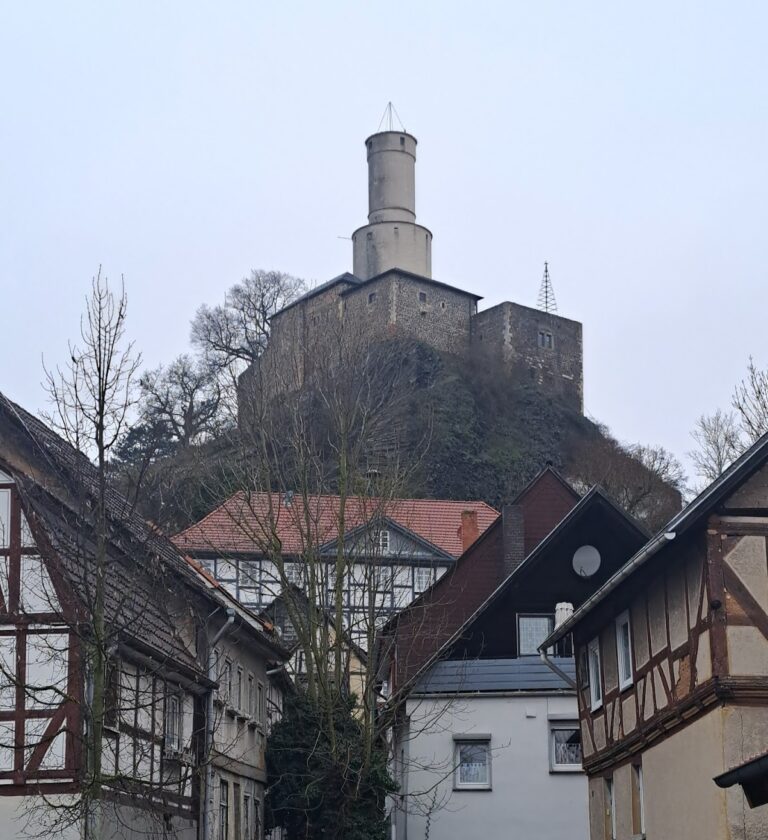
Obernburg is a Romanesque medieval hilltop castle ruin in Germany, above the town of Gudensberg in Hesse. It stands on the Schlossberg, which was a seat of the counts of the Hessengau by 1045. The Hessengau was a medieval regional county whose count exercised judicial, fiscal, and military authority in what is now northern Hesse. Obernburg and the surrounding settlement became closely connected with the political development of Gudensberg and the succession of ruling families in the region.
The counts of the Hessengau
From 1027, the office of count was held by the originally Swabian Werner family. By 1045, the Schlossberg served as the counts’ seat. The count presided over the regional court, collected taxes and other dues, organized the military levy, and held the regional judicial and political assembly known as a Thing on the nearby Mader Heath. The foundation and settlement of the town of Gudensberg followed this concentration of authority.
Obernburg was first recorded in 1121 under the name Udensberc. At that time it was associated with the Giso family, which inherited the Hessengau county after the death of Werner IV. After Giso IV died, his heiress Hedwig married Ludwig I, count and later landgrave of Thuringia, probably before 1122. The county therefore passed to the Ludowinger family, the ruling house of medieval Thuringia. It was generally administered by younger brothers of the landgraves, who held the title “counts of Gudensberg.”
From Thuringian rule to Hesse
In 1170, Landgrave Ludwig of Thuringia transferred his allodial property in Gudensberg to Fulda Abbey. An allod was hereditary property held as an owner’s possession rather than as a fief. Obernburg and the rest of the county had, however, been a fief of the Archbishopric of Mainz since 1121. Mainz was a major ecclesiastical principality of the medieval Holy Roman Empire, and its claims brought the castle into repeated conflict with the emerging Hessian territory.
Konrad of Thuringia, one of the counts of Gudensberg, became notorious for his attack on Fritzlar in 1232. After a lengthy siege, he burned the neighboring Mainz cathedral city and killed most of its inhabitants. As penance, Konrad entered the Teutonic Order, a religious-military institution founded during the Crusades, and later became its grand master, its highest governing officer.
After Heinrich Raspe, the last Ludowinger landgrave of Thuringia, died in 1247, the castle passed to the new landgraviate of Hesse, established under Heinrich of Brabant, known as the Child of Brabant and a grandson of Saint Elisabeth. Heinrich was proclaimed landgrave on the Mader Heath in 1247. He first made Marburg his official residence and moved the residence to Kassel from 1277.
Conflicts with Mainz
Obernburg remained part of the military and political contest between Mainz and Hesse. In 1312, during a feud between the Archbishopric of Mainz and the Landgraviate of Hesse, Heinrich, Count of Waldeck, stormed the castle. He was an ally of Mainz and an official in Lower Hesse.
The castle again faced attack in 1387. On 2 September, the nearby Wenigenburg, which occupied another position on the same mountain and served as Obernburg’s outer bailey, was destroyed during a conflict with Mainz. Obernburg itself was successfully defended by Ekkebrecht of Grifte against the troops of Archbishop Adolf I of Nassau and remained undamaged. Under Landgrave Ludwig I of Hesse, from 1413 to 1427, it again served as a principal Hessian base against Mainz’s aggression.
Destruction and preservation
The castle’s outer defensive enclosure, known as a zwinger, was constructed in 1500. A zwinger was an outer zone placed in front of a castle’s principal defenses. The castle’s bergfried, the main defensive tower of a medieval German castle, collapsed in 1613.
During the Thirty Years’ War, Johann t’Serclaes von Tilly, Count of Tilly, convened a diet of Hessian towns at Obernburg. In 1640, Croatian troops devastated Gudensberg. Matthäus Merian the Elder made an engraving of Gudensberg in 1627, providing the oldest demonstrable pictorial representation of Obernburg. The view was reproduced in Wigand Gerstenberg’s chronicle of Thuringia and Hesse and later included in Merian’s Topographia Germaniae, published between 1642 and 1688.
After 1700, the castle gradually fell into decay. During the Seven Years’ War, British troops under John Manners subjected the partly preserved ruins to a two-day bombardment in 1761, causing severe damage. Napoleonic troops plundered the remains in 1806 and destroyed the castle completely. In 1809, Jérôme Bonaparte, Napoleon’s brother and King of Westphalia, had the remains auctioned.
The castle gate was renewed and secured in 1850, while the enclosing wall was renovated in 1900. The city of Gudensberg acquired Obernburg in 1901, and the stump of the bergfried was repaired in 1950. From 1986, the Obernburg Friends of Gudensberg association undertook repairs and stabilization work, completing the renovation in 2006. Since 14 May 2006, the site has also been used as an exhibition setting for art.
Remains
Hilltop setting and layout
Obernburg occupies the wooded Schlossberg, a basalt cone rising to 305.8 metres above Gudensberg. The Goldbach, a tributary of the Ems, passes along the mountain’s eastern side from north to south. The castle’s position on the summit places it within the historic landscape of the Hessengau. Views from the summit extend north toward the Odenberg and Langenberge, northeast toward the Kaufungen Forest, east toward Felsberg and the Heiligenberg, and south and southwest toward Homberg and Fritzlar across the Eder valley toward the Kellerwald.
The castle was organized around its principal defenses and an outer defensive enclosure. The Wenigenburg formed the outer bailey, but stood elsewhere on the same mountain rather than within the surviving castle fabric. The present remains consist of sections of the walls, the lower structure of the former bergfried, and the castle gate. The visible fabric reflects the Romanesque character of the medieval hilltop fortress, later defensive additions, wartime damage, and modern stabilization.
Surviving structures
Castle gate
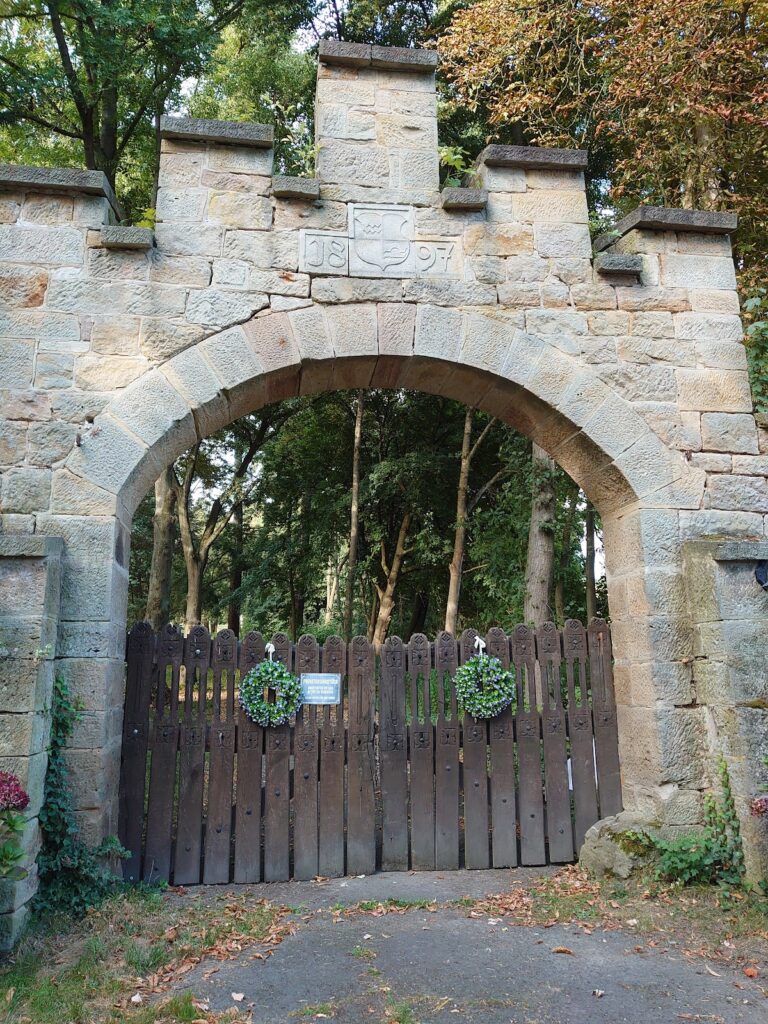
The castle gate is one of the principal surviving elements of Obernburg. It was renewed and secured in 1850 after the castle’s destruction and later decay. The gate has also acquired a civic role, since the coat of arms of Gudensberg depicts a stylized version of it.
Bergfried and defensive walls
Only the lower structure, or stump, of the bergfried survives. The tower collapsed in 1613, and its remaining base was repaired in 1950. Wall sections and the enclosing wall complete the principal preserved fabric. The outer defensive enclosure was added in 1500, while the surviving walls were severely damaged by the British bombardment of 1761 and the destruction carried out by Napoleonic troops in 1806. Repairs, stabilization, and renovation between 1986 and 2006 secured the remains in their present form.