Ruin Neuravensburg: A Medieval Hilltop Castle Ruin in Germany


Site at a Glance
- Rating
- 4.5
- Popularity
- Low
- Country
- Germany
- Primary era
- Medieval
- External website
- Open
- Eras represented
- Medieval, Early Modern
- Civilizations
- Holy Roman Empire
- Site type
- Military
- Remains
- Castle
On this page8 sections
History
Ruin Neuravensburg is a high-medieval hilltop castle ruin in Germany, built at the end of the twelfth century above Neuravensburg, now a district of Wangen im Allgäu. The counts of the Argengau established the castle, which was first mentioned in 1271.
Medieval Castle
The castle took its name from the von Ravensburg imperial ministerials. These members of the medieval service nobility held administrative, military, or court offices for the emperor or other territorial lords. During the thirteenth century, the von Ravensburg family exercised authority connected with the castle.
Destruction and Palace Rebuilding
The castle was destroyed during the German Peasants’ War in 1525, a broad uprising of rural communities and towns against aspects of lordship and social order in the German lands. Between 1614 and 1617, Abbot Bernhard Müller of the Abbey of Saint Gall rebuilt the complex and expanded it into a palace. The Abbey of Saint Gall was a historic monastic institution in present-day Switzerland, governed by its abbot.
The complex was later called Neuravensburg Palace. In 1836, it was sold for demolition, and parts of the site were demolished between 1837 and 1845.
Conservation and Research
Stabilization work was carried out on the keep ruins in 1913 and 1962. The city of Wangen purchased the ruin in 1992 and commissioned further conservation work in 1995 and 1996. The Burg- und Heimatverein Neuravensburg, founded in 1987, assumed responsibility for preserving and researching the castle complex.
Remains
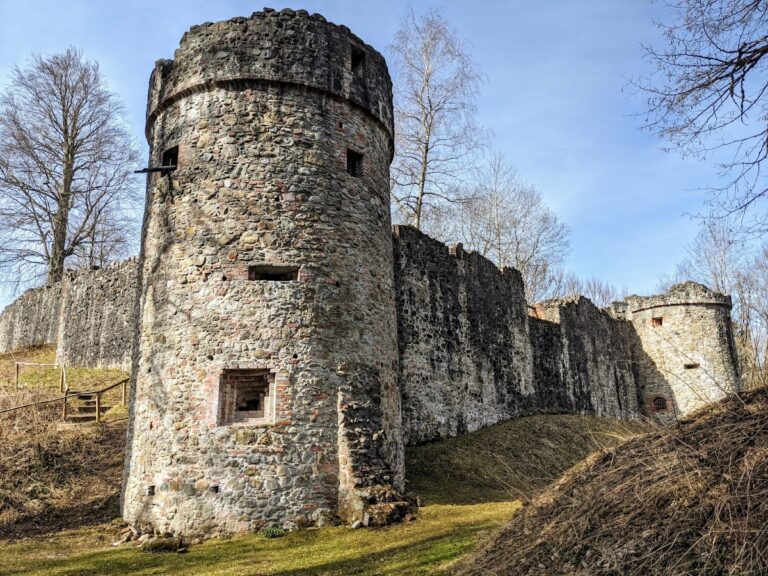
Ruin Neuravensburg stands at about 564 metres above sea level on a ridge above the Upper Argen and high above Neuravensburg. It occupies a spur position, meaning that the castle was built on a projecting elevated landform for defensive advantage. The ridge is a drumlin, an elongated hill formed by glacial movement. The surviving complex consists principally of the ruined keep and the foundations of the residential palas, the castle’s principal residential and representative building.
Castle Structures
Keep
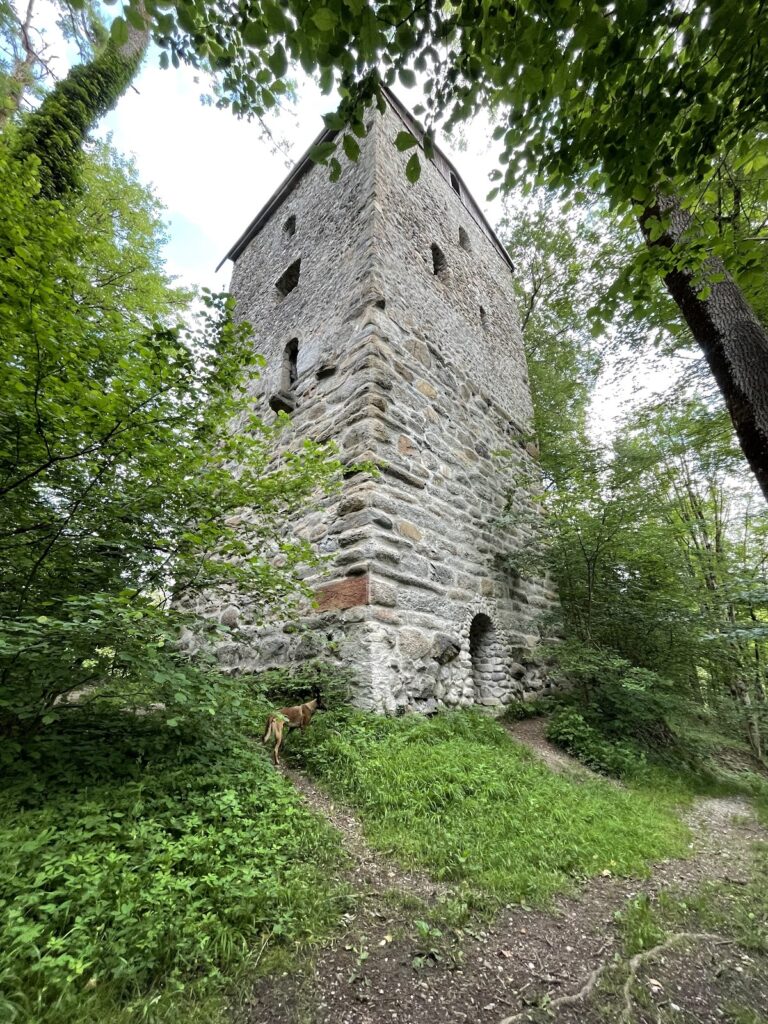
The keep, the main defensive tower of a medieval German castle, forms the most imposing surviving part of Neuravensburg. Its ruins are a landmark of Neuravensburg. The structure has been stabilized, and it contains an observation platform and can also be entered internally.
Palas Foundations
The foundations of the palas survive as part of the complex. The palas served as the castle’s principal residential and representative building and preserves the location of this major element of the rebuilt palace complex.
Nearby sites