Schloss Senftenau: A Former Moated Castle and Manor House in Germany


Site at a Glance
- Rating
- 4.3
- Popularity
- Very Low
- Country
- Germany
- Primary era
- Early Modern
- Eras represented
- Medieval, Early Modern
- Civilizations
- Holy Roman Empire
- Site type
- Domestic
- Remains
- Manor House
On this page7 sections
History
Schloss Senftenau is a historic manor complex in Lindau, Germany, probably established as a moated castle during the twelfth or thirteenth century. Its medieval origins, later role as a noble residence, and surviving sixteenth- and eighteenth-century fabric reflect the changing ownership and use of the estate.
Medieval origins and the Montfort estate
The former moated castle of Count Ulrich von Montfort was first mentioned in 1344. In that year, Count Ulrich II of Montfort, also known as Ulrich of Feldkirch, transferred Senftenau Castle to the emperor as a fief. A fief was land or property held from a superior lord in return for defined obligations. The estate included both the castle and a mill within the political framework of the Holy Roman Empire, the medieval and early-modern order that governed the imperial and ecclesiastical fiefs of the period.
After 1356, the estate changed hands among patrician families and served as a summer residence. Patricians were wealthy and politically influential urban families, whose ownership connected Senftenau with Lindau’s civic elite as well as with noble property arrangements.
The Humpis and Kurtz von Senftenau families
During the German Peasants’ War, a widespread revolt across parts of the Holy Roman Empire in 1524 and 1525, Schloss Senftenau passed to the Humpis family in 1525. In 1551, Sebastian Kurtz, an agent of the Fugger merchant and banking dynasty of Augsburg, purchased the castle from Friedrich Hundtpiss of the Siggen-Brochenzell branch of the Humpis line.
Senftenau was held as a fief of Lindau’s women’s collegiate foundation. Sebastian Kurtz married Magdalena Gründlin, who held the imperial fief Schloss Senftenau, and subsequently adopted the name Kurtz von Senftenau. He had four sons and commissioned the castle chapel in 1533. In 1536, Sebastian Kurtz and his children were raised to the rank of baron, while his grandchildren received countly status in 1636.
From 1540 to 1830, members of the Kurtz von Senftenau family belonged to Zum Sünfzen, Lindau’s patrician society. The fief returned to Lindau ownership in 1605, although the family’s association with the estate remained central to its historical identity.
Alterations and modern ownership
The complex was altered during the sixteenth and eighteenth centuries. Its principal building was renewed between 1551 and 1569, while additional buildings were constructed or reshaped in the Baroque style, an ornate architectural tradition that developed in Europe during the seventeenth century and continued into the eighteenth.
The writer Bruno Wille moved into the castle in 1918. The Jobst family has owned Schloss Senftenau since 1984. Extensive renovation and conversion work carried out between 1984 and 2008 included clearing overgrowth from the castle pond, helping preserve the relationship between the buildings and the water feature.
Remains
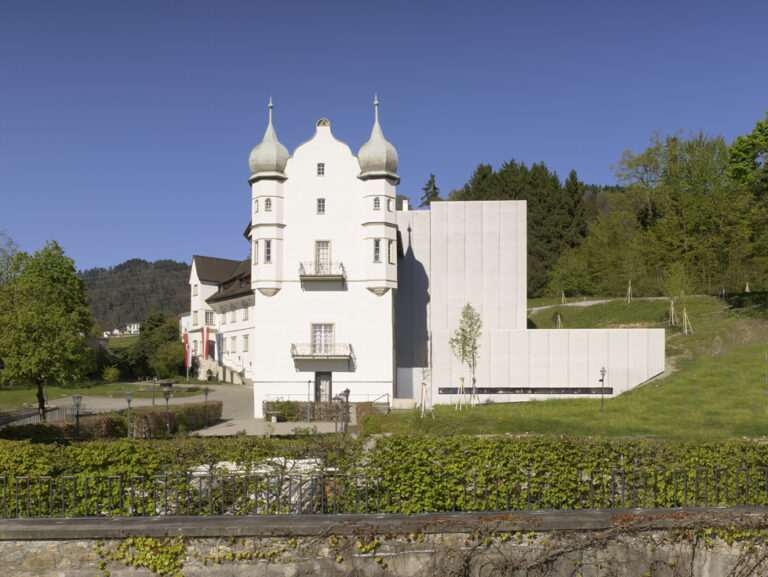
Schloss Senftenau is a substantial manor house with a park in Lindau’s Aeschach district. The present complex developed from a moated castle and includes a principal building renewed in the sixteenth century, Baroque ancillary buildings, a chapel, and a small pond along the south side.
Principal buildings and chapel
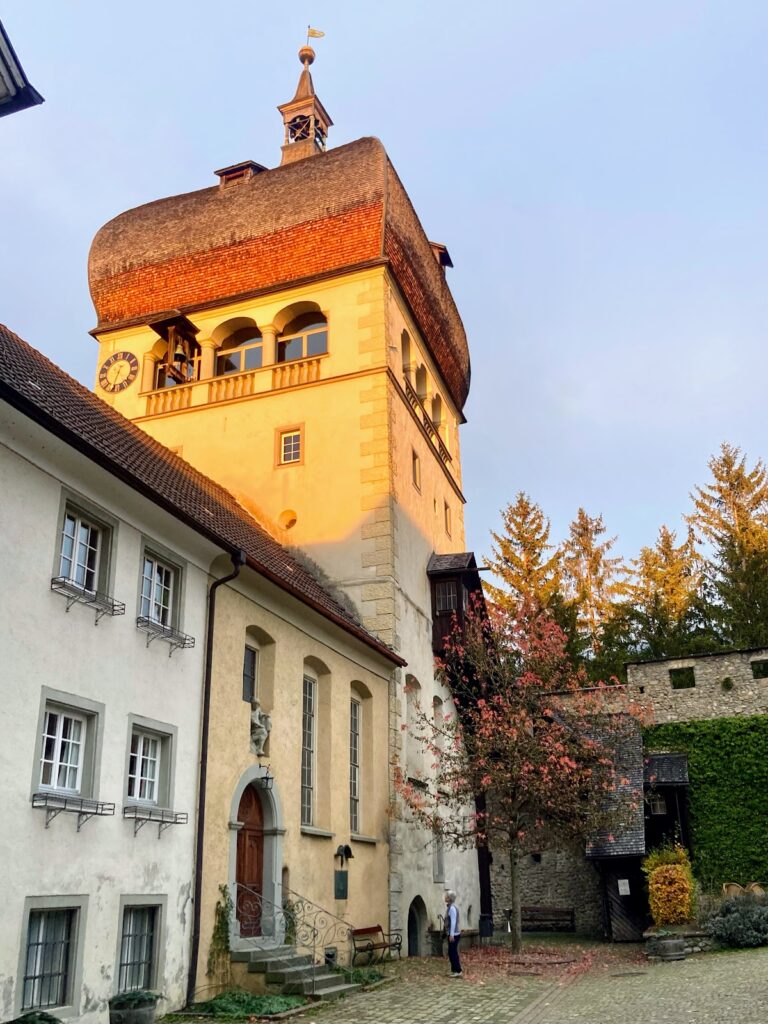
The main building belongs to the renewal carried out between 1551 and 1569. It stands with ancillary buildings from later Baroque alterations, forming the surviving core of the manor complex. The castle chapel, commissioned in 1533 by Sebastian Kurtz, is another documented part of the estate’s architectural development.
Pond and entrance heraldry
The small pond on the south side preserves an element of the site’s earlier defensive setting. It receives water through a piped inlet and from groundwater, and has no outlet. The eastern entrance bears coats of arms linked with the Kurtz, Funck von Senftenau, and Humpis families.
The Kurtz von Senftenau arms show a peacock tail between two ibex horns. The right horn is gold and the left is black; the associated coverings are black and gold on the right and red and silver on the left.
Nearby sites