Schloss Hofen: A Renaissance Residence and Educational Centre in Austria


Site at a Glance
- Rating
- 4.5
- Popularity
- Very Low
- Country
- Austria
- Primary era
- Early Modern
- External website
- Open
- Eras represented
- Medieval, Early Modern, Modern
- Civilizations
- Habsburg, Holy Roman Empire
- Site type
- Domestic
- Remains
- Manor House
On this page10 sections
History
Schloss Hofen is a Renaissance residence in Austria near Lochau on the shore of Lake Constance. Its construction belongs to the sixteenth century and reflects the Renaissance architectural movement, which revived and adapted classical forms. The estate grew from an earlier Hofen farm or tower connected with the Counts of Montfort and later became a Raitenau family residence.
From Montfort estate to Raitenau residence
From 1218, the Hofen farm or tower served as the seat of ministers of the Counts of Montfort. These ministers, known as ministeriales, were administrative and military servants who occupied an intermediate social position between free and unfree status. The Hofen residence also housed the castle guards responsible for Lochau Castle, known as Alt-Hofen, which stood on higher ground above it. Montfort control continued until 1451.
Troops of the Swabian League destroyed Alt-Hofen in 1452. The Swabian League was a late-medieval alliance of cities and territories in southwestern Germany. In 1456, the former castle became an Austrian fief held by Jos Mündelin. Its ruins remain on a wooded elevated spur northeast of Lochau, above Schloss Hofen.
The Raitenau family was present in Lochau from 1467 to 1658. Hans Gaudenz von Raitenau received Hofen Castle in 1562 and commissioned the new residence, Schloss Hofen, in 1584 and 1585. The building was completed around 1616 by Hans Werner IV von Raitenau. The family’s connection with the estate also included the St. Oswald Chapel, probably erected before 1496 by Hans Werner II von Raitenau as a house chapel. It was later dedicated as the Chapel of the Holy Cross.
Wolf Dietrich von Raitenau was born at Schloss Hofen in 1559. From 1587 to 1612, he served as Prince-Archbishop of Salzburg, the Catholic leader of the Archdiocese of Salzburg. During the Thirty Years’ War, the major European conflict of 1618 to 1648 involving religious, dynastic, and political struggles, Swedish forces captured Schloss Hofen. Field marshal Karl Gustav Wrangel established his headquarters there on 3 January 1647 after Swedish forces had successfully repelled a siege of Lindau.
Changing ownership and institutional uses
After the Raitenau period, the estate passed to the Lords of Königsegg-Rothenfels in 1659, the Barons of Stotzingen in 1680, and Franz Joseph Maria von Debern in 1733. Under Joseph Benedikt von Clavell and his descendants, the buildings were adapted as a brewery between 1757 and 1848. A brewery is a facility used to produce beer.
From the middle of the nineteenth century, Schloss Hofen changed hands frequently. Ownership first moved among aristocratic families and, from 1898, among bourgeois owners. This followed its allodification in 1875, when the former feudal holding became privately owned property rather than a fief.
The Order of Saint Vincent de Paul in Zams acquired the castle in 1908 and established a home there for children with intellectual disabilities. During the First World War, Schloss Hofen became a reserve hospital, a military medical institution for non-frontline treatment and recovery. It later served as a convalescent home for soldiers and hosted courses for war-disabled veterans.
The Land of Vorarlberg purchased the property in 1929 and made it available to the Child Rescue Association for a girls’ educational institution. The Sisters of Mercy continued to operate the institution until the girls moved to another home in 1936. The sisters left Schloss Hofen in 1940. During the Second World War, the building was used both as a hospital and as an office of the German armed forces.
In 1951, Vorarlberg sold Schloss Hofen to the Chamber of Commercial Economy. A vocational school for the hospitality industry, together with a boarding school, opened there in 1952. The Land of Vorarlberg bought the property again in 1972. Following extensive renovation and adaptation, it opened a state educational centre on 28 November 1981. In 1991, Schloss Hofen was transferred to a nonprofit limited-liability company, and the institution thereafter operated as a centre for science, training, and continuing education.
A comprehensive renovation completed in 2016 removed two rear extensions built in 1908 and replaced them with two freestanding circulation towers. Schloss Hofen is described as one of Vorarlberg’s two major Renaissance buildings, together with Hohenems Palace.
Remains
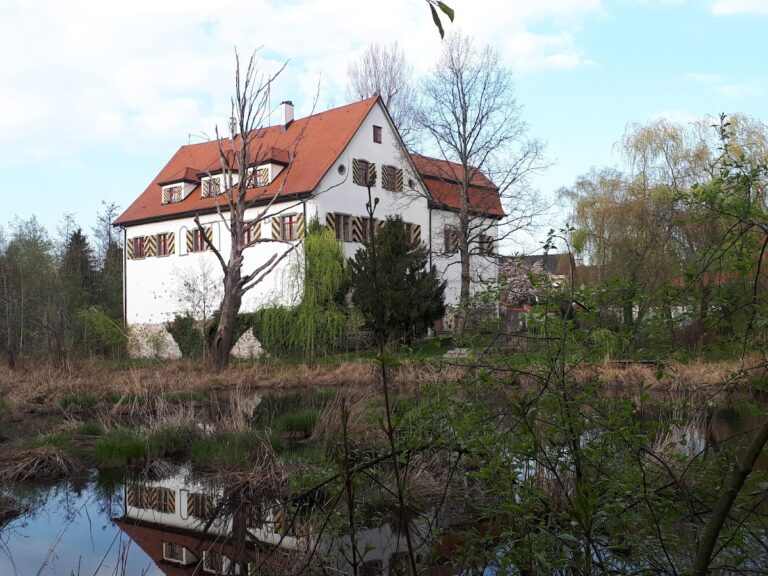
Schloss Hofen is a relatively restrained Renaissance manor set between Lochau and Eichenberg near Lake Constance. Its three-storey residential wing is formed by two wings meeting at an obtuse angle. The arrangement of the building and its position within the surrounding landscape have been characterized as presenting an overall image of Vorarlberg’s medieval architecture.
Residential and service buildings
Residential wing
The main residential wing consists of three storeys and two angled sections. A Raitenau coat-of-arms stone dated 1585 is placed above the outer entrance, linking the surviving entrance arrangement with the family’s construction of the Renaissance residence.
Service building and rear additions
A service building formerly stood in front of the residential wing on the west side. Extensive alterations and restorations left only its exterior walls by 1951. Two rear additions from 1908 were removed during the renovation completed in 2016. Two freestanding towers now occupy their place and provide circulation and access within the complex.
Chapel and earlier castle
Chapel of the Holy Cross
The St. Oswald Chapel is associated directly with Schloss Hofen. Probably built before 1496 by Hans Werner II von Raitenau as the family house chapel, it was later dedicated as the Chapel of the Holy Cross.
Alt-Hofen ruins
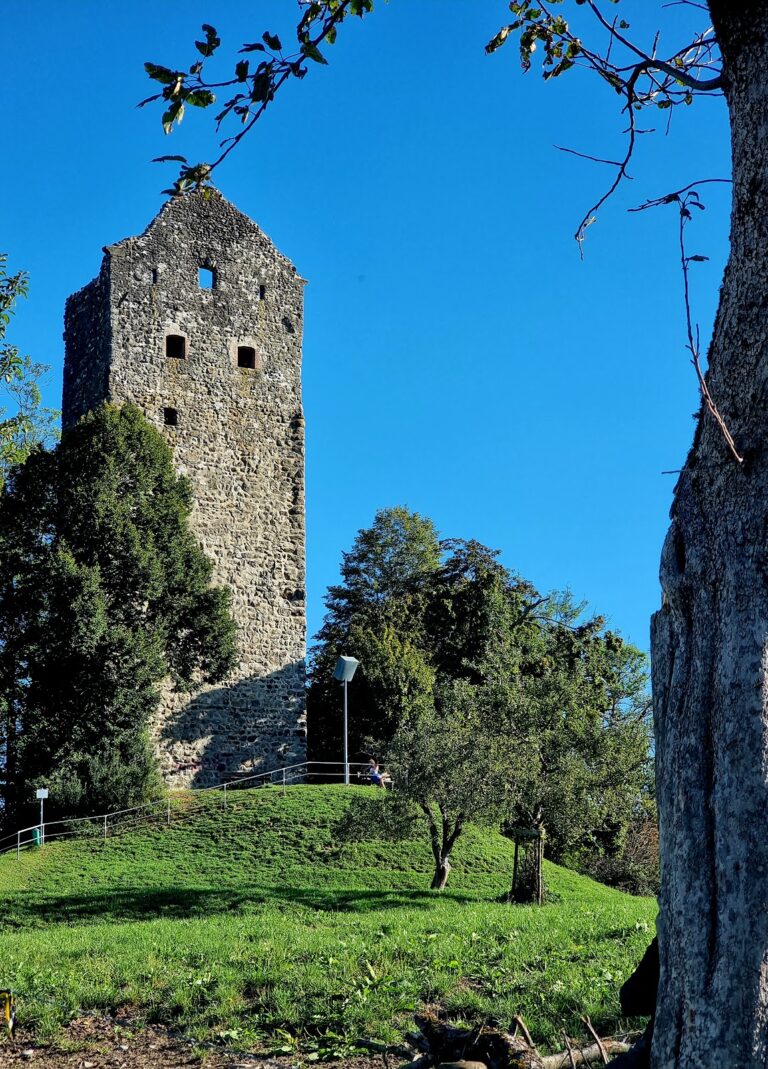
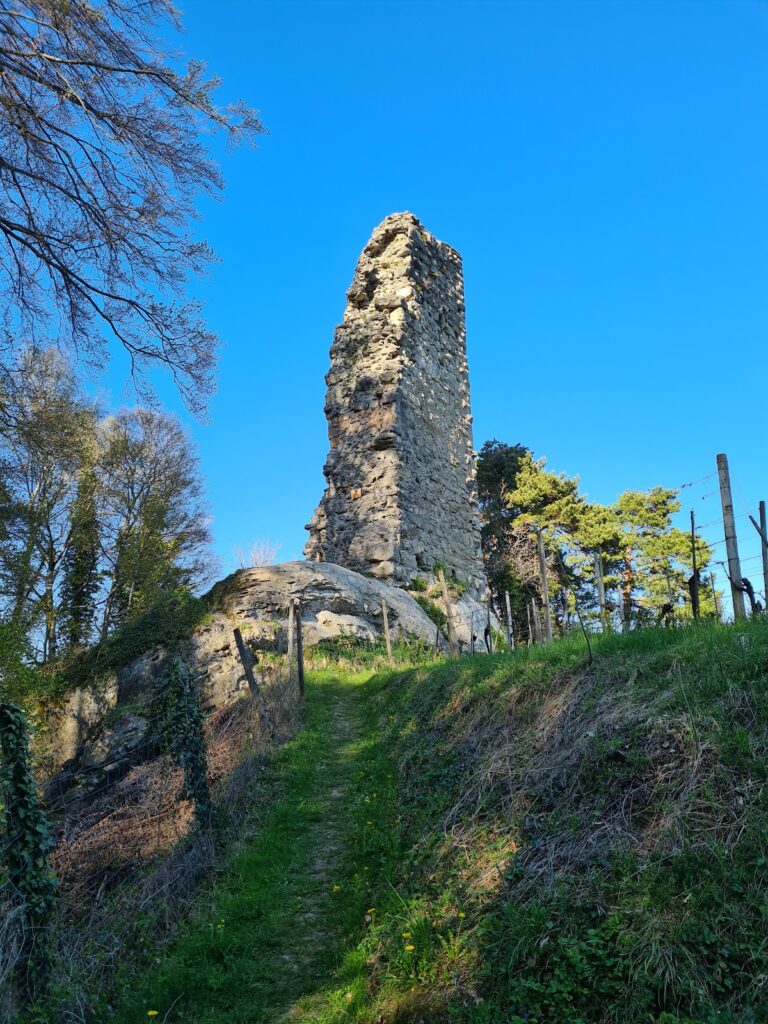
The earlier Alt-Hofen castle occupies a wooded elevated spur northeast of Schloss Hofen. Destroyed in 1452, it survives as a ruin above the later residence and preserves the physical connection between the medieval castle-guard estate and the Renaissance complex below.
Nearby sites