Schloss Wasserburg: A Renaissance Castle in Germany
Site at a Glance
- Rating
- 4.6
- Popularity
- Very Low
- Country
- Germany
- Primary era
- Early Modern
- Eras represented
- Early Modern
- Civilizations
- Holy Roman Empire
- Site type
- Military
- Remains
- Castle
On this page5 sections
History
Schloss Wasserburg is a Renaissance castle in Germany, in Wasserburg on Lake Constance, built between 1537 and 1555 as the replacement for an earlier fortress. Its origins lie in a stronghold associated with the medieval Abbey of Saint Gall, a major monastic institution whose estates and religious community were connected with Wasserburg.
Fortress of the Abbey of Saint Gall
In the tenth century, the fortress stood on an island and reportedly offered refuge to members of the monastery’s religious community. A possible Hungarian attack between 925 and 955 may have been repelled, although fire damaged the foreland. Archaeological traces connected with these events were identified during excavations in 1993.
Until 1280, Wasserburg was administered for Saint Gall by the Lords of Kisslegg, medieval dependent nobles who served a higher lord in administrative or military roles. The lordship then passed to the Lords of Schellenberg for 500 marks of silver. They enlarged Wasserburg as a fortress held as a fief of Saint Gall, a relationship that continued until 1826.
On 24 June 1358, troops of the league of cities destroyed the fortress. In 1386, the lordship was transferred to the Counts of Montfort for 650 pounds of Heller. From the 1450s, Wasserburg belonged to the Montfort-Rothenfels-Wasserburg branch, a regional line of the Montfort dynasty, under Hugo XIII.
Montfort, Fugger, and Habsburg Rule
Between 1537 and 1555, the Counts of Montfort replaced the Schellenberg fortress with a Renaissance castle. Renaissance architecture revived classical forms and proportions in Europe during the fifteenth and sixteenth centuries. The heavily indebted counts sold Wasserburg in 1592 to the Counts Fugger of Kirchberg and Weißenhorn of Babenhausen.
During Fugger rule, witch persecutions took place in Wasserburg between 1655 and 1664, causing the deaths of at least 25 people. In 1720, the Fugger administration built a causeway that connected the former island with the mainland. A fire in 1750 permanently changed the castle, destroying its west wing.
Because of their debts, the Fuggers transferred the lordship to the Austrian archducal house in 1755. Wasserburg remained part of Further Austria, the Habsburgs’ group of territories in southwestern Germany and the Swabian region, until the Treaty of Pressburg transferred it to the Electorate of Bavaria on 26 December 1805. Bavaria became a kingdom on 1 January 1806. The Köberle family has owned the castle privately since 1812, and the complex now contains a hotel and restaurant.
Remains
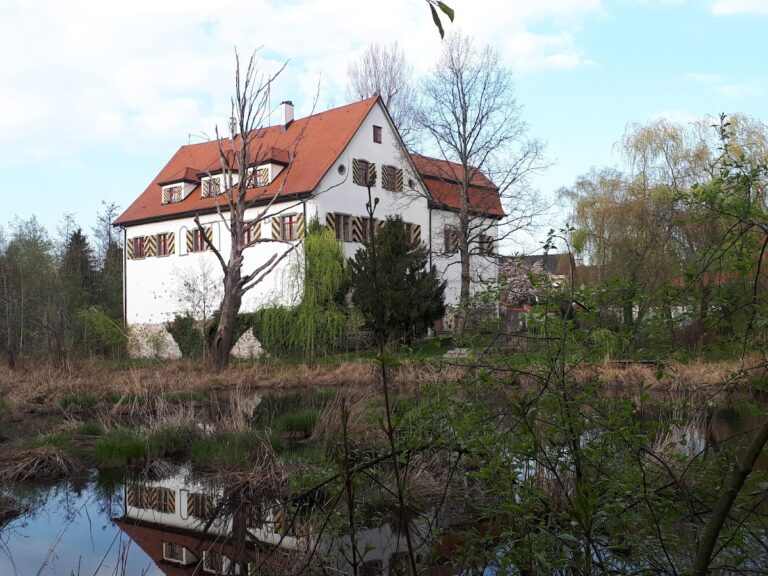
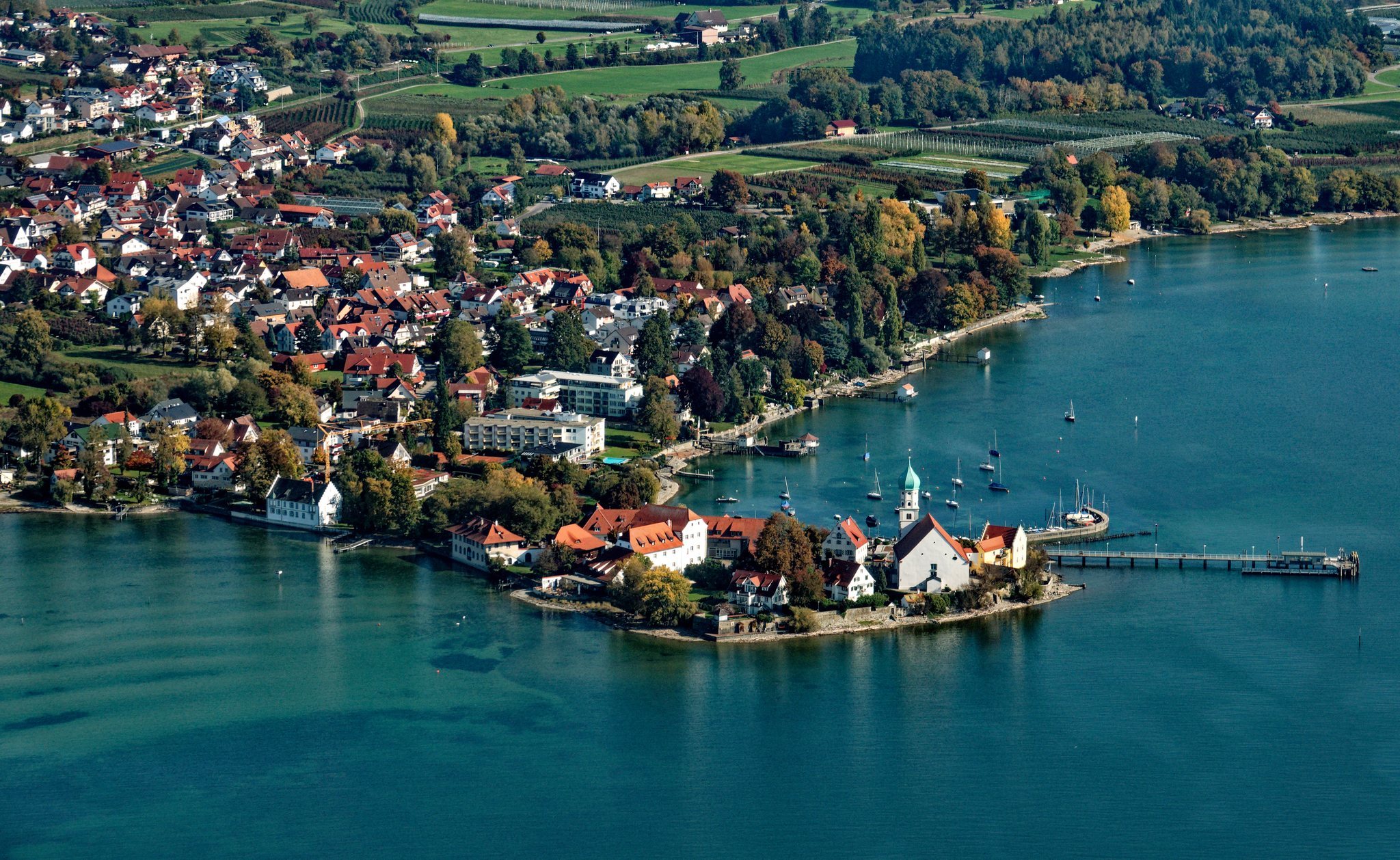
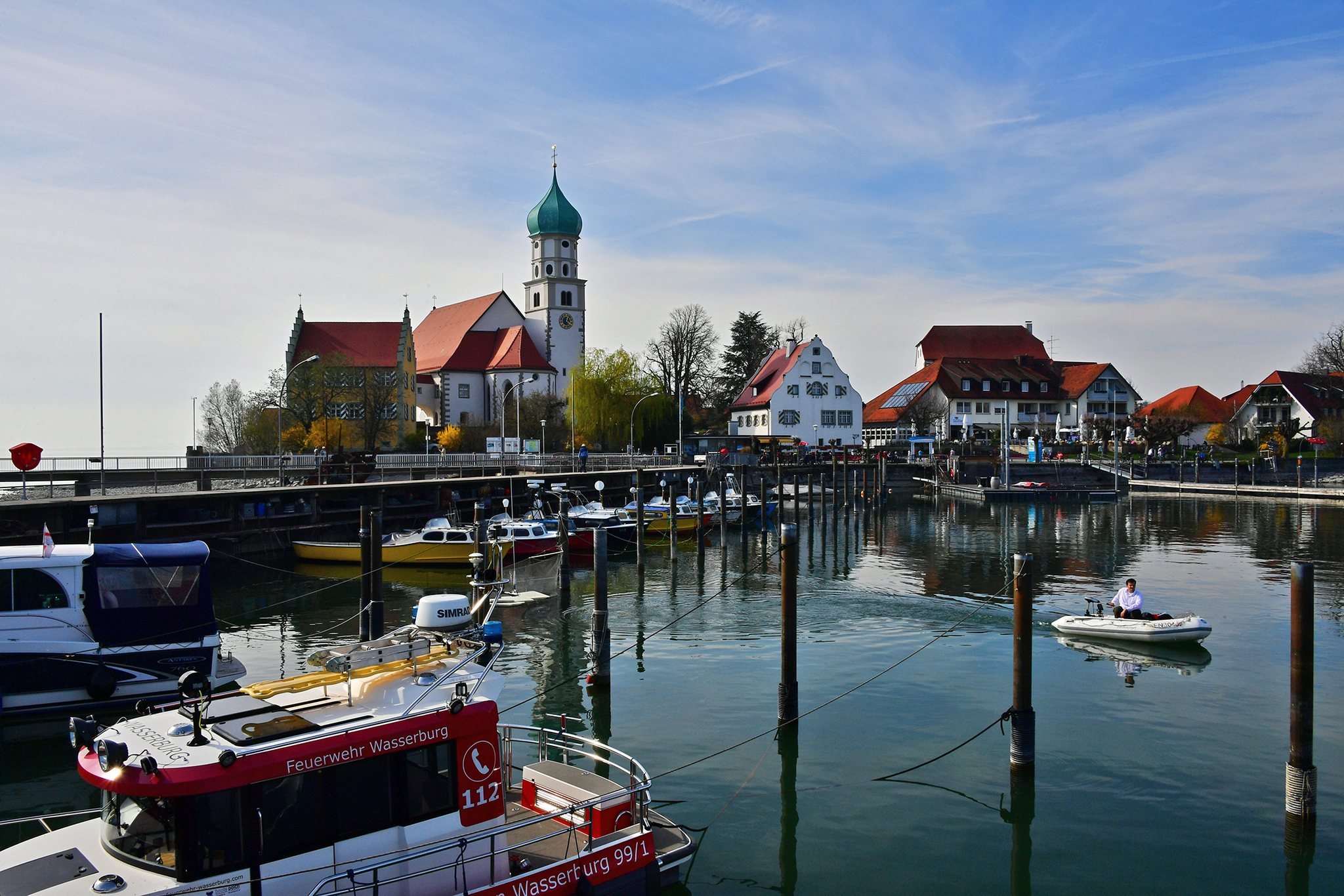
Schloss Wasserburg occupies the center of the Wasserburg peninsula alongside the parish church of St. George and the Malhaus, a former courthouse. The surviving castle forms part of a three-wing Renaissance complex, built with walls reaching up to three metres in thickness. Its arrangement preserves the form of the sixteenth-century replacement for the medieval fortress.
The Renaissance Castle
The west wing was completely destroyed by fire on 17 February 1750 and was never rebuilt. The remaining buildings therefore preserve an incomplete Renaissance plan, while the substantial wall construction reflects the defensive character inherited from the earlier fortress. The castle’s present use as a hotel and restaurant continues the occupation of the historic building within the peninsula’s central group of structures.