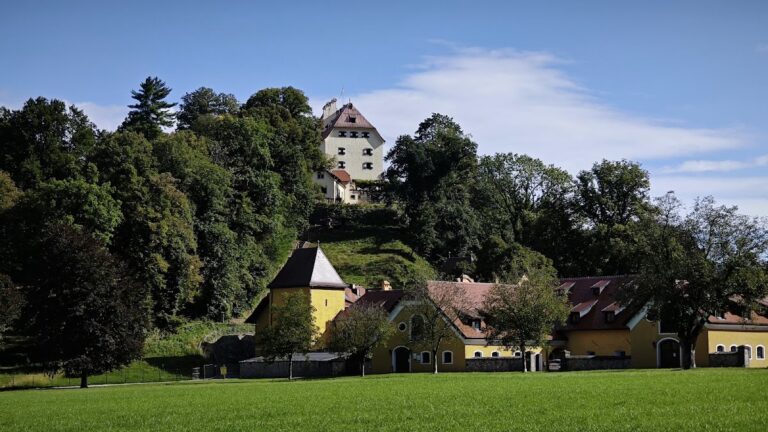
Ruine Karlstein: A Medieval Hilltop Castle Ruin in Germany


Site at a Glance
- Rating
- 4.6
- Popularity
- Low
- Country
- Germany
- Primary era
- Medieval
- External website
- Open
- Eras represented
- Medieval
- Civilizations
- Duchy of Bavaria, Holy Roman Empire
- Site type
- Military
- Remains
- Castle
On this page9 sections
History
Ruine Karlstein is a medieval hilltop castle ruin in Germany, above Bad Reichenhall, commissioned by Konrad von Peilstein shortly before 1150. The castle occupied a steep rocky summit and later became an administrative and judicial centre for the surrounding estate.
Foundation and Early Lords
The Peilsteiner family came from Lower Austria and probably reached the area after the archbishop of Salzburg appointed a Peilstein count as his Vogt, a secular official responsible for legal or administrative authority on behalf of an ecclesiastical ruler. A castle captain named Karl lived at Karlstein toward the end of the twelfth century, and the complex was probably named after him. Karlstein appears in written records for the first time in 1208.
In 1218, the castle passed to the Duke of Bavaria. The duke entrusted its administration and care to ministeriales, dependent medieval officials and retainers who served rulers and nobles in military and administrative roles. From the late Middle Ages, Karlstein exercised lower jurisdiction over the surrounding Hofmark, a territorial estate whose lord held specified local judicial rights.
Palace, Decline, and Conservation
The Bavarian duke granted Karlstein and its Hofmark for life to Reichenhall patricians and high-ranking officials in return for payments. These residents sought a seat appropriate to their social position. Under the influential Fröschl family of Marzoll and Tauerstein, the castle was converted into a palace, a form it retained until it fell into ruin toward the end of the seventeenth century.
The castle chapel, dedicated to Saint Andrew, belonged to the original construction period. Its western outer wall had become severely dilapidated and was demolished in 1671. On the rock in front of the castle, the Catholic pilgrimage church of St. Pankraz was built in the Baroque style between 1687 and 1689. A bailey, or fortified outer courtyard, probably occupied this rock during the High Middle Ages.
Ruine Karlstein is protected as both a listed architectural monument and an archaeological monument. The archaeological protection includes medieval and early-modern remains beneath the castle ruin. From July to mid-December 2012, the Bavarian State Forests carried out conservation work that repaired and partly supported the masonry, renewed plaster, strengthened window lintels, cleared some tree growth, and improved sections of the path leading to the castle.
Remains
Castle Setting and Enclosure
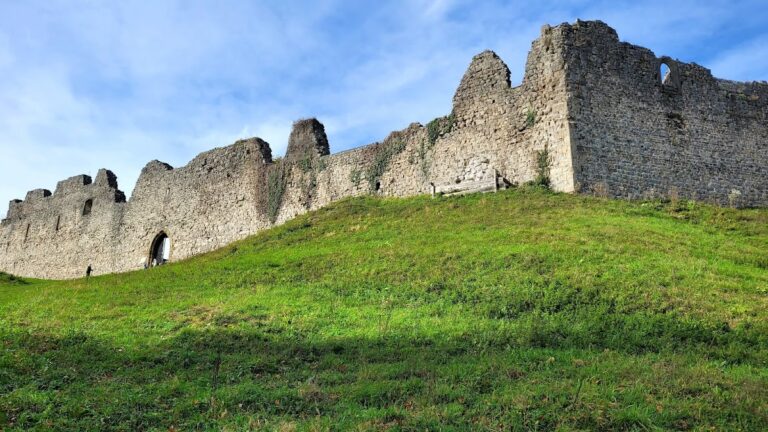
Ruine Karlstein occupies a rocky summit at about 615 metres above sea level above Lake Thumsee in the Karlstein district of Bad Reichenhall. The steep rock provided a summit position for the hilltop castle. Its enclosing wall dates from the initial construction period before 1150. Near the centre of the complex, an almost square cistern collected rainwater.
Principal Structures
Keep
The highest point of the courtyard carries the remains of a round tower with a high entrance. Built in the first half of the thirteenth century, after Karlstein came into the possession of the Duke of Bavaria, the tower served as the keep, the principal fortified tower and defensive refuge of a medieval castle.
Gate and Chapel
A large round-arched gate survives from the late phase of the complex. Beside it stood the castle chapel, a long building with a recessed rectangular entrance. Dedicated to Saint Andrew, the chapel formed part of the early castle complex.
Prehistoric Settlement
Numerous Bronze Age habitation sites were found on the northern flank of the rock directly below the present ruin. They belong to the prehistoric settlement area of Karlstein. Habitation sites from the Bronze Age and the Urnfield period, a later Bronze Age period associated with placing cremated human remains in urns, were also identified on Haiderburgstein northeast of St. Pankraz Church. The area occupied by the present castle was probably settled during the same period, although later medieval construction covered it and archaeological evidence there has not survived.
The 2012 conservation program left repaired and partly supported masonry, renewed plaster, strengthened window lintels, and reduced vegetation on the castle walls and the surrounding rock.
Nearby sites