Plainburg Castle Ruins: A Medieval Hilltop Fortress in Austria


Site at a Glance
- Rating
- 4.2
- Popularity
- Low
- Country
- Austria
- Primary era
- Medieval
- Eras represented
- Medieval, Early Modern
- Civilizations
- Holy Roman Empire
- Site type
- Military
- Remains
- Castle
On this page9 sections
History
Origins and the Plain Family
Plainburg Castle Ruins, also known as Salzbüchsl, is a medieval hilltop fortress in Austria above Großgmain. The castle was established during the eleventh century and is regarded as one of Austria’s oldest castle ruins. The mountain had already served as a Celtic burial place around 1200 BC, while a Roman fort is believed to have stood there during Roman rule, although this remains uncertain.
Count Werigandus de Playen was named in an imperial charter in 1108 as the builder of the castle. He had constructed at least the inner courtyard and gatehouse around 1100. The fortress was first recorded as Plagien Castrum around 1140 and remained associated with the Plain family, a medieval noble family, until that family’s decline after the deaths of Otto II and Konrad III in 1260.
The date and authorship of the surviving outer-courtyard walls are uncertain. Their masonry was less carefully executed than the earlier work, and these outer walls have survived in poorer condition.
Archiepiscopal Stronghold
In 1292, Plainburg passed to the Archdiocese of Salzburg. It then served the prince-archbishops of Salzburg, who combined senior ecclesiastical authority with territorial rule, as a stronghold and defensive position. The castle helped protect salt-trade routes linking the Hallgraves of Bad Reichenhall, officials connected with that salt-producing and trading center, to Salzburg.
The fortress underwent mainly military alterations between 1470 and 1800. Archbishop Paris von Lodron restored the complex in 1620. In 1674, the passage between the inner and outer courtyards was altered to give it its present Gothic appearance. Gothic architecture is a medieval tradition associated with features such as pointed arches, vertical emphasis, and elaborate stone detailing. The coat of arms above the passage belongs to Archbishop Max Gandolf von Kuenburg.
Decline and Preservation
The last soldier left the fortress in 1796, after which the ruins began to deteriorate. Later efforts associated with King Ludwig I of Bavaria and Prince Otto von Bismarck did not halt the decay.
Structural-security work on the gatehouse during the 1970s led to the removal of its uppermost storey. A child’s skeleton was found embedded in the masonry. The discovery overlaps with a local legend about an early count of Plain whose abducted child was killed and walled into the castle, but the legend need not describe the circumstances of the skeleton’s burial. Building sacrifices were not unusual during the Middle Ages and the early modern period. The ruins are protected as a listed monument in Austria.
Remains
Fortress Layout
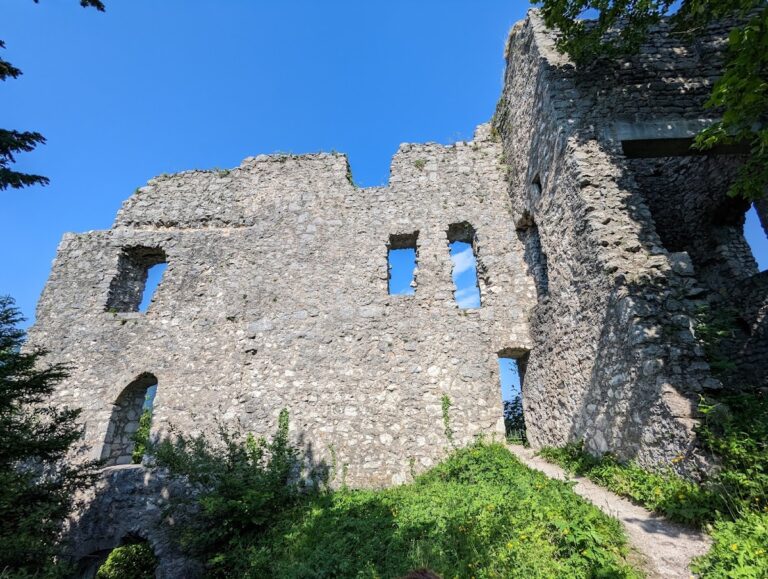
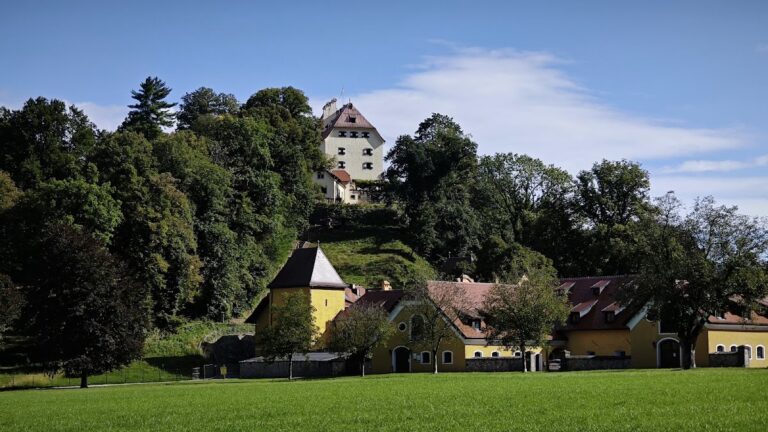
Plainburg occupies a hilltop position reaching up to 643 metres above sea level above the Gmain Valley. The surviving complex includes exterior walls more than five metres high, averaging about 1.45 metres in thickness, together with the inner courtyard, entrance area, and gatehouse. The outer-courtyard walls are substantially less well preserved than the earlier masonry, leaving the complex in a ruinous condition.
Approach and Gatehouse
The east side was the castle’s only tactically disadvantageous side because the gatehouse stood there. Its vulnerability was addressed through a deliberately engineered approach. A steep path rises toward the gatehouse in two long curves, and the final section exposed an attacker’s right side, which was normally less protected by a shield.
Courtyard Passage
The passage linking the inner and outer courtyards has the Gothic appearance created by its alteration in 1674. A coat of arms is mounted above the passage, identifying the association with Archbishop Max Gandolf von Kuenburg.
Gatehouse Evidence
The gatehouse preserves evidence of the structural-security work carried out in the 1970s. Removing its uppermost storey exposed a child’s skeleton embedded in the masonry, a find that has become associated with the local tradition concerning a child walled into the castle.
Nearby sites