Burg Reichenstein: An Imperial Castle Above Neckargemünd


Site at a Glance
- Rating
- 4
- Popularity
- Low
- Country
- Germany
- Primary era
- Medieval
- External website
- Open
- Eras represented
- Medieval, Modern
- Civilizations
- Holy Roman Empire
- Site type
- Military
- Remains
- Castle
On this page11 sections
History
Burg Reichenstein is a ruined hill castle in Germany above Neckargemünd, probably built as a Reichsburg, a castle held directly by the medieval German king or emperor, in the early thirteenth century. Its position formed part of a defensive system protecting imperial territory from the Wittelsbach lands around Heidelberg. Rather than serving as the center of a large estate, Reichenstein appears to have been established chiefly for territorial security.
Foundation as an Imperial Castle
The castle’s name is understood as an indication of its imperial status. Older interpretations allowed for an earlier predecessor, but more recent dating places the beginning of construction after the Counts of Lauffen lost their position on nearby Dilsberg in 1216 to 1219. Reichenstein possessed little more than woodland, so it did not become the seat of a manorial lordship. Its purpose was instead connected with the protection and control of the surrounding territory.
The original holders may have been the Lords of Mauer, also known as Nessel, although their occupation of a castle at Neckargemünd is not securely established. In 1286, King Rudolf I granted the former possessions of Diether Nessel of Neckargemünd to Count Palatine Ludwig II after Nessel had forfeited properties, imperial fiefs, and other fiefs because of crimes. The Nessel holdings at Neckargemünd later became Palatine fiefs held by the Lords Landschad von Steinach. A reference from around 1605 to a Landschad castle near Neckargemünd may have referred to Reichenstein, while the Landschad also possessed a nearby manorial farm.
Imperial Pledges and Palatine Expansion
Reichenstein first appears in a document from 1292. In that year, Rudolf I’s son Albrecht promised the castle’s rights to Ludwig II of the Palatinate if Albrecht were elected as his father’s successor. Adolf of Nassau was elected German king in May 1292, however, and Ludwig did not receive the promised rights.
In 1297, Adolf pawned Reichenstein, along with other property at Neckargemünd and Eberbach, to Eberhard I of Katzenelnbogen. A Reichspfand was an imperial property or right pledged by a king to another lord, commonly in return for financial or political support. The Counts of Katzenelnbogen sought to create a continuous territory between the Kraichgau, the Odenwald, and the Middle Rhine, which gave Reichenstein strategic value.
Albrecht, who succeeded Adolf, did not confirm the Katzenelnbogen possession. From the early fourteenth century, imperial pledges in the lower Neckar region were held by the Lords of Weinsberg, who were related to the Katzenelnbogen family. After Konrad IV of Weinsberg died in 1325, Reichenstein and Neckargemünd passed to Engelhard VI of Weinsberg.
In 1329, Emperor Louis the Bavarian authorized the Counts Palatine Rudolf II and Rupert I to redeem the pledges at Neckargemünd. In 1330, the Counts Palatine received numerous other imperial properties in the lower Neckar region, creating a new center of Palatine territorial power there. The Counts Palatine of the Rhine later ruled the Kurpfalz, or Electoral Palatinate, an imperial principality whose rulers held the electoral office used to choose the German king.
Decline and Disappearance
The court of the Meckesheim judicial district moved to a site below Reichenstein in 1346. The castle soon lost importance to Dilsberg, which had also entered Palatine possession by 1338 and housed the Palatine administrative office. Reichenstein was mentioned again in 1353 and for the final time in 1355. It was probably abandoned soon afterward and fell into ruin.
By 1494, the steward of the Dilsberg estate leased the garden land around Reichenstein to citizens of Neckargemünd, while the castle itself was not leased. Bone finds indicate that parts of the abandoned complex may have been used to keep animals. Stone and other building materials were gradually taken away for use elsewhere.
Later references preserve scattered impressions of the ruin. Around 1605, Hans Ulrich I Landschad von Steinach described a castle ruin near Neckargemünd that may have been Reichenstein. A print by Merian from the first half of the seventeenth century shows a box-like structure above Neckargemünd that some researchers identify with the ruin. In 1712, town administrator Edmund Münster described old, grass-covered masonry on the mountain and associated it with a castle called Reichenstein. Johann Goswin Widder still saw fragments in the late eighteenth century, but Albert Ludwig Grimm wrote in 1822 that the remains had almost disappeared.
Parkland and Modern Investigation
The Hollmuth remained a separate cadastral district until the sixteenth century. Neckargemünd tried to acquire the mountain, its woodland, and the castle area, but initially obtained only small portions. The woodland on the ridge passed to Bammental in 1803. Most of the castle area remained with Pflege Schönau, an ecclesiastical property administration, and several private citizens until the municipality acquired it in 1984.
During the nineteenth century, the site became a popular viewpoint, but it was overgrown by the beginning of the twentieth century. In 1926, Neckargemünd ended the lease of the neglected Borchard garden and created the Burg-Reichenstein Garden as a park-like public green space below the ruin. A protective and sales hut designed by architect Ludwig Neuer was built in 1932. From 1934, plans by architect Hans Kayser extended the garden into parts of the castle area and produced the terraces that remain visible today. Excavation and restoration continued until 1937, but the work was not recorded in excavation reports, leaving its interpretation uncertain.
Objects recovered in 1934 and transferred to the Prehistoric Institute of Heidelberg University were later dated to the thirteenth and fourteenth centuries. After the Second World War, the castle area and garden again became overgrown. The green area was repaired in 1967 and 1978, and further work on older and newer masonry followed the city’s acquisition of the site in 1984. Between 1987 and 1989, part of the hilltop and the castle’s northwest wall was blasted away to construct a water reservoir. This work exposed further objects from the thirteenth and fourteenth centuries. The Reichenstein Working Group of the Neckargemünd Cultural Association was founded in 1995 to document the castle and oversee its conservation.
Remains
Hilltop Layout and Defenses
Burg Reichenstein occupies a wooded hill south above the old town of Neckargemünd, on Hollmuth in the Sommerwiese and Mühlrain areas, east of the Elsenz. Its position allowed control of the Neckar, Elsenz, and Wiesenbach valleys, as well as the former long-distance road from Heidelberg to Mosbach. The Reichenstein railway tunnel passes beneath the hill. The terrain indicates that the castle was an elongated, almost rectangular fortification.
Southern Defenses
The southern side was probably protected from the ridge by a neck ditch, a ditch cut across the connecting ridge, and a shield wall, a particularly strong defensive wall placed on the side most exposed to attack. Original masonry survives sufficiently in the southern part of the complex to support this interpretation by comparison with other castles in the Neckar Valley. The surviving southern masonry contains three layers from different periods, including a modern upper layer.
Western Entrance
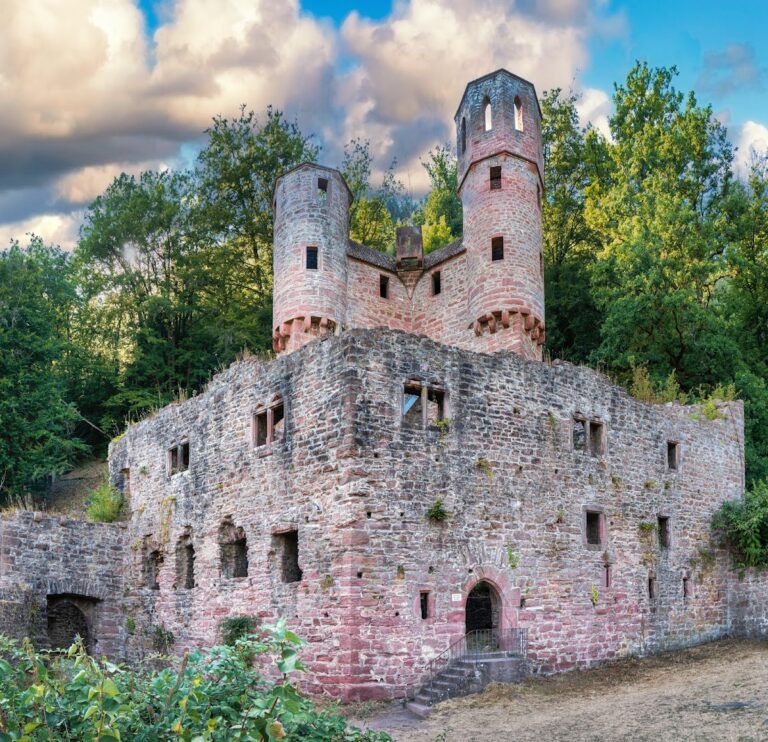
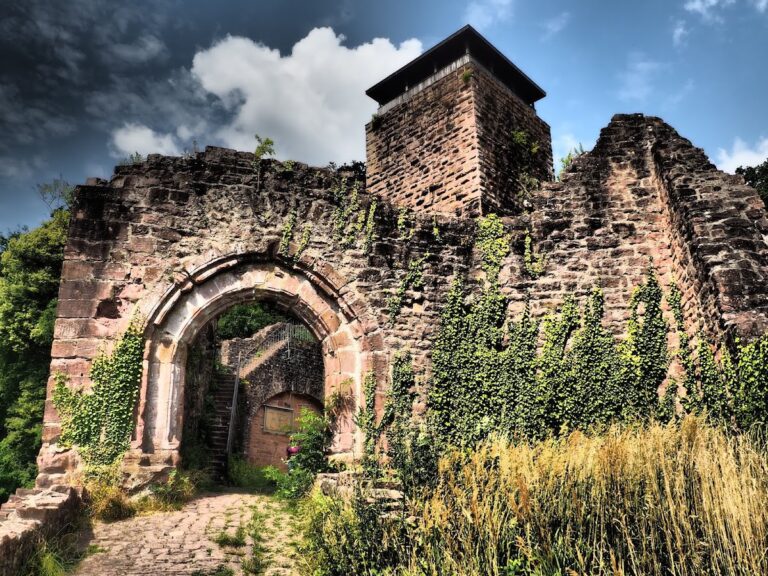
The presumed entrance lay in the western long wall. The gate now standing there was built in 1934 from masonry fragments found on the site, so it does not represent the original medieval entrance. No interior buildings of the medieval castle remain visibly identifiable.
Gardens and Later Masonry
The present grounds were heavily altered by the removal of stone, prolonged agricultural use, nineteenth- and twentieth-century construction, and the terracing carried out during the 1930s garden expansion. The Burg-Reichenstein Garden contains the stepped surfaces created in 1934. Many visible wall sections were built in the nineteenth century as retaining walls for gardens or were freely reconstructed without a scientific basis. Other medieval masonry fragments were repeatedly and unsystematically rebuilt into the terraces and elsewhere in the grounds, making the older and newer fabric difficult to distinguish with certainty.
Archaeological Finds
Excavations in 1934 and work connected with the 1987 to 1989 reservoir construction produced archaeological material dating to the thirteenth and fourteenth centuries. Masonry fragments recovered during the 1930s were incorporated into the terracing and other parts of the grounds. These finds provide evidence for the period in which the castle was active, while the altered hilltop preserves only limited clues to its original arrangement.