Burg Schadeck: A Medieval Hillside Castle in Germany


Site at a Glance
- Rating
- 4.7
- Popularity
- Low
- Country
- Germany
- Primary era
- Medieval
- External website
- Open
- Eras represented
- Medieval, Modern
- Civilizations
- Holy Roman Empire
- Site type
- Military
- Remains
- Castle
On this page8 sections
History
Burg Schadeck, also known as Schwalbennest, is a ruined medieval hillside castle in Germany near Neckarsteinach. It was probably established around 1230 by Ulrich II, the youngest son of Ulrich I of Steinach, as the fourth and latest castle associated with the town. Schadeck is the youngest of the four Neckarsteinach castles, which also include Vorderburg, Mittelburg, and Hinterburg.
Foundation and the Landschad family
Creating Schadeck required a substantial section of the rocky slope to be cut away. Its earlier name, Schadheck, developed into Schadeck, while Schwalbennest means “Swallow’s Nest.” The name became associated with the noble family Landschad von Steinach, distinguishing this branch from other surviving lines of the Lords of Steinach.
After an older Steinach line died out, the Landschad von Steinach acquired Vorderburg as well. In 1335, Bligger X and Dieter I Landschad von Steinach sold Schadeck in equal shares to the ecclesiastical foundations of Worms and Mainz. By 1350, the Worms share appears to have passed forcibly to Mainz.
Changing ownership
In 1395, Schadeck was divided among the descendants of Eberhard von Rosenberg, the Mainz bailiff of Walldürn. The heirs later transferred portions of their holdings to other lesser nobles. By 1428, the entire castle belonged to Mainz Archbishop Konrad, who pledged it to Dieter II Landschad von Steinach.
When the pledge was not redeemed, Schadeck became the family’s allodial property, meaning hereditary property held by the family rather than as a fief. It remained with the Landschad von Steinach until the principal line descended from Hans ended with the death of Dieter VIII in 1625.
Dieter VIII’s daughter Eva Elisabeth, widow of Wolf Conrad Greck von Kochendorf, sold Schadeck and the family’s remaining hereditary property on 6 May 1657 to Wolf Heinrich Metternich zu Burscheid. He already held from Speyer and Worms the former fiefs over the town, Vorderburg, Mittelburg, and half of Hinterburg.
When the Burscheid line of the Metternich family died out in 1753, the former fiefs and the hereditary property, including Schadeck, passed to the ecclesiastical foundations of Speyer and Worms. After 1803, their territorial possessions passed to the Land of Hesse, which still owns the castle.
Legends and later interpretation
Romanticized stories about Neckarsteinach, the Landschad von Steinach, and Schadeck circulated widely. In 1838, Victor Hugo created a fictional episode set at Schwalbennest, presenting it as the 12th-century stronghold of Bligger the Scourge, an allegedly violent robber knight serving under Rudolf of Habsburg. Rudolf was King of the Romans from 1273 and the first Habsburg to hold that position, but Hugo’s narrative is a literary invention rather than established castle history.
In Hugo’s tale, Bligger defied an imperial ban, defeated besiegers in three sorties, and was excommunicated. His retainers then abandoned and sealed the castle, leaving Bligger to die alone in the courtyard. His son supposedly took the cross and returned from the Holy Land with the sultan’s head, later represented on the coat of arms of the stone knight Ulrich Landschad, whose tomb was said to be in the church at Steinach.
An enigmatic inscription on one of the two upper towers refers to 1871. Its possible connection with the Franco-Prussian War remains unresolved.
Remains
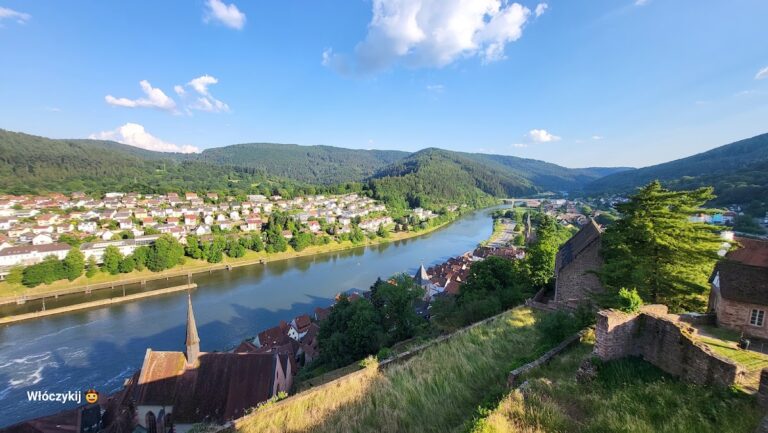
Schadeck occupies a rocky setting at about 190 metres above sea level near Neckarsteinach in the Bergstrasse district. Unlike the other three castles associated with the town, it stands downstream on a steeply descending mountain massif rather than on a projecting mountain spur. The ruined castle projects from the slope, a physical position that helps explain the name Schwalbennest.
Approach and defensive works
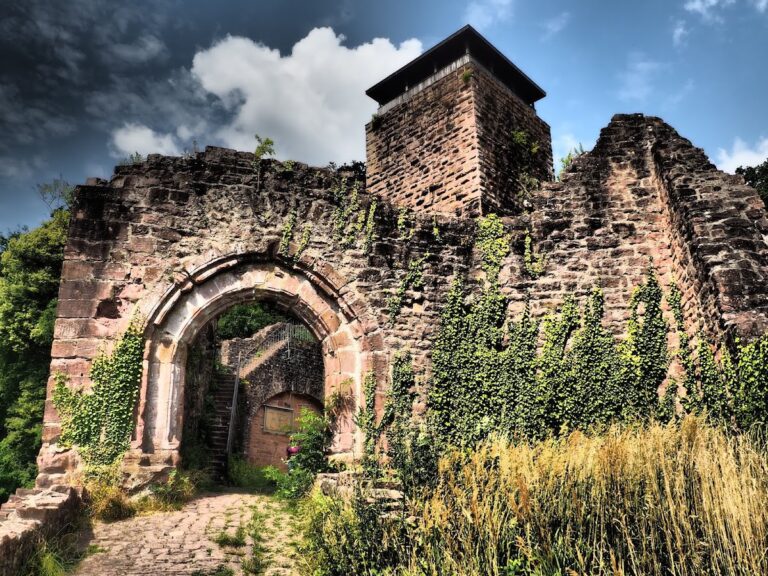
Access originally followed a serpentine path. It was later reorganized through a neck ditch, a trench cut across the approach to a rocky site. Instead of a keep, Schadeck has a two-winged shield wall, a heavily reinforced defensive wall protecting the most exposed side of a castle. Its point faces the rock massif, and a wall-walk runs along its length.
Shield wall and towers
During alterations in the fifteenth century, a tower was added at each end of the wall-walk. The northern tower later received an octagonal upper section during the nineteenth-century period of Romanticization. One of the two upper towers bears the enigmatic inscription dated 1871.
Residential buildings
The principal residential building, or palas, was moved during the fifteenth-century alterations into the protected but damp angle of the shield wall. Another former palas stood in the present courtyard. Its surviving window openings overlook Neckarsteinach, while remains of additional residential buildings can still be seen within the inner castle.