Asseburg: A Medieval Hill Castle and Territorial Fortress in Germany


Site at a Glance
- Rating
- 4.4
- Popularity
- Low
- Country
- Germany
- Primary era
- Medieval
- External website
- Open
- Eras represented
- Medieval
- Civilizations
- Holy Roman Empire
- Site type
- Military
- Remains
- Castle
On this page8 sections
History
Asseburg is a medieval hill castle ruin in Germany, built between 1218 and 1223 by Gunzelin of Wolfenbüttel. Its form belonged to the medieval period, and its large fortified enclosure made it one of the largest medieval hill castles in North Germany. The castle was established as a Ganerbenburg, a stronghold jointly owned, administered, and occupied by several associated families or family branches.
Foundation and Political Conflict
Gunzelin had advanced from Welf ministerial service into the imperial ministerial service. Imperial ministerials were officials who served the emperor and could attain considerable political and military power. He had acted as seneschal for Emperor Otto IV, a Welf ruler whose court official managed aspects of the imperial household and court. After Otto’s death in 1218, Gunzelin transferred his allegiance to the Staufen emperor Frederick II. The Welfs and Staufens were rival German dynastic factions in the early thirteenth century.
Asseburg was built in territory hostile to the Welfs on land belonging to Gandersheim Abbey. Through the new fortress, Gunzelin established himself as a regional lord and sought to secure his position and the surrounding lands near Wolfenbüttel. His co-builders included his son Burchard, Harold of Biewende, and other people from the Hildesheim and Halberstadt areas whose identities are not known. Gunzelin’s descendants later formed the House of Asseburg, named after the castle.
The construction provoked a dispute with Gandersheim Abbey. In 1220, Abbess Mechthild of Wohldenberg complained to Pope Honorius III that the castle violated the abbey’s property rights. The pope instructed local bishops to oppose the building and ordered its demolition. Gunzelin ignored the order and completed Asseburg.
The Ducal Siege and Territorial Role
The Duchy of Brunswick-Lüneburg, ruled by Duke Albert I, besieged Asseburg for three years from 1254. Gunzelin’s eldest son Burchard, also known as Busso and as Burchard of Asseburg, led the defense. The siege ended in the winter of 1258 through negotiations. The castle was surrendered in return for 400 gold marks and free passage for its garrison to Westphalia.
Asseburg remained in the dukes’ possession until 1330 and became one of the duchy’s strongest territorial fortresses. Financial difficulties then resulted in the castle being pledged to the city of Brunswick. The city sought to protect the long-distance route below the Asse, which linked the Rhine and Elbe regions through Brunswick, Wolfenbüttel, Halberstadt, and Leipzig, approximately along the course of the modern B 79.
Destruction and Later Investigation
After an inheritance division in 1492, Duke Henry the Elder of Brunswick demanded that Brunswick return its territorial rights and possessions, including Asseburg. When the city council refused, he advanced with an army. The castle lacked water and lay far from Brunswick, making defense difficult in the judgment of its garrison. The garrison withdrew and set the fortress on fire on 12 August 1492. Asseburg, which had never been captured, is said to have burned for three days.
The fortress has remained a ruin since the fire. Its masonry deteriorated through exposure, and inhabitants of nearby villages removed stone from the fortifications for their houses. A wedding party visiting the Asse Forest held an afternoon picnic at the ruins on 14 June 1733. The party accompanied Princess Elisabeth Christine of Brunswick-Wolfenbüttel-Bevern on her journey from Salzdahlum Palace to marry Crown Prince Frederick of Prussia, later known as Frederick the Great.
The Assegesellschaft carried out a limited archaeological excavation in 1892, although its results were not documented. The association later continued research into the extensive fortress and undertook securing and renovation work. In 2001, Hans-Wilhelm Heine of the Lower Saxony State Office for the Preservation of Monuments and a representative of the Wolfenbüttel district archaeology service searched for the previously forgotten siege works. Metal-detector prospecting at the Rockesberg siegework in 2006 recovered knives, horseshoes, riding equipment, and numerous crossbow bolts attributed to the siege of approximately 1255 to 1258. Their distribution indicates that the bolts belonged to the castle garrison and were fired during sorties toward the Rockesberg position.
Remains
Asseburg occupies a narrow crest of the Asse ridge near Wolfenbüttel, within the municipality of Wittmar. The slopes descend steeply by about 100 metres. The elongated fortification covered approximately 7,200 square metres, extending about 180 metres from east to west and measuring roughly 50 metres in width. A rampart-and-ditch system enclosed the entire castle, while the ridge setting and multiple forward defenses formed a layered fortified layout.
Main Castle
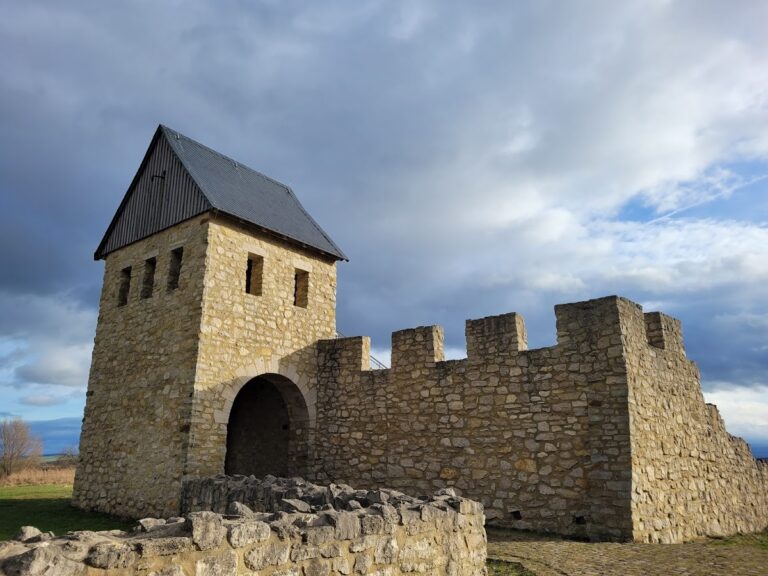
The main castle was divided lengthwise into a lower southeastern half and a higher northwestern half. Four cross-walls divided the northwestern half into five courtyards, each reached through a gate. Entrances stood at both narrow ends, on the east and west. A freestanding square bergfried, the principal defensive and refuge tower of a medieval German castle, occupied the northwestern courtyard. In the southeastern section, a wall ran along the crest of the rampart. Only individual wall remnants and the lower sections of towers survive, although a square tower and part of the enclosing wall in the northwestern area have been restored.
Outer Defenses and Siege Works
About 100 metres below the main castle, a further ditch began as a quarry and was later linked to the inner fortification by three additional rampart-and-ditch systems. This created a two-part outer bailey, an outer fortified area, whose use is represented by a small number of finds. Cross-ditches cut across the ridge before both narrow ends of the castle, producing five raised areas that served as forward fortifications.
The 2006 investigations also located a ground-cut platform between the Rockesberg siegework and Asseburg. It is thought to have been prepared for a blide, a large medieval siege engine designed to throw projectiles against fortifications. The nearby siegework produced the crossbow bolts and other objects associated with the three-year siege.
Restored Features
In the southwestern part of the main castle, a gate and gatekeeper’s house have been restored. Together with the restored square tower and wall section in the northwestern area, these structures provide surviving examples of the castle’s former fortified fabric within a site otherwise preserved mainly through fragmentary masonry and tower bases.
Nearby sites