Schloss Destedt: A Medieval Castle Transformed into a Baroque Palace


Site at a Glance
- Rating
- 4.7
- Popularity
- Very Low
- Country
- Germany
- Primary era
- Early Modern
- External website
- Open
- Eras represented
- Medieval, Early Modern
- Civilizations
- Holy Roman Empire
- Site type
- Domestic
- Remains
- Elite Residence
On this page9 sections
History
Schloss Destedt in Germany originated as a medieval water castle at the foot of the Elm, a wooded ridge in present-day Lower Saxony. Its foundation date is unknown, but the fortification controlled the western approach to the ridge and movement along the trade route between Braunschweig and Magdeburg. The site later became the ancestral seat traditionally associated with the ancient noble Veltheim family of the Brunswick region.
Medieval castle and Veltheim ownership
During the twelfth and thirteenth centuries, the castle belonged to the counts of Wernigerode. From 1356, the Lords of Veltheim and Harbke are documented as its owners after entering the service of Duke Wilhelm of Braunschweig. The settlement of Destedt, first recorded shortly after 1300, was in the possession of the Lords of Veltheim by 1388.
In 1430, Brunswick mercenaries besieged the castle. Before the attackers could take it, the defenders set the complex on fire and escaped through an underground passage leading toward the Elm. Sewer works between 1980 and 1983 exposed part of this passage. In 1466, the castle was described as an uninhabited knightly estate of the Veltheim family, then serving as a Vorwerk, or outlying estate associated with a larger manor. Notes made by Matthaus Merian in the second half of the seventeenth century state that the complex had apparently stood in ruins for centuries.
From divided estate to Baroque palace
Around 1600, Joachim von Veltheim, a princely Brunswick master of the hunt, acquired the castle. Before 1650, the property was divided into an upper castle and a lower castle, situated approximately 200 metres apart. The two parts were later reunited under one owner after the completion of the palace complex.
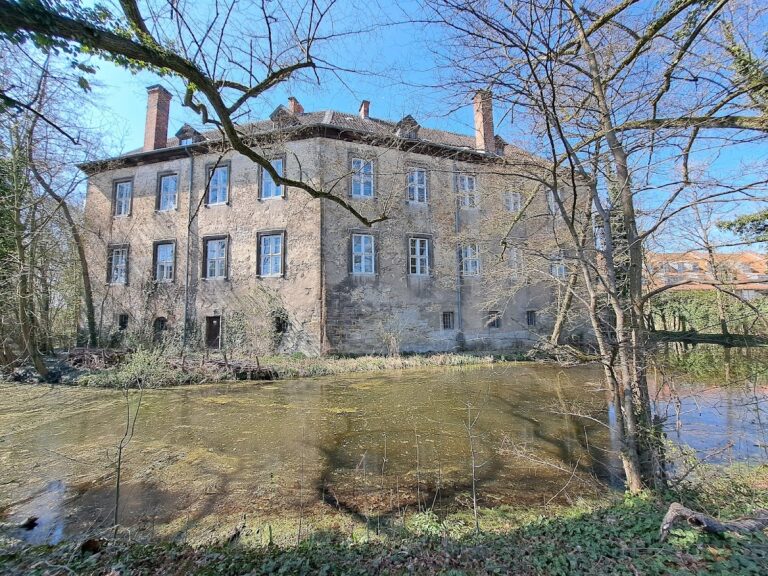
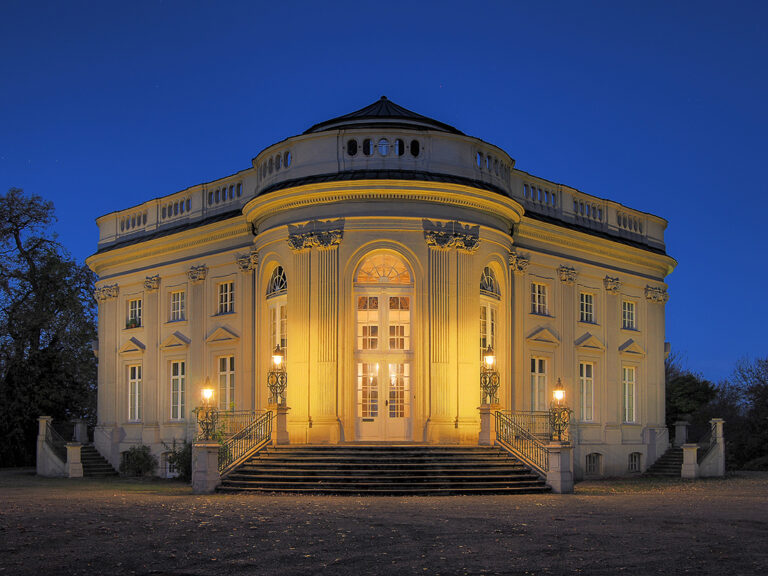
In 1693, Joachim Ludolf von Veltheim built the present Baroque palace in the area of the upper castle. Johann Balthasar Lauterbach, a Brunswick architect and state building official, probably played a major role in its design. Georg Philipp III von Veltheim completed the palace around 1740 and added ancillary buildings, gatehouses, and side wings. He also created a formal French garden west of the palace. From about 1750, the acquisition of the neighbouring parsonage through a land exchange allowed the garden and the later park on the north side of the palace to develop.
Later history and protection
Schloss Destedt remained associated with the Veltheim family and its estate. On 4 June 1902, the German admiral Adolf von Trotha married Anna von Veltheim at the palace. Since 1970, the Schlosspark has been a designated landscape-protection area in the Wolfenbuttel district, reflecting the continuing importance of the grounds as part of the historic estate.
Remains
The complex retains an upper castle centered on the Baroque palace and a lower castle approximately 200 metres away. The palace occupies the area of the former upper castle, while the lower castle preserves the character of an agricultural and service courtyard established after the estate was divided. North of the palace, the grounds preserve the sequence of a Baroque garden, kitchen garden, and orchard or tree garden, later reshaped as an English landscape garden.
Palace and castle buildings
Baroque palace
The palace has two upper floors above a cellar-like lower structure. Its facade is arranged in three equal sections, with a projecting central section crowned by a large gable. Four Ionic colossal pilasters, very large classical pilasters extending across more than one storey, rise through both upper floors in the central section. The gable carries the coats of arms of the von Veltheim and von Bibow families and a Latin inscription.
The entrance occupies the front facade and is approached by a double flight of stairs. A broad terrace runs along the rear of the building. From this terrace, a second double staircase, constructed in 1875, descends to the park.
Lower castle
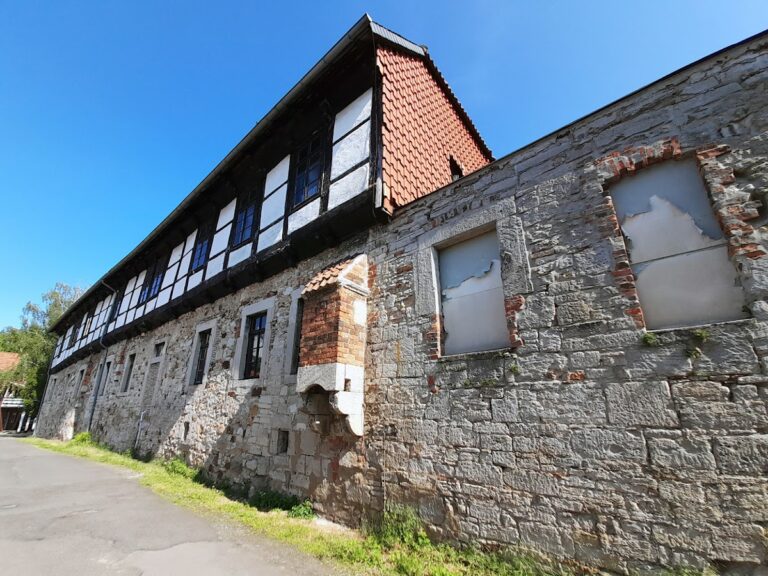
The lower castle retains the appearance of an agricultural and service courtyard dating from the period when the Veltheim estate was divided. It continued to serve this character into modern times and remains physically separate from the upper castle by approximately 200 metres.
Historic garden and park
The park north of the palace developed from the combination of a formal Baroque garden, a kitchen garden, and an orchard or tree garden. The Baroque phase used geometric order and symmetry, while the later English landscape garden created a more naturalistic arrangement of lawns, trees, and irregular planting. A tree list from 1992 recorded 150 species, approximately half of them foreign or exotic. Many of the notable trees were American species that General Friedrich Adolf Riedesel is said to have sent from America. Riedesel was a German military officer and general known for his role in the American Revolutionary War.
Nearby sites