Bar Castle: A Frontier Fortress in Ukraine


Site at a Glance
- Rating
- 4.1
- Popularity
- Low
- Country
- Ukraine
- Primary era
- Early Modern
- Eras represented
- Early Modern
- Civilizations
- Kingdom of Poland, Polish–Lithuanian Commonwealth
- Site type
- Military
- Remains
- Fort
On this page9 sections
History
Rov and the first castle
Bar Castle is a historic fortress in Bar, Ukraine, developed first as the wooden castle of Rov by the Koriatowicz princes around 1380. The Koriatowicz dynasty, a Lithuanian princely line, ruled Podolia before the region entered the Polish Crown. In 1386, King Władysław II Jagiełło confirmed their privilege. After the last Koriatowicz representative died in 1430, Rov and its castle passed to the Polish Crown.
The castle resisted a Tatar attack in 1431, but it was captured and destroyed in 1452. Its starost, Stogniew Rej, and his family were taken captive. Repeated Tatar raids during the late fifteenth century prompted successive rebuilding campaigns. In 1456, King Casimir IV Jagiellon authorized Andrzej Odrowąż to purchase Rov and its surrounding lands from Rej’s heirs.
The foundation of Bar
Queen Bona Sforza acquired Rov and its surrounding territory in 1533. She ordered a new fortress and renamed the town Bar after her hereditary duchy of Bari in Italy. A new castle was built on a different site around 1538, while the earlier location developed into a settlement known as Upper Bar.
The new fortress strengthened the southern frontier of the Polish-Lithuanian Commonwealth and controlled routes leading toward the Black Sea. Its position between the Kuchman and Black routes led contemporaries to describe it as the “key to Eastern Podolia.” Wojciech Starzechowski, the first Bar starost, directed the early development of the fortress. A later phase of stone construction is associated with Martin Herburth, who served as Bar starost from 1553 to 1570.
The seventeenth-century fortress
In 1636, Grand Crown Hetman Stanisław Koniecpolski, the highest military commander in the Crown of Poland, transferred his residence to Bar and substantially enlarged the castle. The masonry fortress was constructed between 1630 and 1647 to plans by Guillaume Le Vasseur de Beauplan, a French military engineer active in the Polish-Lithuanian Commonwealth. An arsenal was built in the 1640s by Krzysztof Arciszewski and Paweł Grodzicki. In 1640, the fortress held four 21-centimetre culverins, two 10-centimetre bastard culverins, and eight field guns.
During the 1648 uprising, Cossack forces commanded by Maksym Kryvonis captured Bar. Large quantities of weapons and military supplies were seized, and the castle was reportedly seriously damaged. The town’s inhabitants were reportedly massacred. Under the Treaty of Buczacz, Bar came under Ottoman rule in 1672. Polish forces led by King Jan III Sobieski captured it in 1674, but the Ottomans soon retook it. Following the peace of 1699, Bar and Podolia returned to Poland.
The Bar Confederation and decline
The Bar Confederation was proclaimed in the castle on 29 February 1768. It was an armed political and military association of Polish nobles opposed to Russian influence and to the policies of King Stanisław August Poniatowski. Russian forces, supported by Crown troops loyal to the king, captured Bar after a siege in June 1768. The castle was stormed under the command of Apraksin, then became heavily ruined and entered a prolonged period of decline.
By the late nineteenth or early twentieth century, the fortress was largely ruined, and a park was laid out on the site at the beginning of the twentieth century. Participants in the civil war of 1918–1920 were buried at the fortress. In March 1944, 477 Soviet soldiers killed in fighting in the Bar district were buried there in mass graves. After the war, the remains of a further 53 soldiers and partisans from different parts of the district were interred at the site.
A 3.5-metre-high soldier sculpture was installed as a memorial in 1973. Archaeological investigations began in 2007 under the direction of Larisa Vynohrodska of the Institute of Archaeology of the National Academy of Sciences of Ukraine. Bar Castle is a monument of architecture of national importance in Ukraine and is listed as a nationally significant monument under inventory number 960.
Remains
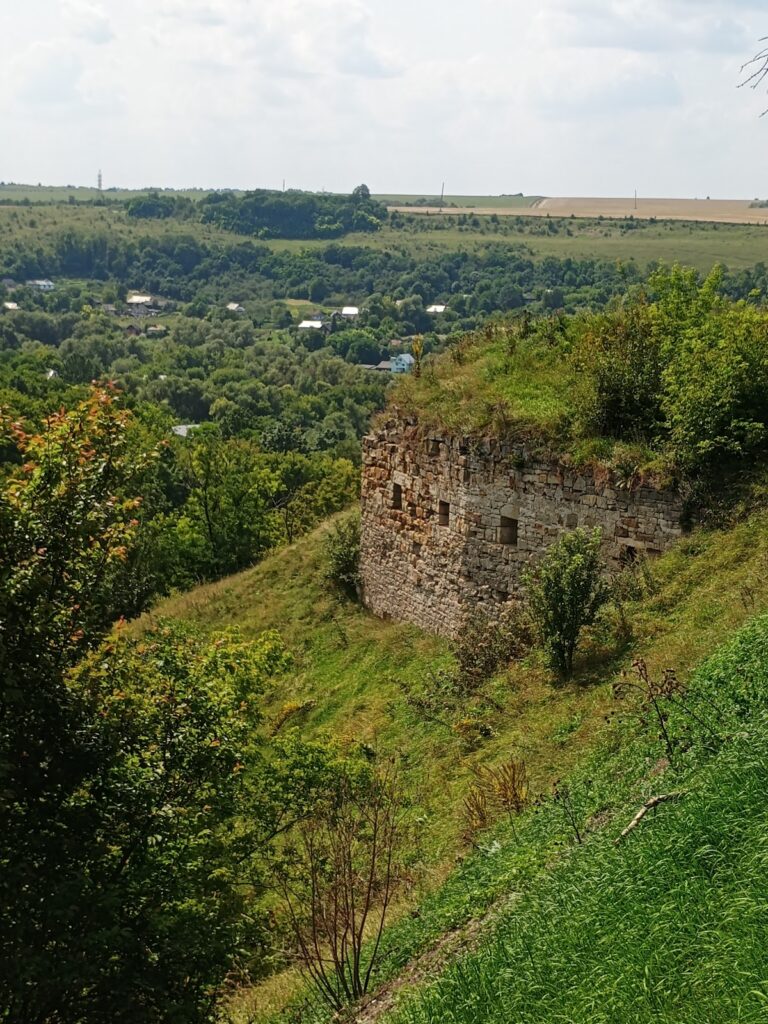
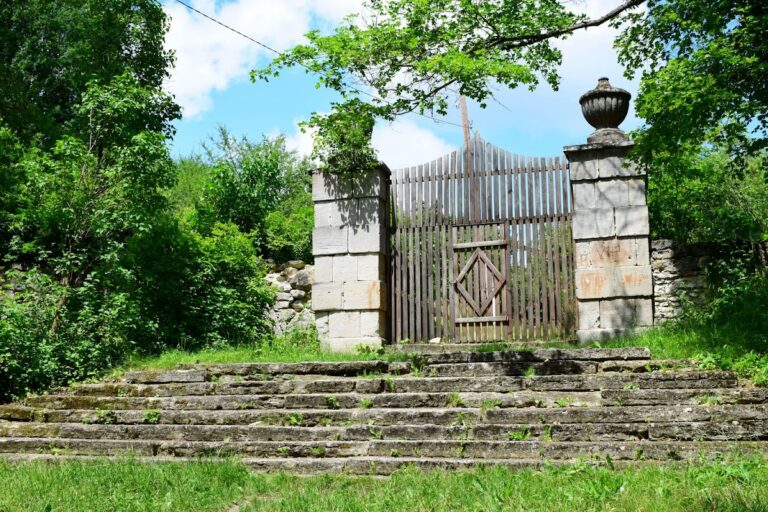
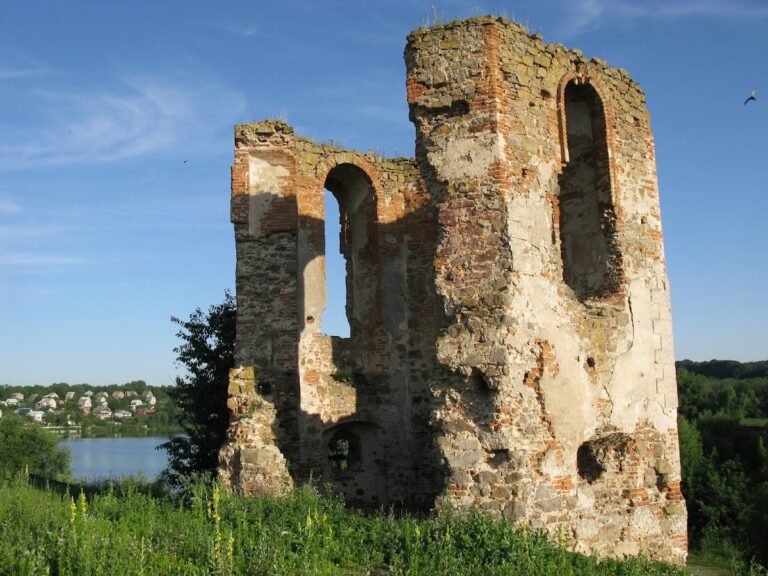
The castle stands on the left bank of the Riv River within Bar. The later fortress occupied a new position across the river from the earlier Rov site, on ground separated from the Kuchman route by a low-lying area. Its defensive history is reflected in the change from an oak-built stronghold with water protection to a quadrangular masonry fortress with projecting corner bastions. The site is now occupied by a park, where only small remnants of the defensive walls survive.
The wooden castle of Rov
The earliest fortress was built mainly of oak logs. Double walls had earth packed between them, while a dam on the river formed a pond that protected the town on three sides. Five wooden two-storey towers reinforced the castle. The main tower contained the principal gate, with a chapel above the entrance and a bell at the top. A copper plaque bearing a Latin inscription about Bona Sforza’s care for Bar and its castle was mounted on the tower. Another tower held a smaller gate linking the castle with the town, and an outer bastion, a projecting fortification for covering approaches and adjoining walls, stood before the entrance. Built from oak beams, it had two towers.
The masonry fortress
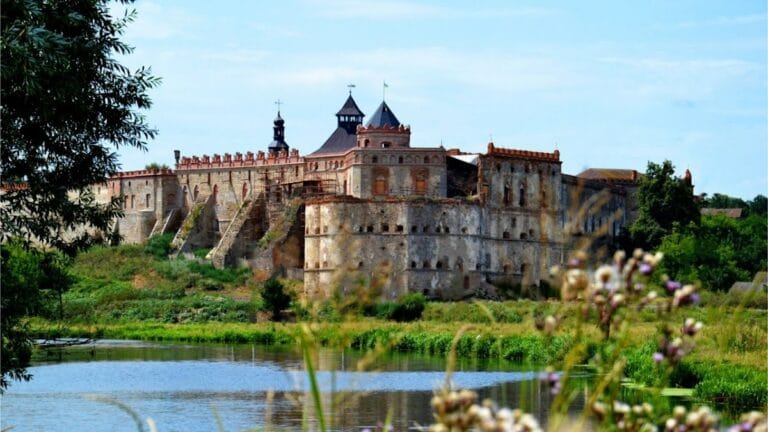
The seventeenth-century fortress had a quadrangular plan, with four bastions projecting diagonally beyond the curtain walls. The walls were approximately 6 metres high. The fortress was regarded as the third-largest in Podolia after Kamianets-Podilskyi and Medzhybizh, and as one of the principal defensive strongholds on the southeastern frontier of the Polish-Lithuanian Commonwealth.
Surviving walls and later landscape
By the early twentieth century, the curtain walls formed the principal surviving remains. They stood approximately 6–7 metres high, with a cornice at about 5–6 metres and loopholes above it. The towers had not survived. The former pond area had become hay meadows and vegetable gardens by that period. Today, small fragments of the defensive walls remain within the park, alongside the later military burial grounds and memorial sculpture.
Nearby sites