Belgrade Castle: A Fortress at the Confluence of the Sava and Danube
Site at a Glance
- Rating
- 4.8
- Popularity
- Very High
- Country
- Serbia
- Primary era
- Early Modern
- External website
- Open
- Eras represented
- Classical, Medieval, Early Modern, Modern
- Civilizations
- Byzantine, Habsburg, Ottoman, Roman, Serbian
- Site type
- Military
- Remains
- Fort
On this page24 sections
History
Belgrade Castle, also known as Belgrade Fortress, is a fortified historic complex in Belgrade, Serbia, built and transformed by Celtic, Roman, Byzantine, Serbian, Ottoman, and Austrian powers. Occupying the ridge above the confluence of the Sava and Danube, it developed from the Celtic settlement of Singidunum in the third century BC, received a permanent Roman stone camp in the early second century, and became one of the central strongholds of the region.
From Singidunum to the Roman frontier
Singidunum was founded in the third century BC by the Scordisci, after their defeat of Thracian and Dacian groups in the area. The exact position of the Celtic fort is uncertain. It stood either on the ridge above the river confluence or near the later necropolises at Karaburma and Rospi Ćuprija.
Rome conquered Singidunum and incorporated it into the empire’s military frontier. Legio VIII Augusta probably occupied an early camp between AD 46 and 69. Legio IV Flavia Felix arrived in AD 86 and remained until the middle of the fifth century. Its permanent presence led to the construction of a stone castrum, a fortified Roman military camp, in the early second century. A Roman pontoon bridge across the Sava linked Singidunum with Taurunum.
Between AD 378 and 441, Gothic and Hun invasions repeatedly destroyed the Roman camp. In AD 476, the settlement again stood on a frontier between the Western Roman Empire, the Eastern Roman Empire, and the Slav-Avar state north of the city.
Byzantine rebuilding and early medieval rule
Around AD 535, Byzantine Emperor Justinian I rebuilt the fortress as part of the wider reconstruction and fortification projects undertaken across the Eastern Roman Empire. Avar sieges later caused repeated destruction. During the seventh century, Slavs and Avars settled in the surrounding region, and the name Belgrade was first recorded in AD 878.
The stronghold successively belonged to Bulgaria, Byzantium, and Bulgaria again before becoming a Byzantine stronghold until the twelfth century. It then entered the emerging Serbian state and became a border city of the Serbian Kingdom and later the Serbian Empire. Although the Hungarian king Béla I gave the fortress to Serbia in the eleventh century as a wedding gift, it remained effectively under Hungarian control except between 1282 and 1319.
The capital of Despot Stefan Lazarević
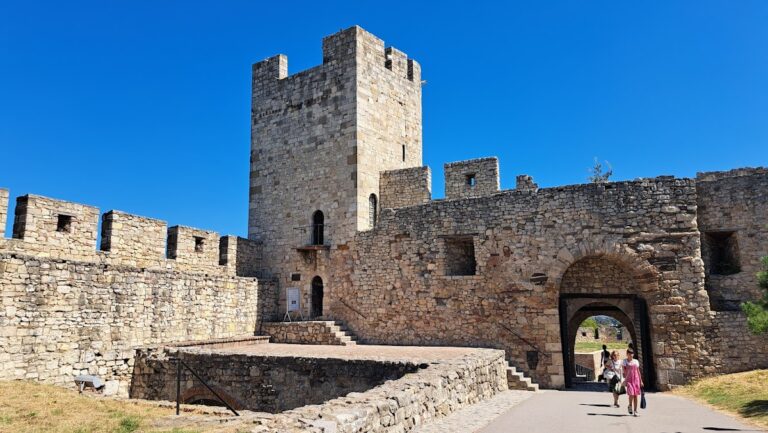
After the Serbian defeat at the Battle of Kosovo, Belgrade became the capital of Despot Stefan Lazarević in 1402. Stefan directed major reconstruction, enlarged the town, and strengthened the surrounding ramparts. The Lower Town developed into a busy urban and commercial center, while the Upper Town and castle defended the settlement from the inland side.
Belgrade remained under Serbian rule for almost a century. After Stefan Lazarević died in 1427, the fortress was returned to Hungary. In 1456, Ottoman Sultan Mehmed II, who had conquered Constantinople in 1453, failed to capture it. The defense was led by the Hungarian commander János Hunyadi.
Ottoman and Austrian transformations
The Ottoman Empire conquered the fortress in 1521 under Sultan Suleiman the Magnificent. Apart from brief Austrian and Serbian occupations, it remained Ottoman until the Ottoman withdrawal from Belgrade and Serbia in 1867.
During the Austrian occupation of 1718 to 1738, the fortress was extensively rebuilt and modernized under the direction of the military engineer Nicolas Doxat de Démoret and within the wider projects of Prince Eugene of Savoy. The period brought new defensive works and buildings, but many were later destroyed. After Austria returned northern Serbia to the Ottoman Empire following the Austro-Turkish War of 1737 to 1739, the Treaty of Belgrade required the demolition of the fortifications and military and civilian buildings constructed by Austria. Many Baroque buildings inside the fortress were consequently lost.
The fortress experienced the Great Serbian Migration of the seventeenth century and the Serbian uprisings of the nineteenth century. During the Austrian occupation, hospitals were established within Belgrade. The City Hospital of Saint John stood somewhere inside the fortress, although its precise location is unknown. A small hospital building erected in 1724 had two rooms, a kitchen, and a basement, but its relationship to the city hospital remains uncertain.
In 1738, civilians fleeing the advancing Ottoman army crowded into the Austrian-held enclosure and brought a major plague outbreak to the fortress. The Austrian garrison was decimated, and the bodies of soldiers who died were burned with their personal possessions. In 1837, Prince Miloš Obrenović imposed a six-week Serbian siege of the Ottoman-held fortress to prevent a plague outbreak from spreading into Belgrade.
Serbian control and the creation of Kalemegdan
The Ottoman garrison withdrew in 1867. On 18 April, Serbian troops under Colonel Svetozar Garašanin ceremonially replaced the Ottoman guards. Five days later, Serbian authorities began rebuilding Ružica Church. Serbia initially administered the fortress without being recognized as its owner because it was still autonomous. Full independence followed in 1878.
In 1867, Prince Mihailo Obrenović ordered artillery fire against the fortress walls. The purpose remains uncertain. He may have intended to demolish obsolete defenses, demonstrate their resilience to Austria-Hungary, or provoke the neighboring power. About 300 rounds were fired, but only approximately 15 meters of rampart were destroyed.
Prince and later King Milan Obrenović subsequently ordered parts of the eastern fortress to be leveled and trees and greenery to be planted. These works developed into Kalemegdan Park. The name Kalemegdan derives from Turkish words meaning “fortress field” and was applied to the park adjoining the fortress. Kalemegdan later formed an administrative quarter of Belgrade known as Grad, or “city.” Its population was recorded as 2,219 in 1890, 2,281 in 1895, 2,777 in 1900, 2,396 in 1905, and 454 in 1910.
War, archaeology, and protection
In January 1911, a field in the Lower Town along the Sava was adapted for aircraft and became Serbia’s second airport. Aviation pioneer Edvard Rusjan died there in a crash on 9 January. The remains of his aircraft were exhibited in the Lower Town, and a surviving rib later became the first exhibit of the predecessor of the modern Aeronautical Museum Belgrade.
The fortress and park were heavily damaged during World War I, especially by Austro-Hungarian gunboats and bombardments in 1914 and 1915. Heavy fighting took place in the Lower Town in 1915, where Serbian forces commanded by Major Dragutin Gavrilović unsuccessfully resisted the Austro-Hungarian invasion. In December 1914, Austro-Hungarian forces also erected gallows in the Upper Town and elsewhere in Belgrade.
World War II brought further damage. The Military Museum was bombed and looted in April 1941, then repaired under German military authority and reopened in July of that year. German archaeological investigations from 1941 to 1943 sought evidence connected with a proposed transformation of Belgrade into Prinz Eugen’s District, but the project was abandoned after the invasion of Yugoslavia. Excavations directed by Wilhelm Unverzagt, with the participation of Wolfram Sievers and Herbert Jankuhn, examined Celtic and Gothic settlement remains, a Roman trench, and remains from the Austrian period. Allied bombing stopped the work in 1943. Some excavation records and artifacts may have been transported to Germany, while others may have been stored in the Belgrade City Museum.
German “terrain cleaning” in 1941 and 1942 completely destroyed the foundations of Austrian artillery barracks built between 1723 and 1736. The Gate of Charles VI was reconstructed in detail by 1943, including its imperial cartouche and a representation of the supposed coat of arms of the never-existing Tribalia. Allied bombing during Easter in April 1944 damaged the gate again.
Postwar archaeology revealed prehistoric, Roman, medieval, and Turkish-Austrian remains. By 2000, approximately 5 percent of the 66-hectare complex had been archaeologically surveyed. By 2010, the surveyed area had increased to about 12 percent, or 8 hectares. The work covered the Upper Town, the Lower Town waterfront rampart, Kalemegdan Park, and the area of the zoo. Discoveries announced in 1969 altered the appearance of the Lower Town by revealing medieval paving, ramparts, and gates. Four massive fifteenth-century pillars in the Upper Town were identified as the remains of a bridge in front of the inner fortress. A new stairway and a reconstructed section of medieval rampart improved physical access to the Lower Town.
Later investigations examined the route to the Small Staircase, the Sava slope bastion, the King, Sava, Dark, and Karađorđe gates, and the Great Ravelin. Excavation during the 2017 reconstruction of Mehmed Paša Sokolović’s Fountain revealed remains of the Roman castrum, two Bronze Age urns, and a Neolithic structure. These discoveries were conserved and reburied.
The city adopted protection measures for Kalemegdan in 1952 and expanded the protected zone in 1962. Belgrade Fortress was among the first cultural monuments officially protected in Serbia after World War II. It became a Cultural Monument of Exceptional Importance in 1979 and is protected by the Republic of Serbia. In 2021, previously protected geological areas were combined and expanded into the 14.07-hectare Kalemegdan Sandbank Natural Monument.
The fortress has been nominated by the Serbian government for UNESCO World Heritage status. In 2020, Europa Nostra included Belgrade Fortress among Europe’s seven most endangered heritage sites because of a proposed gondola lift between Kalemegdan and Ušće. The proposal drew opposition from environmentalists, architects, urbanists, and local authorities, and conflicted with Belgrade’s 2016 General Regulatory Plan, which prohibited cable transportation and recreation structures in the fortress area.
Remains
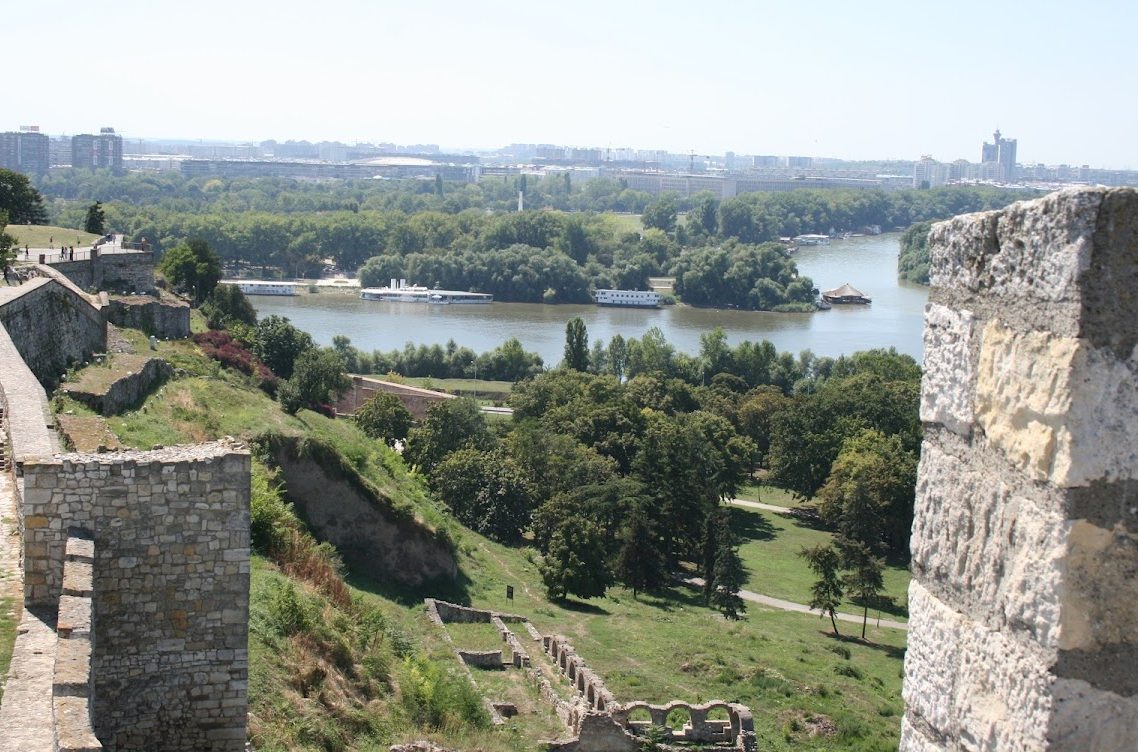
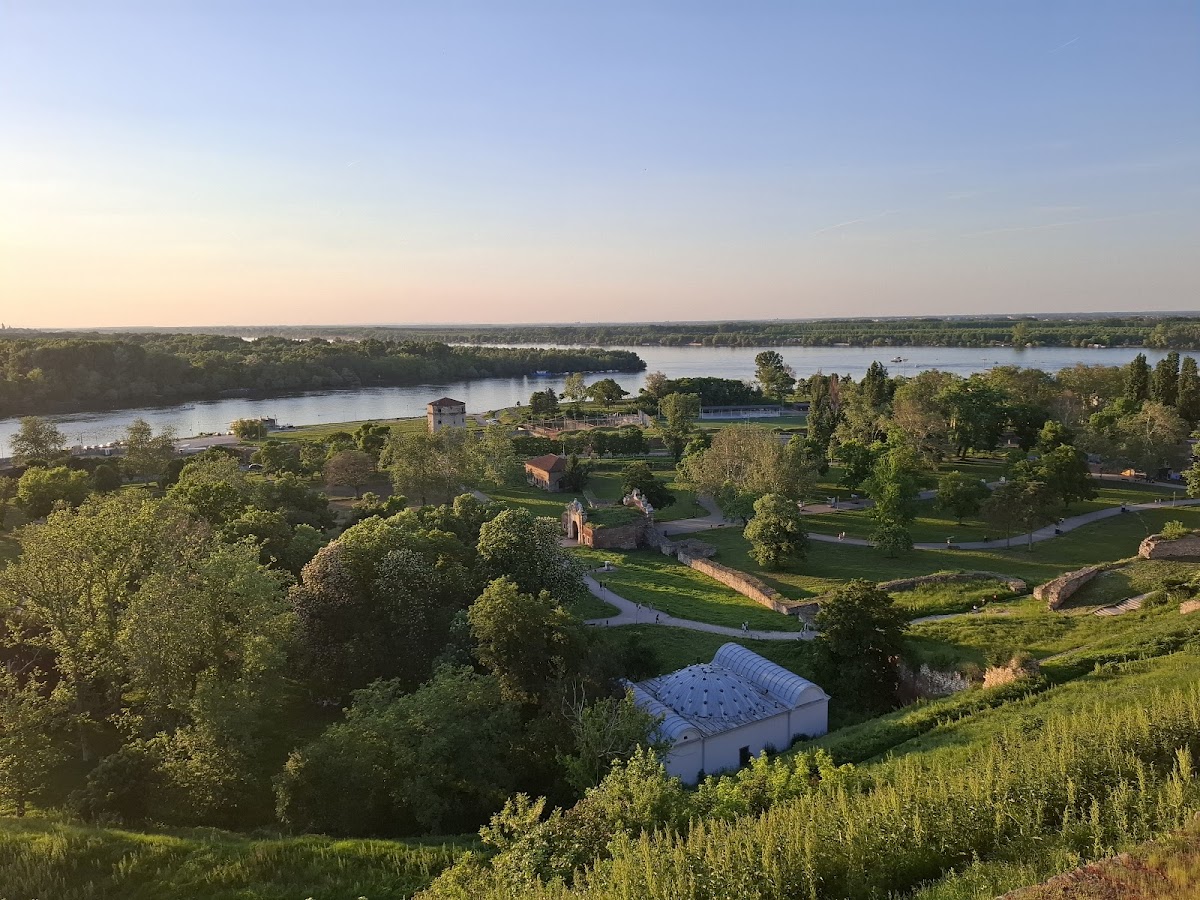
Belgrade Fortress occupies the terminal ridge of the Šumadija geological bar, approximately 125.5 meters above sea level. The ridge overlooks Great War Island and the confluence of the Sava and Danube, while the complex borders Dorćol, Stari Grad, and Kosančićev Venac. The site covers about 66 hectares and consists of the Upper Town, Lower Town, Great Kalemegdan Park, and Little Kalemegdan Park. The fortress proper is formed by the Upper and Lower towns, while the two Kalemegdan areas are now parkland.
Roman and medieval foundations
Roman castrum
The Roman castrum occupied the present Upper Town and Kalemegdan Park. It formed an irregular rectangle about 570 by 330 meters and covered between 16 and 20 hectares. The camp was enclosed by tall walls built of white Tašmajdan limestone. Its earliest defenses consisted of earthen ramparts and wooden palisades before the fortifications were rebuilt in stone. Remains of the early stone fort can be seen near the northeastern corner of the acropolis.
Lower Town
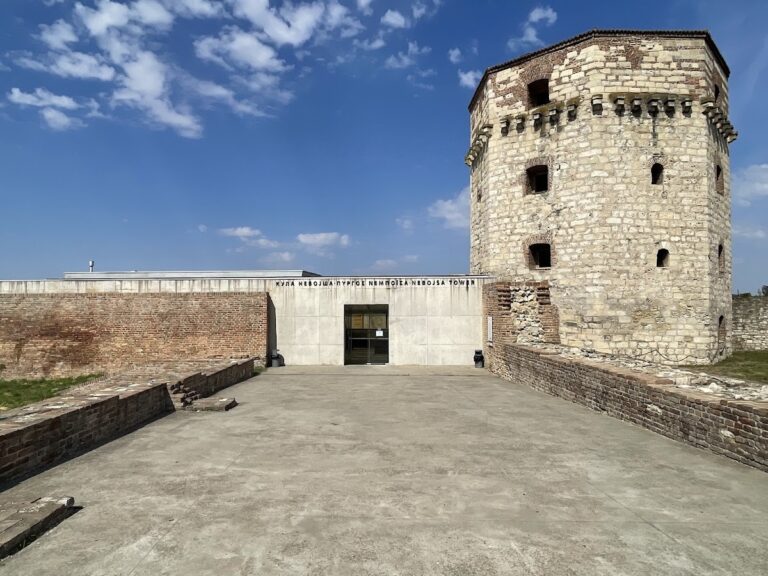
The Lower Town descends toward the rivers and contains the former waterfront defenses, medieval paving, gates, ramparts, churches, the Belgrade Planetarium, and Kula Nebojša near the Danube. A former canal that supplied the medieval city passed through the fortress area and is now covered by earth. The slope between the Lower and Upper towns preserves the relationship between the lower riverside settlement and the higher defensive area. The Lower Town is vulnerable to flooding, and Kula Nebojša suffered extensive damage during the floods of 2006.
Churches and religious buildings
Ružica Church and the Church of Sveta Petka
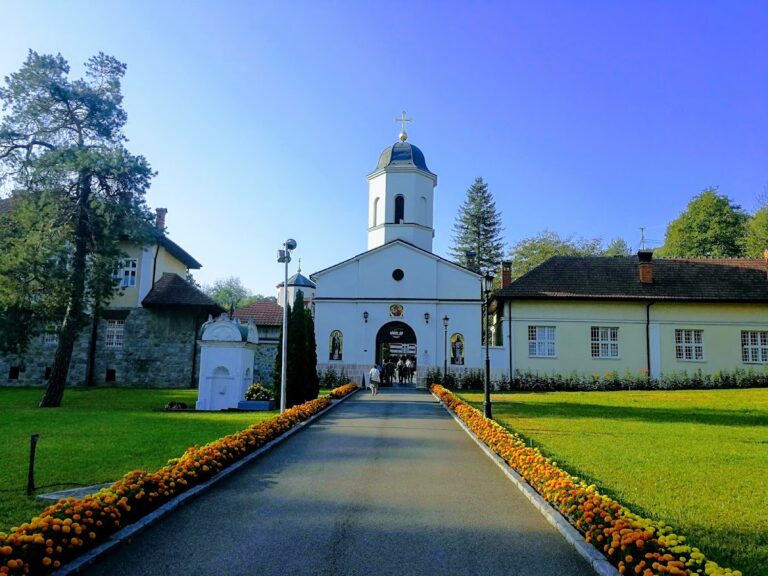
Ružica Church occupies a former Austrian gun depot. Nearby, the modern Church of Sveta Petka was designed by Momir Korunović on the site of an older chapel. Construction began in the first half of the 1930s, and the church was consecrated on 27 October 1937.
Former cathedral church
The former Church of the Dormition of the Most Holy Mother of God was a large three-nave church with a dome. Built during the restored Byzantine rule, probably in the twelfth century, it served as the cathedral church and later as the seat of the Serbian Orthodox Metropolitan of Belgrade. Stefan Lazarević expanded it with choirs and a surrounding monastery complex. Its contents included an icon of the Mother of God, relics of Saint Petka and Saint Empress Theophano, icons of the Twelve Apostles, and a reliquary containing a hand.
The Ottomans converted the church into a mosque in 1521. An explosion in 1717 destroyed almost all of the Lower Town, including the church, and Austrian forces later demolished the remaining ruins while leveling the terrain. The church’s exact location and exterior appearance are unknown. Surviving evidence includes part of a marble lintel with an incomplete ktetor inscription, which records the founder or patron of an Orthodox religious building, attributed to Stefan Lazarević and discovered in 1967. Larger remains of the adjacent Metropolitan’s Seat, including arched open walls from its former porch, were found in 1977.
Ottoman and Austrian structures
Kula Nebojša
Kula Nebojša is a tower near the Danube in the Lower Town. Its name means “Impregnable,” “Fearless,” or “Daredevil Tower.” It now houses a museum dedicated to the Greek revolutionary Rigas Feraios, who was strangled there by the Ottomans and whose body was thrown into the Danube.
Great Austrian Gunpowder Magazine
The Great Austrian Gunpowder Magazine was built during the Austrian occupation of 1718 to 1739 after the earlier magazine was destroyed in the siege of 1717. It lies beneath a rampart about 7 meters thick. The structure contains Roman artifacts found in or around the fortress, including tombstone stelae, monuments, altars, and the third-century Sarcophagus of Jonah.
Its lapidarium, a display of stone archaeological and architectural fragments, included the marble sculpture known as the Herkulanka. Made around AD 300 and found near the Military Museum, it represents a richly dressed woman in a chiton and himation. She is thought to have been an important female resident of Singidunum. The sculpture was vandalized and broken during a break-in in 2020.
Roman Well
The structure called the Roman Well is neither Roman nor originally a water well. An underground structure existed during the medieval period and may have served as a dungeon. A later account described it as a grain silo. During the Austrian reconstruction of 1717 to 1731, the present shaft was excavated to approximately 54 meters, but water was not found, and the structure was converted into a cistern.
The architect and military engineer Balthasar Neumann designed the shaft and its water-lifting arrangements. The shaft measures 3.4 meters in diameter and descends about 50 meters. A manually operated wooden mechanism with 12 pistons was intended to raise water. Neumann also designed a double spiral staircase with 212 steps, descending about 35 meters, while a flooded corridor connects the two sections at the bottom.
The Austrians called the structure the Great Well. It gradually acquired the name Roman Well after Serbian rebels liberated Belgrade in the early nineteenth century, when old buildings were commonly assumed to be Roman. The wooden mechanism has disappeared, and the descent is closed for safety reasons, although the upper section was reopened in 2014. Investigations recovered human and animal skeletons, coins, construction debris, and other discarded material. They found no tunnel linking the structure to the Sava. In 2006, divers found an amphipod species not previously recorded in Serbia, approximately 5 millimeters long. By 2017, about 15 cubic meters of debris had made the well 1.5 meters shallower. At that time, the water measured approximately 12 degrees Celsius and extended to about 14 meters.
Türbe and Great Ravelin
The türbe, an Islamic mausoleum built over the grave of a prominent person, stands on the central Upper Town plateau. It has a regular hexagonal plan, sides of about 4 meters, a height of 7 meters, and a diameter of 8 meters. Although associated with Damad Ali Pasha, it was built in 1784 over the grave of Izzet Mehmed Pasha, an Ottoman grand vizier and governor of Belgrade. It was reconstructed in 1818 and 1819 after damage during the First Serbian Uprising. Selim Sirri Pasha and Hasan Pasha, both later fortress governors, were also buried there.
Conservation in 2017 replaced the roof covering and wiring, drained the floor, conserved the interior and exterior, replaced rotten wooden flooring with brick slabs, and renewed the wooden tomb covering. A separate building on the Great Ravelin, a detached defensive work protecting an approach or gate, was constructed in the 1830s or 1840s for Ottoman guards. It covers about 100 square meters. From 1957 it housed the Museum of Forestry and Hunting, which became part of the Museum of Natural History in 1973. Since 1994, the building has served as a Natural History Museum gallery.
Modern buildings and military remains
Military Museum
The former Serbian General Staff building was constructed between 1902 and 1904 and destroyed by Austro-Hungarian bombardment in October 1915. A replacement designed by Janko Šafarik was erected on the same site, with a natural-stone base, an artificial-stone side staircase, and a cast-iron fence and candelabra. After the General Staff moved in during 1928, the building became the Military Museum. It was transferred to the Institute for the Protection of Cultural Monuments in 1961, and its facade was fully renovated in 2021.
Postwar bunker
A defensive bunker was built in 1948 and 1949 after the Tito-Stalin split, the political rupture between Yugoslavia under Josip Broz Tito and the Soviet Union under Joseph Stalin. Its construction exposed a 5-meter-thick rampart belonging to the original Nebojša Tower. The bunker covers about 200 square meters and contains a cannon dome for artillery and military units. It was later adapted for visitors and retains 1950s equipment, including safety doors, beds, ventilation, and water tanks.
Parks, gates, monuments, and public institutions
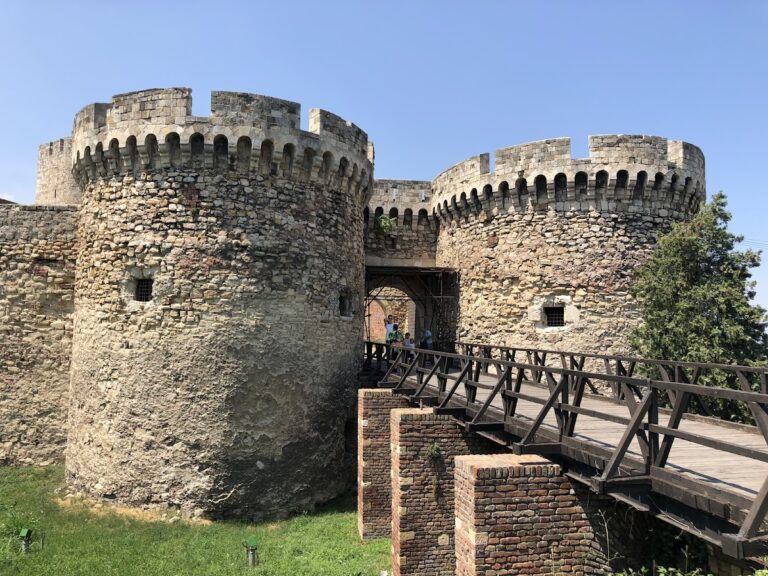
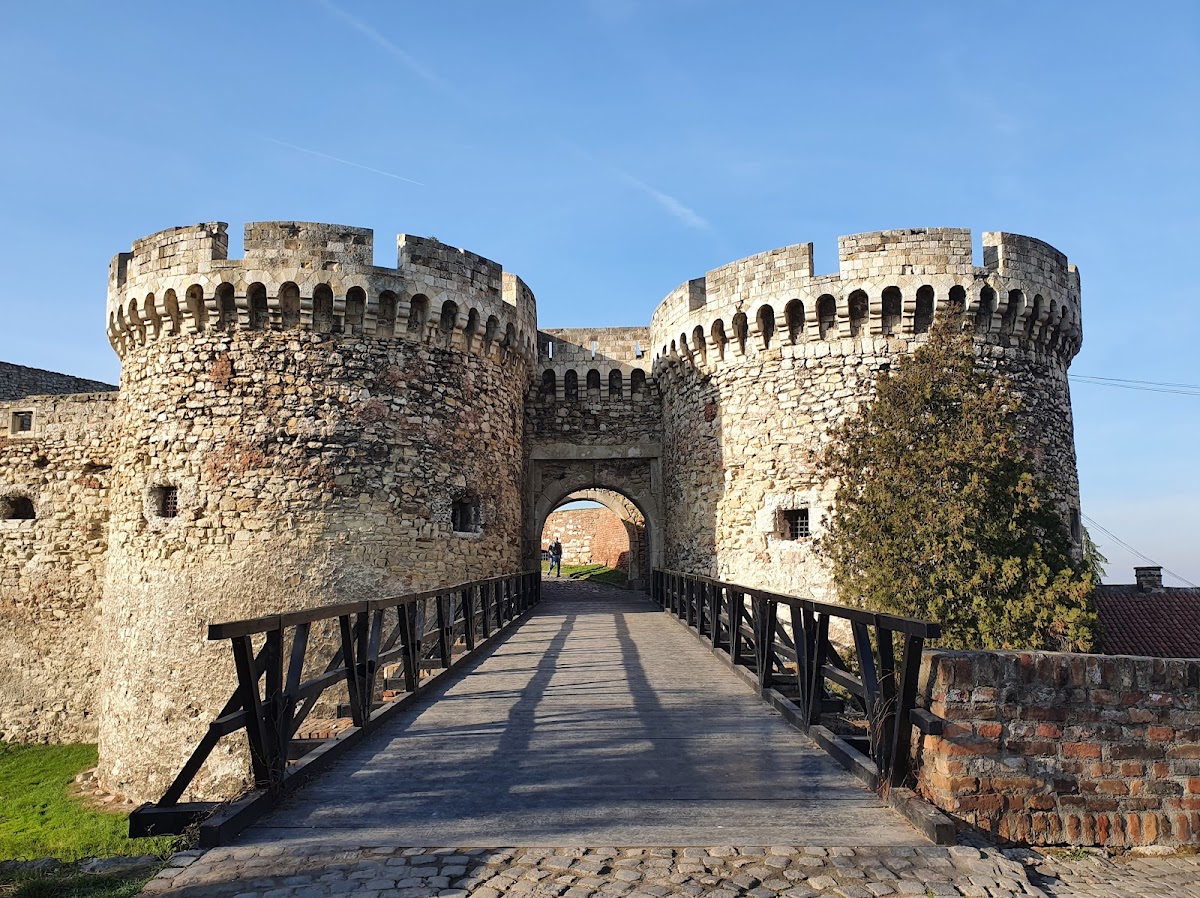
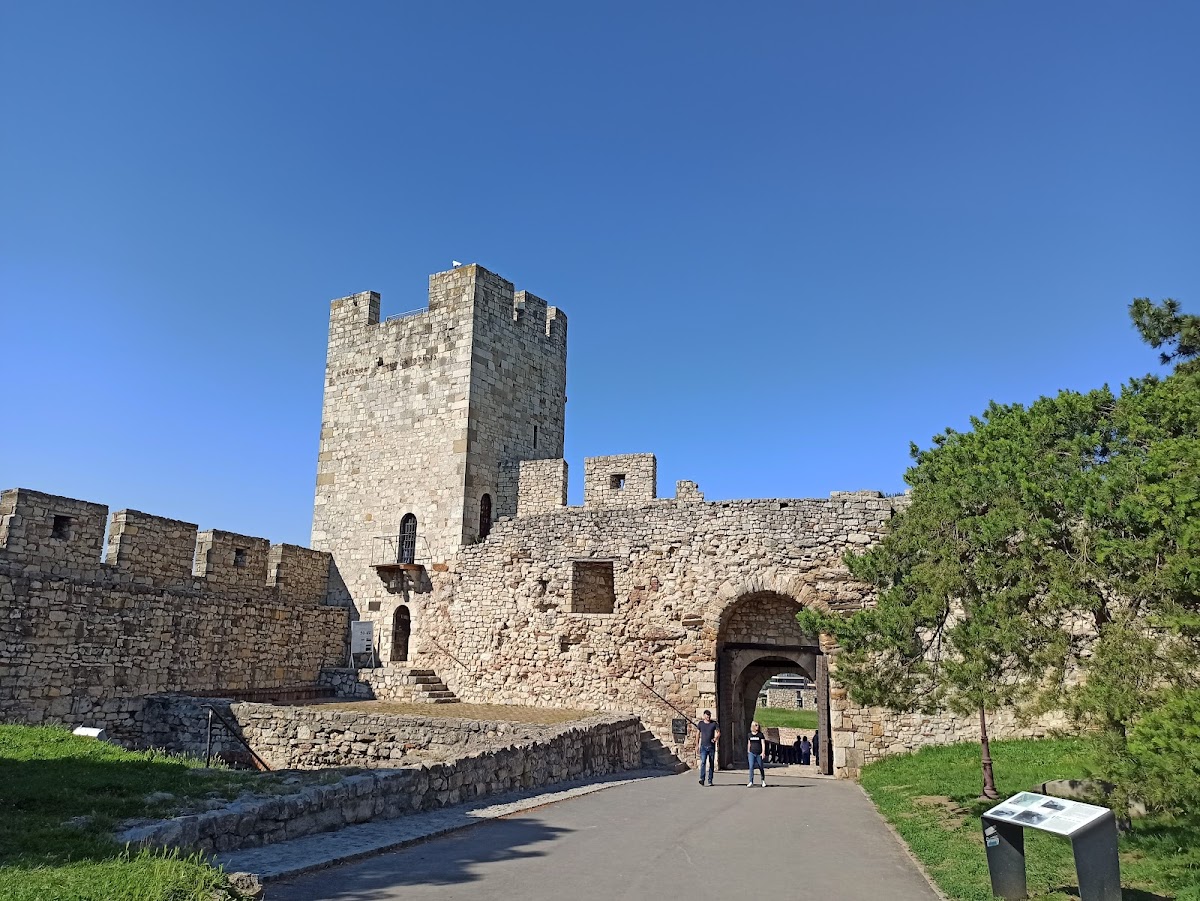
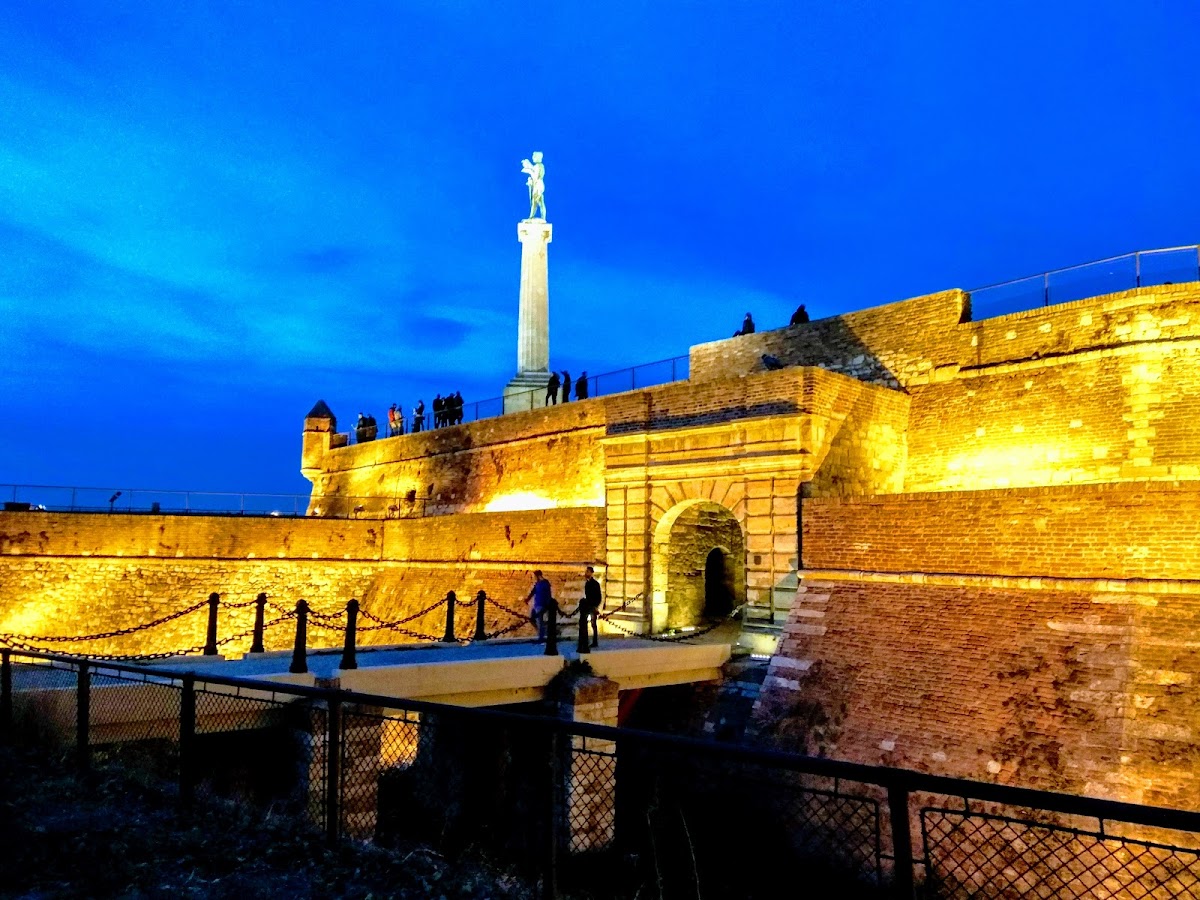
The Upper Town is now a park with promenades, the Victor monument, the Roman Well, Despot Stefan Tower, the tomb of Damad Ali Pasha, Mehmed Paša Sokolović’s Fountain, and sports courts. The complex also includes the Sahat Kula clock tower, Zindan Gate, King’s Gate, Sava Gate, Dark Gate, Karađorđe Gate, the Great Ravelin, and the Small Staircase. The Sava Gate was reconstructed and reopened in 2009, restoring pedestrian communication between the Sava and Danube sides.
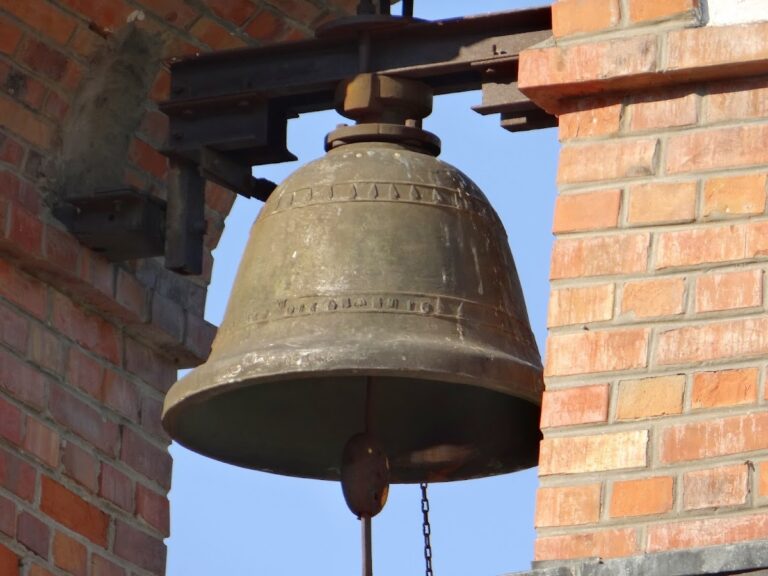
Great Kalemegdan occupies the southern part of the complex. Its geometrical promenades contain the Military Museum, the former Museum of Forestry and Hunting building, and the Monument of Gratitude to France. A monument to Karađorđe formerly stood at the latter location and was melted down during the Austro-Hungarian occupation. The later Franz Joseph monument was captured by Serbian forces in 1918 and melted into three church bells. The largest hangs in Ružica Church.
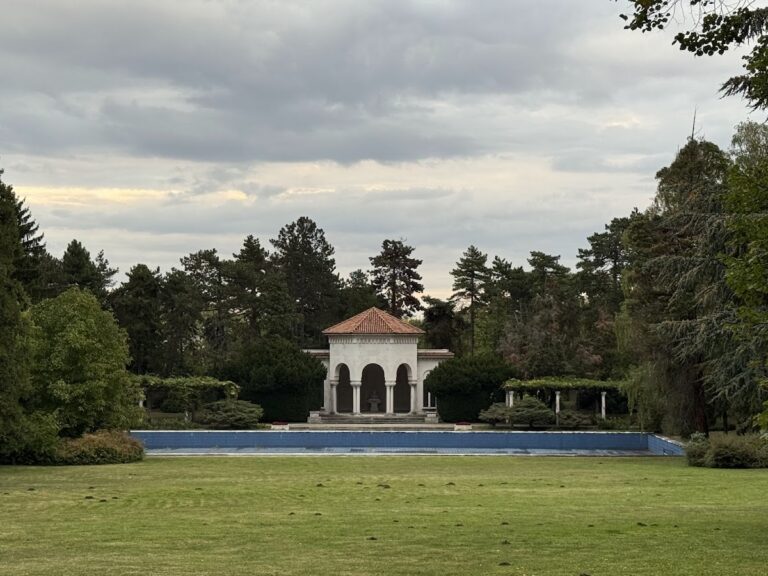
Little Kalemegdan occupies the eastern section adjoining the urban part of Belgrade. Its northern area contains the Belgrade Zoo, opened in 1936, and the Cvijeta Zuzorić Art Pavilion. Other institutions and features across the complex include museums, galleries, churches, the Planetarium, the People’s Observatory, the Music Pavilion, sports grounds, an archaeological research center, and the Memorial Ossuary for the defenders of Belgrade in 1914 and 1915. Kilometers of tunnels, underground corridors, and catacombs also extend through the fortress, many of them unexplored.
Tombs and memorials
The Tomb of People’s Heroes contains the remains of Communist Party members and wartime figures Ivan Milutinović, Đuro Đaković, Ivo Lola Ribar, and Moša Pijade. Built in 1948 for the first three, it used granite intended for the Church of Saint Sava. Busts were added in 1949 and 1959. The complex became a cultural monument in 1983 and has repeatedly been vandalized since the 1990s.
A monument dedicated to the founders of the Serbian and Yugoslav basketball school was installed in 2018 between the basketball courts of Partizan and Crvena Zvezda. Designed by sculptor Radoš Radenković on the initiative of former player Nataša Kovačević, it represents three stylized arms reaching for a basketball and commemorates the Yugoslav national team that qualified for the 1950 FIBA World Championship.