Burg bei Burgweiler: A Medieval Moated Castle Site in Germany
Site at a Glance
- Rating
- 3.3
- Popularity
- Very Low
- Country
- Germany
- Primary era
- Medieval
- Eras represented
- Medieval
- Civilizations
- Holy Roman Empire
- Site type
- Military
- Remains
- Castle
On this page8 sections
History
Burg bei Burgweiler is an abandoned high-medieval moated castle site in Germany, near Ostrach in Baden-Württemberg. Built as a medieval motte castle, it occupied an elevated position above the otherwise flat Ried, a wetland landscape, and formed part of the historical setting of Burgweiler.
Early medieval occupation
A nobleman named Wolvberadus of Weiler and his wife are thought to have lived at the site around 1050. The surviving evidence does not establish how the castle developed from this early association, but the mound later became the seat of a substantial fortified residence.
The lords of Gundelfingen
Documentary evidence begins at the start of the thirteenth century, when the noble lords of Gundelfingen held possessions in the area for several decades. Their ties to the Hohenstaufen, a medieval German ruling dynasty whose members included Holy Roman Emperors, may have helped them extend estates that had originally been scattered between Münsingen and Riedlingen toward Burgweiler.
In 1279, Conrad II of Gundelfingen transferred his possessions in the Ostrach and Burgweiler area to Salem Abbey. This major Cistercian monastery in southwestern Germany was also an important medieval landholder. Conrad’s heavy debts and inheritance disputes contributed to the transfer, while political circumstances may also have played a part. The period during which the castle continued to exist after this change is unknown.
Parish estate and pleasure garden
More than 400 years ago, the Burg property became part of the parish estate, and it remains associated with the Burgweiler parish. More than 250 years ago, Pastor Geiger cleared vegetation from the hill, filled in the moat, and strengthened a cart track to the summit. He transformed the mound into a pleasure garden with a stone garden house. The garden was probably mentioned in the 1813 Lexicon of Baden because of its attractive view across the surrounding Ried landscape.
Modern local associations
Since 1969, the Burgweiler music association has maintained and used the castle hill and has held an annual Burg Festival there. Since 1979, the Burgnarren Burgweiler carnival association has also drawn on the former castle’s history. Its council is called the Burgrat, and the carnival figure Butz, created in 1986, refers to the nobles of Burgweiler.
Remains
Motte and defensive earthworks
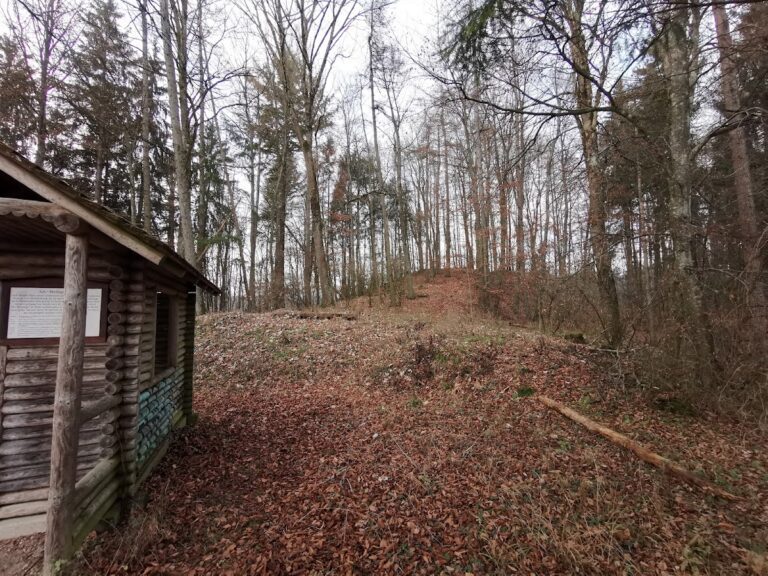
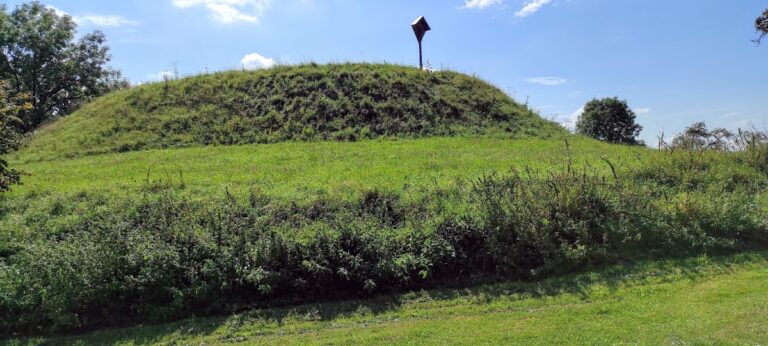
The remains consist of a wooded motte, a medieval castle built around a raised mound that supported a tower or keep. The oval castle site covers approximately 685 square metres. Its mound rises about 10 metres and measures roughly 24 to 32 metres across. The castle belonged to a type associated with the Hohenstaufen period, with a substantial masonry ring wall enclosing a central keep and other buildings.
A continuous water-filled moat once surrounded the mound. A rampart stood immediately outside the moat, with another rampart beyond it, creating a layered defensive arrangement. The moat was later filled when the hill became a pleasure garden, but its U-shaped course remains visible in the landscape. The summit still includes the stone garden house built during that later transformation.
Setting and approach
The castle hill stands approximately 500 metres east of Burgweiler, on an elevation in the upper Linzgau, a historical region of southwestern Germany. The settlement lay on the opposite side of the marshland and could be reached by a corduroy causeway, a track made by laying logs across wet ground. The mound now lies at the edge of the Burgweiler and Pfrunger Ried nature reserve, which extends eastward from the site. Burg bei Burgweiler survives as a castle hill and abandoned castle site rather than as a standing castle.
Nearby sites