Burg Nesselburg: A Medieval Administrative Castle Ruin in Bavaria


Site at a Glance
- Rating
- 2.8
- Popularity
- Very Low
- Country
- Germany
- Primary era
- Medieval
- Eras represented
- Medieval
- Civilizations
- Holy Roman Empire
- Site type
- Military
- Remains
- Castle
On this page7 sections
History
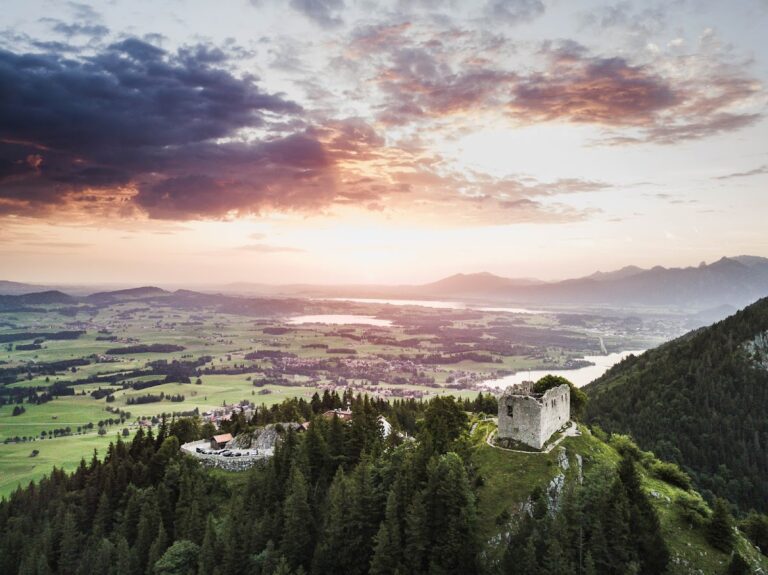
Burg Nesselburg is a medieval castle ruin above Nesselwang in Bavaria, Germany. The noble lords of Rettenberg established it toward the end of the thirteenth century, and it first appears in a record dated 1302. From 1350, the castle became the center of an administrative district within the Augsburg bishopric, an ecclesiastical principality governed by the bishop of Augsburg.
Rettenberg Lordship and Augsburg Administration
The lords of Rettenberg soon pledged their lordship to the Augsburg bishopric, receiving it back as a fief, or territory held in return for service and allegiance. When Heinrich, the last Rettenberg, died without children, his relative Peter von Hohenegg claimed the inheritance. The Augsburg bishopric compensated him with 1,300 pounds of heller, a small medieval German coin used here as an accounting measure rather than a weight of goods.
Nesselburg continued as the seat of the district administration, known as a Pflegamt, and Augsburgian administrators and bailiffs lived there. During the German Peasants’ War, a widespread uprising of 1524 to 1525 against authorities and social conditions, insurgents plundered the administrative seat and burned it in 1525. The castle was later made habitable again, but a second fire in 1595 left its rooms unusable.
Loss of Administrative Function
After the 1595 fire, the Augsburg bishopric acquired a house on Nesselwang’s main street and established the administrative seat there in 1601. That building burned during Nesselwang’s local fire in 1635. A new administrative building was later erected on the same site, before being demolished in 1976. The move away from the hilltop castle ended Nesselburg’s role as a residential and administrative center.
Repair and Heritage Protection
Private purchaser Gerald Wimmer of Frankfurt am Main acquired the castle in 1996 and began repairing unstable masonry in 1997. The work stopped after a year, although surviving sections have since been repaired in stages. On 31 January 2025, Burg Nesselburg, together with its associated waterfall and the Schlosswald forest, was sold to the market town of Nesselwang, which planned to resume the earlier repair efforts. The ruin is designated as an architectural heritage monument in Bavaria.
Remains
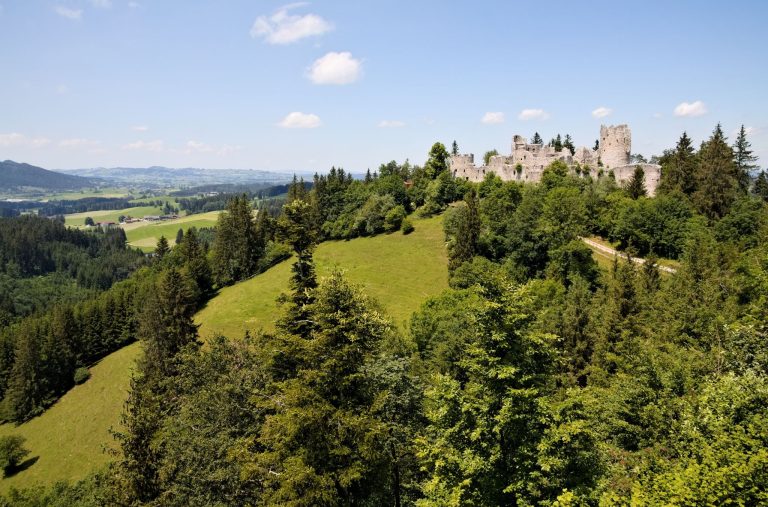
Burg Nesselburg occupies the cone of the Kappelköpfel, a spur extending from the Alpspitz, at approximately 1,038 metres above sea level and about 170 metres above Nesselwang. The spur castle stands on a roughly rectangular plateau measuring about 30 by 23 metres. Its remains consist of substantial standing masonry, ditches, and traces visible in the terrain. A neck ditch protects the side facing the mountain slope, while steep ground descends into ravines on the eastern and western sides.
Defensive Enclosure and Approach
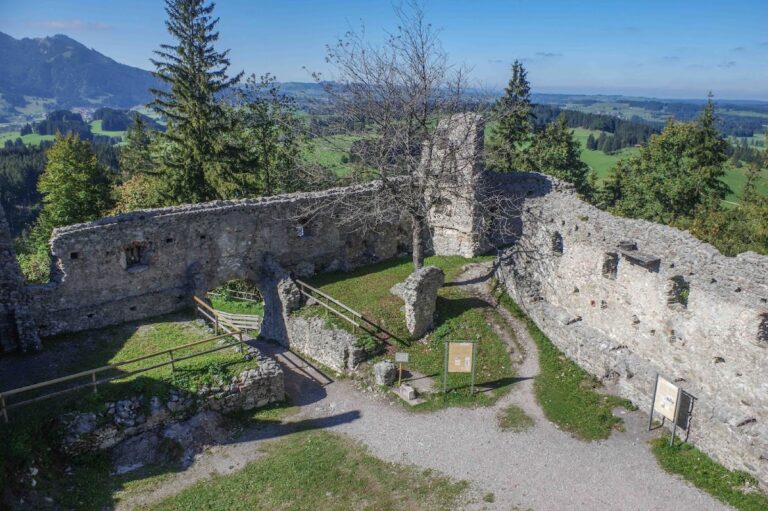
The southern side of the plateau is occupied by the remains of a shield wall, a heavily strengthened section of the fortification protecting the most exposed side. It is approximately 2.6 metres thick and survives to a height of up to seven metres. The wall was built from irregular masonry using stream-worn stones, Nagelfluh conglomerate made from rounded stones cemented together, sandstone, and tuff. Corner ashlar blocks remain visible at the southeastern corner.
The western connecting wall survives and leads toward the gate beside the principal building, while the corresponding eastern wall has disappeared. The former castle road approached the gate opening from the northwest. A second ditch cuts across the mountain slope north of the gate, adding another element to the approach defenses.
Residential Building
The palas, the castle’s principal residential and representative building, stood in the northern part of the plateau. Its northern wall is largely missing, while the surviving western connecting wall and the gate preserve part of its relationship with the defensive enclosure. Together, these remains indicate the division between the castle’s residential core and its fortified perimeter.