St. Leonhard: A Church Serving Heitlern and Dorf in Pfronten
Site at a Glance
- Rating
- 4.5
- Popularity
- Very Low
- Country
- Germany
- Primary era
- Early Modern
- External website
- Open
- Eras represented
- Medieval, Early Modern, Modern
- Civilizations
- German, Holy Roman Empire, Kingdom of Bavaria
- Site type
- Religious
- Remains
- Church
On this page12 sections
History
St. Leonhard is a church in Pfronten, Germany, serving the districts of Heitlern and Dorf as a subsidiary church of St. Nicholas in Pfronten-Berg. A complete rebuilding was authorized in 1726, and its interior includes Rococo decoration. The church’s position near a crossing of the Vils made it important to worshippers south of the river when floods blocked the way to their parish church.
Origins and community role
Dorf is regarded as one of Pfronten’s oldest settlements, although it first appears in written records in 1497. Its residents may have moved from older farmsteads in the Dorf-Heitlern area and established a village around a newly dug pond. Heitlern had a shared church, whose wardens are also named in a document of 1497. The dedication to St. Leonhard may point to an earlier foundation: veneration of the saint had spread in southern Germany by the late 11th century, though the dedication alone does not establish when the church was built.
A medieval imperial road ran past the church on ground above the flood-prone river, then crossed the Vils to the north by bridge. Between the road and church stood a carters’ inn, first mentioned in 1519 as an inn by St. Leonhard and now known as the Gasthof Adler. Floods repeatedly destroyed the crossing, making it difficult for people in the Lower Parish, the communities south of the Vils, to reach Sunday services at their parish church. This was one reason a chaplaincy, a local pastoral foundation served by a chaplain, was established at Heitlern in 1526.
The building beside the church that now houses a kindergarten was once the home of the priest who celebrated an early Mass. The chaplaincy’s income could not adequately support its priest, and the position was vacant before 1600. The premises later served as the parish school until 1816. St. Leonhard also had its own small walled burial ground. Burials there of people from beyond the locality continued until 1800, including people who died at the nearby Pfronten Seelhaus, a charitable institution. The parish cemetery did not provide space for them.
Damage, rebuilding, and later changes
Church accounts from 1603 describe repeated repairs, particularly to the steep shingle roof after a severe windstorm. The sacristy, the room used to store church furnishings, appears to have been damp: vestments and other items were spread in the sun to dry. The church’s location beside the road also exposed it to wartime danger. During the Thirty Years’ War, a series of European conflicts fought from 1618 to 1648, Swedish soldiers set St. Leonhard on fire during an incursion in 1634. Repairs followed in the ensuing years.
In 1726, the church received permission from the bishop for a complete rebuilding, as the structure needed to be reconstructed from the ground up. The Pfronten builder Michael Erdt carried out the work. The altar paintings and figures honor saints named Francis in tribute to the local priest Franz de Paula Wind, who served during this period and lived from 1710 to 1769. Joseph Stapf’s Rococo pulpit was initially intended for St. Martin, to which Stapf gave it in 1778; priest Köberle arranged for its transfer to St. Leonhard in 1898.
Renovation work in 1961 uncovered an older choir painting beneath a mural by Karl Keller, dated 1895, and brought it back into view. Leaking church doors were replaced in the early 1960s. Work in 1981 addressed the damaged stone supports for the exterior chain.
Remains
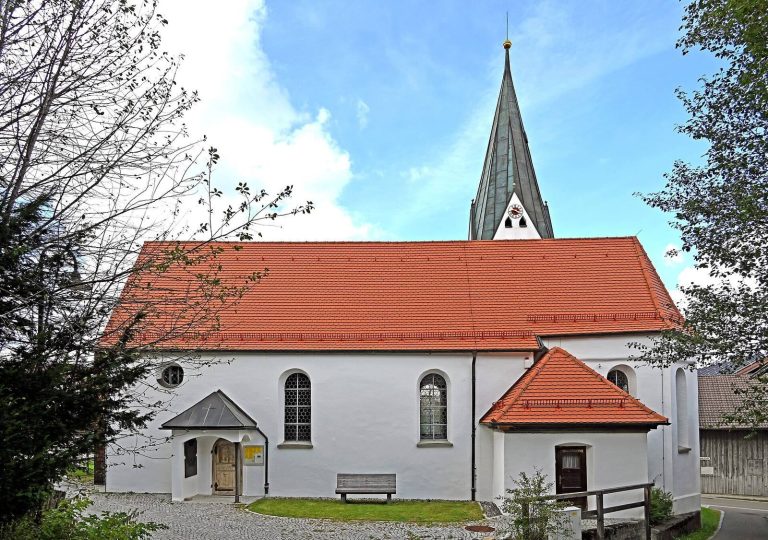
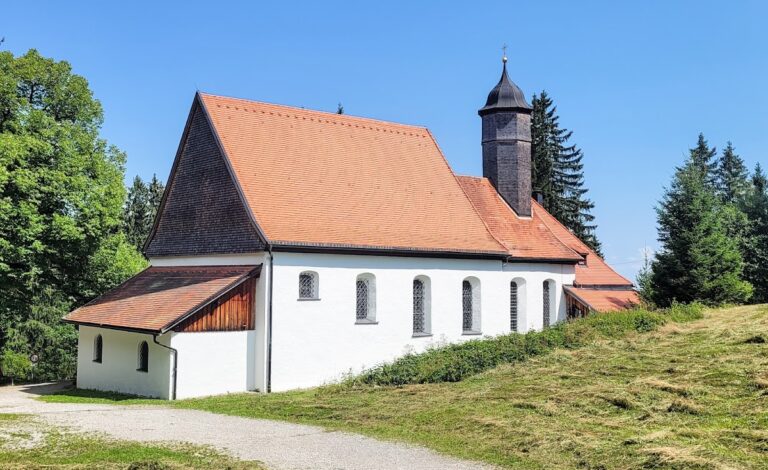
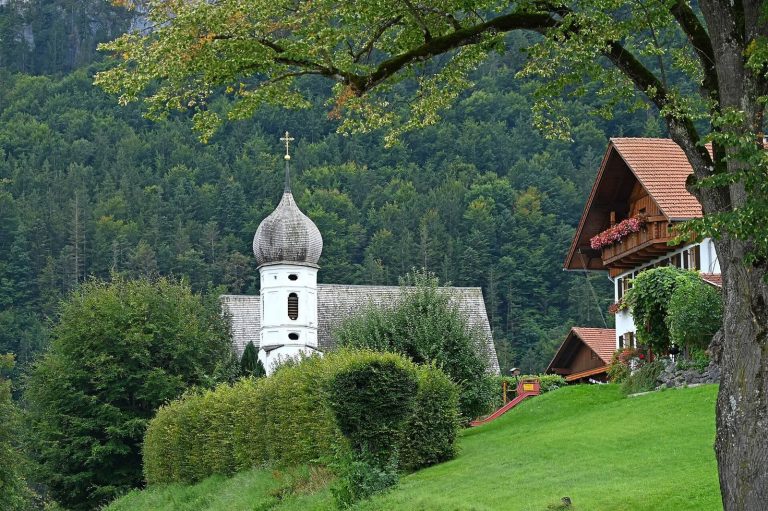
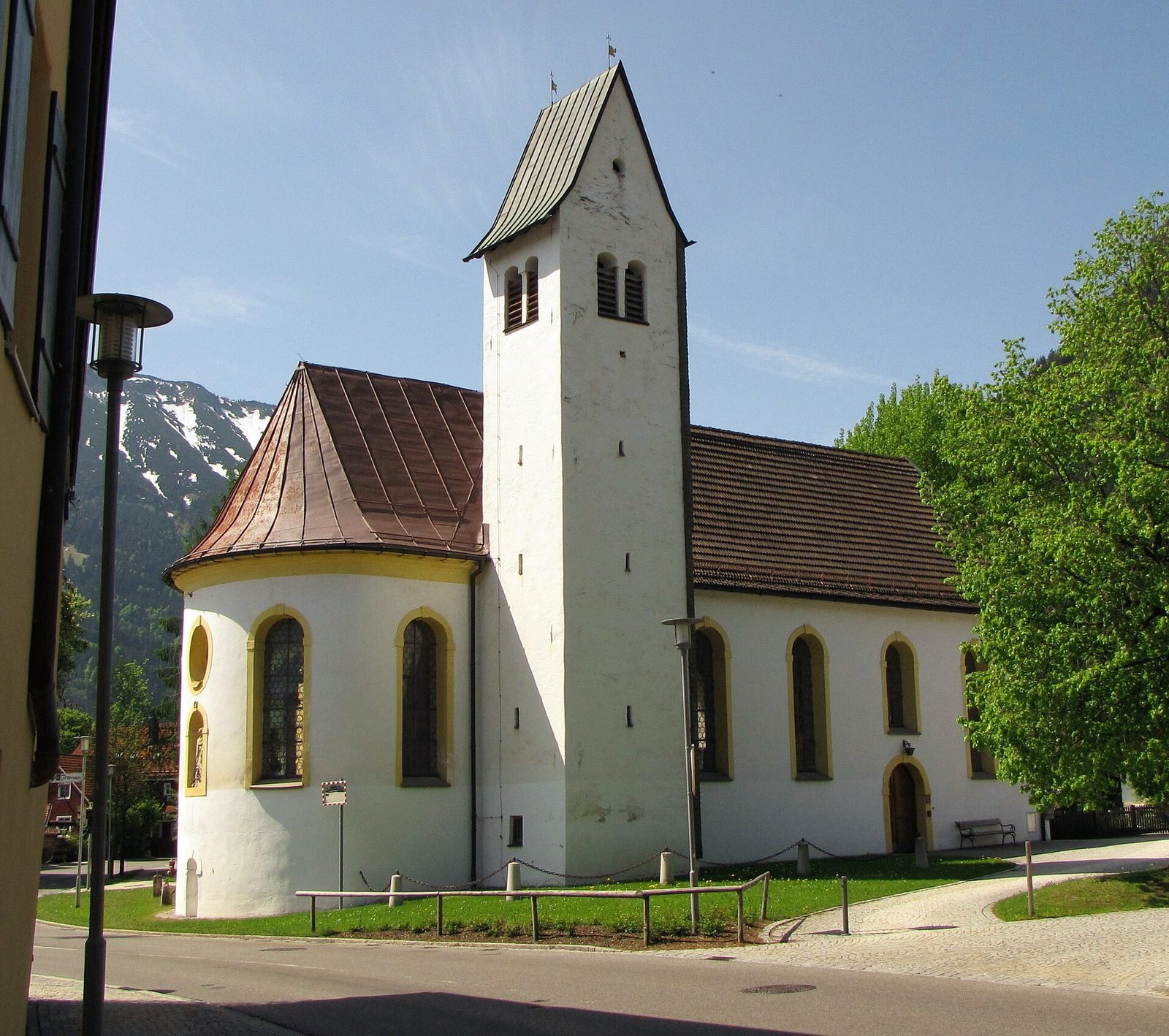
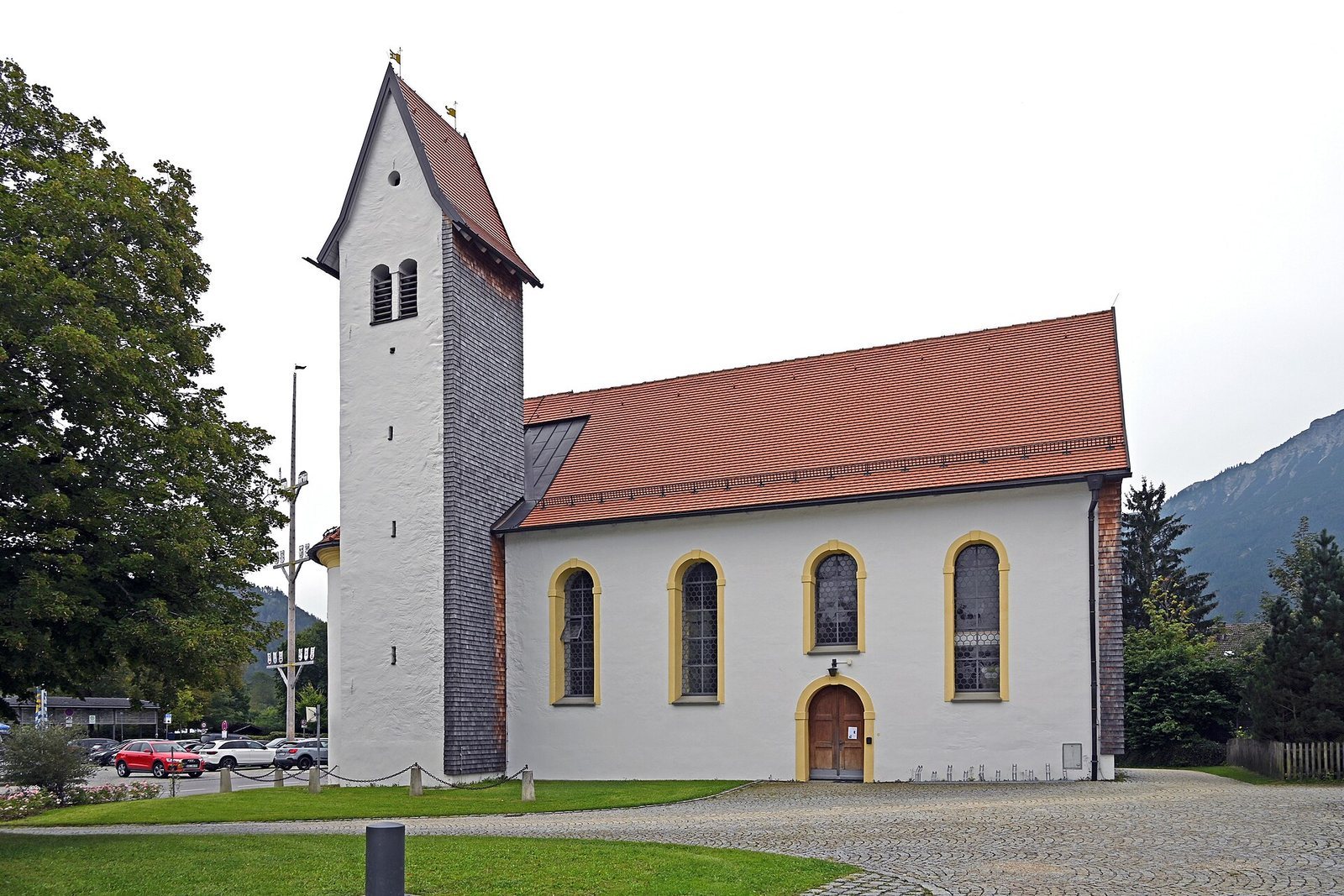
The church’s plan centers on a nave (the main body of the church) with four window sections, opening into a narrower choir (the area around the altar) with two sections and a semicircular end. An elevated gallery occupies the rear. The church was once smaller, and its enclosing walls and the oldest masonry in the tower date to about 1423. The tower reached its current height in 1641. A nave ceiling painting shows an onion-shaped roof as a proposed design, rather than confirming that it was built. A small walled cemetery also belonged to the church.
Painted and sculpted interior
Frescoes
The choir fresco presents St. Leonhard as a protector of prisoners, shown chained inside a dungeon. It is probably the work of a painter from Pfronten. The nave ceiling paintings were made by Johann Heel, half-brother of Peter Heel, and Bonaventura Stapf. Stapf may have painted the rural scenes, while Heel may have completed the other sections. On the gallery’s front, a painted cycle about death, judgment, heaven, and hell has stylistic features associated with Johann Heel.
Stucco and high altar
Peter Heel and his journeyman Magnus Bertle created the elaborate stucco, or decorative plasterwork. Heel also made the high altar, an example of Early Rococo, an ornate European artistic style. Its two columns are decorative elements rather than supports for the structure.
Side altars
Maximilian Hitzelberger carved the side altar figures. The altar frames, in the later High Rococo style, were probably based on designs by Joseph Stapf. The paintings and sculptures honor Francis Xavier, a Jesuit missionary; Francis Solanus, a Franciscan missionary; Francis of Assisi, founder of the Franciscan order; Francis of Paola, founder of the Minim order; and Francis Borgia, a Jesuit leader.
Pulpit
The church’s Rococo pulpit was made by Joseph Stapf. It was originally intended for St. Martin before being brought to St. Leonhard.
Exterior features
Iron chain
An iron chain once ran around the outside of the church, held up by stone posts. By the second half of the 20th century, only remnants remained. During later work, damaged posts on the south side were reset and the chain above them was completed.
North entrance doors
The former north entrance doors had substantial fittings. After their removal, the old door leaves were placed against the end wall of the ice cellar at Heimathaus Pfronten, a local history museum.