Burg Langenegg: A Medieval Hilltop Castle Ruin in Germany


Site at a Glance
- Rating
- 3.8
- Popularity
- Very Low
- Country
- Germany
- Primary era
- Medieval
- Eras represented
- Medieval
- Civilizations
- Holy Roman Empire
- Site type
- Military
- Remains
- Castle
On this page6 sections
History
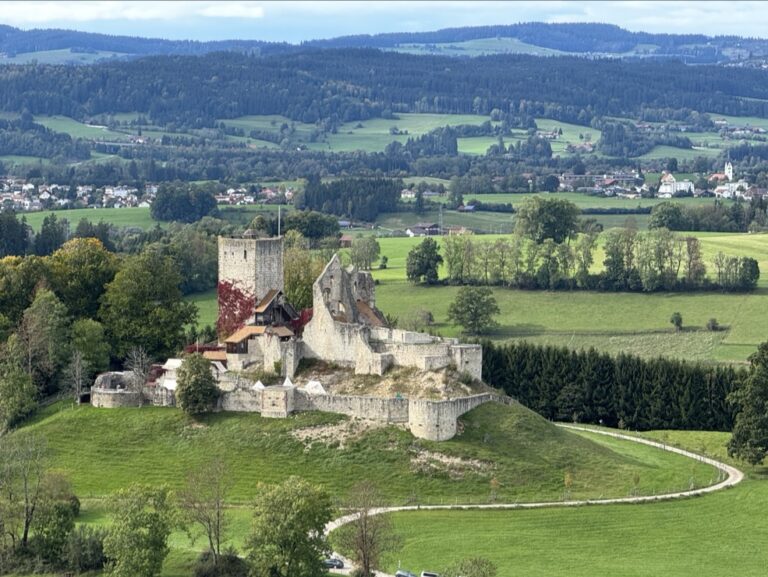
Burg Langenegg is a medieval hilltop castle ruin in Germany, located at Martinszell in Waltenhofen, Bavaria. Its main tower was built around 1250, and the castle became the family seat and political center of three successive noble families in the Allgäu.
The Lords of Langenegg and Rauns
In 1415, the male line of the Lords of Langenegg died out. Through an heiress, the castle passed to the Lords of Rauns. Before their own male line became extinct, they sold part of the complex to Winter, a related patrician of Kempten. A patrician was a member of the wealthy urban elite, often involved in civic, commercial, or political affairs. Winter then adopted the name “von Langenegg.”
Decline under the Prince-Abbey of Kempten
After the death of the last Lord of Langenegg in 1647, the castle reverted to the Prince-Abbot of Kempten, its feudal overlord. A Prince-Abbot governed both a religious foundation and its territory. The castle was subsequently allowed to fall into ruin.
The correctional institution and Anna Schwegelin
From 1734, the Prince-Abbey of Kempten converted the complex into a correctional institution and poorhouse. Such institutions combined the confinement or discipline of inmates with relief for impoverished people. In 1775, Anna Schwegelin’s case began there after she was imprisoned as a vagrant and denounced as a witch by a fellow inmate following a quarrel. The court of the Kempten Prince-Abbey sentenced her to death, but the sentence was not carried out. She died in Kempten prison in 1781 and later became known as the “last witch of Germany.”
The surviving remains are protected in Bavaria as an architectural monument, an archaeological or ground monument, and a natural monument.
Remains
The surviving defensive tower
The castle once occupied a large area on a wooded hill within a loop of the Iller. Its surviving central defensive tower was later used as a residential tower and retains the form of a rectangular structure. The ground plan measures 12.8 by 14.6 metres, while the walls are between 1.3 and 2 metres thick and rise to the height of four former storeys.
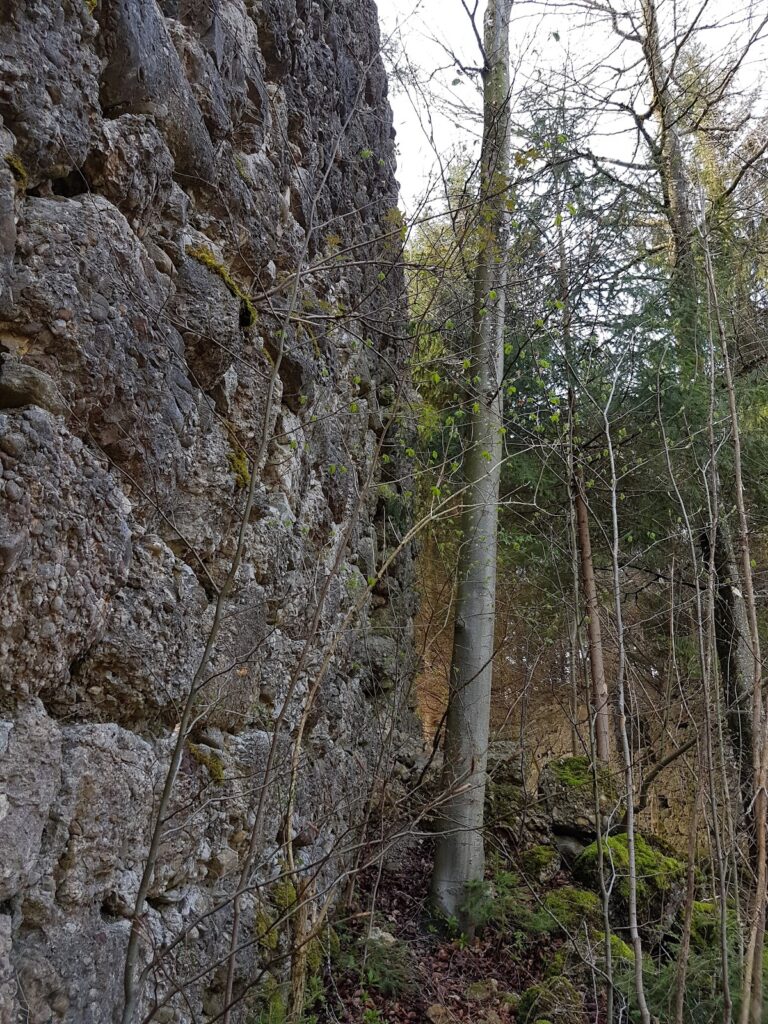
The tower is built from Nagelfluh blocks, a conglomerate rock formed from cemented gravel. It remains as a medieval element of the former castle complex and was structurally secured between 2001 and 2004.