Rotemberk: The Remains of a Medieval Castle in Czechia


Site at a Glance
- Rating
- 3.9
- Popularity
- Very Low
- Country
- Czechia
- Primary era
- Medieval
- Eras represented
- Medieval
- Civilizations
- Holy Roman Empire, Kingdom of Bohemia
- Site type
- Military
- Remains
- Castle
On this page8 sections
History
Rotemberk is an abandoned medieval castle in Czechia, north of Habřina in the Hradec Králové District. Its origins are uncertain, although it may have been established in the first half of the thirteenth century. Archaeological evidence securely places the castle in the fourteenth and fifteenth centuries, while an isolated sherd may point to activity in the thirteenth century.
Origins and Earlier Settlement
Rotemberk, also known as Rotmberk and Neznašov, may have replaced the older Vražba Castle after that site ceased to serve as a residence and administrative centre. Another interpretation connects it with a prehistoric settlement about one kilometre to the south, suggesting that the medieval castle continued an earlier settled location.
The Neznašov Family
The first known owner was Ješek of Neznášov, recorded in 1370 or 1371. The castle remained with his descendants, including Majnuš of Neznášov, Bavor, Petr, and Čeňko, until 1457, when it passed to Čeňko’s widow, Anna. In 1494 it belonged to Bavor of Hustířany. After Bavor’s death, the part of the estate containing the castle went to his son Jiřík, and after Jiřík died it passed to his brother Jan the Elder.
Desertion and Later Protection
Rotemberk was recorded as deserted in 1542. A mill below the castle, then called Podhradní mlýn, preserves an association with the vanished stronghold and has since been converted into a residential building. Archaeological research in 1978 exposed stone and brick wall remains together with pottery from the fourteenth and fifteenth centuries. Since 1964, Rotemberk, the remains of nearby Vražba Castle, and the fortified site at Habřina have been protected together as a cultural monument.
Remains
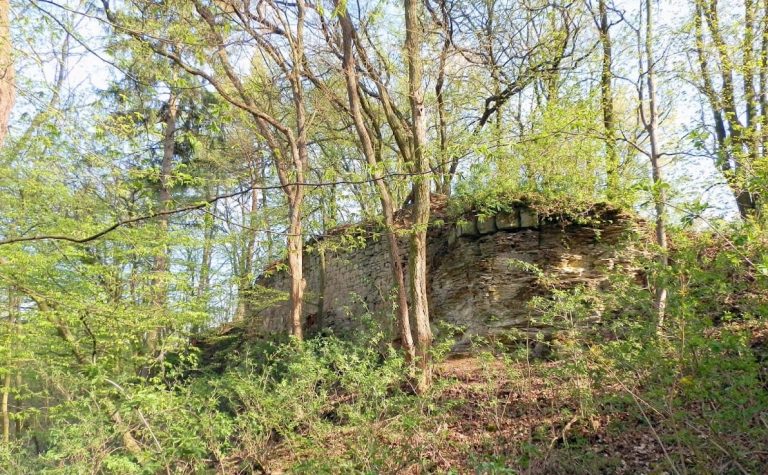
The remains occupy an elongated ridge called Na Hradě, about 300 to 305 metres above sea level, above the left bank of the Hustířanka stream. The spur extends westward, with the castle positioned north of Habřina and west of Neznášov. Agricultural changes have altered the appearance of the site, but its forecourt, ditches, ramparts, and two-part core still indicate the broad arrangement of the medieval stronghold.
Forecourt and Outer Defences
An elongated forecourt extends eastward from the castle core and is divided from it by a neck ditch. The eastern side faced an adjoining plateau and therefore received the strongest defensive works. Traces of fortifications survive along the southern and eastern sides, while steep slopes protected the other approaches. An irregular double rampart enclosed the castle, and another ditch defended the inner core. A faint rampart at the head of the forecourt may predate the medieval castle and may belong to the Lusatian culture, a prehistoric Central European culture associated with the Late Bronze Age and Early Iron Age, or to another prehistoric period.
Castle Core
The two-part castle core was enclosed by the rampart system and inner ditch. A round tower probably stood within the complex. On the southern side, a depression marks a former building with a basement, while a well occupied the southeastern corner. Rotemberk may represent a closed castle, a fortified complex in which perimeter walls retained masonry that fell from higher structures. Over time, this process formed an elevated mound whose surface rose well above the medieval ground level.
Excavated Structures and Materials
Excavation revealed fragments of stone and brick walls and ceramic material dating from the fourteenth and fifteenth centuries. These remains confirm the castle’s medieval occupation, while the surviving earthworks preserve its defensive outline. The precise arrangement and height of the original buildings remain uncertain.