Burg Rettenberg: A Medieval Lords’ Seat in Germany
Site at a Glance
- Rating
- 3.8
- Popularity
- Very Low
- Country
- Germany
- Primary era
- Medieval
- Eras represented
- Medieval
- Civilizations
- Holy Roman Empire
- Site type
- Military
- Remains
- Castle
On this page12 sections
History
Burg Rettenberg, also known as Burg Vorderburg, is a medieval hilltop castle in Germany that probably originated around 1100 as the seat of the Lords of Rettenberg. The castle stood at the centre of a powerful noble family whose influence extended across the Oberallgäu and neighbouring territories.
The Lords of Rettenberg
Adelprecht of Rotinberch appears before 1130 as bailiff of the Augsburg monastery of St. Ulrich and Afra. The Rettenbergs were probably first ministerials, or nobles serving the Welf dynasty, before entering the following of the Staufers around 1185. The Welfs and Staufers were major ruling dynasties in the medieval German kingdom. The Staufers included emperors such as Frederick Barbarossa and exercised broad political influence during the twelfth and thirteenth centuries.
During the twelfth century, the Lords of Trauchburg and Hohenegg branched off from the Rettenberg family. The Rettenbergs themselves became the most important noble family in the Oberallgäu, holding the bailiwicks of numerous monasteries. Their possessions extended beyond their ancestral castle to other castle sites in present-day Swabia and the neighbouring Tyrolean Außerfern, including Vilsegg, Eisenberg, Nesselburg, and Burgberg. Lesser noble families, among them Maiselstein, Burgegg, Hindelang, Wertach, and Haslach, belonged to their following and held seats in the surrounding area.
The family also held land in the Kleinwalsertal. During the fourteenth century, the Counts of Rettenberg granted this territory to Walser settlers as hereditary fiefs. These grants formed part of the family’s wider control of land and dependent relationships in the region.
Transfer to Augsburg
Around 1350, Heinrich of Rettenberg died without a male heir. His daughters divided the inheritance. Elisabeth, the wife of Georg of Starkenberg, received the lordship of Rettenberg, while her sister Adelheid of Waldburg received the lordship of Burgberg. The sisters sold their inherited shares in the following year.
The lordship of Rettenberg passed to the Prince-Bishopric of Augsburg for 1,600 pounds in Constance currency. The Prince-Bishopric of Augsburg was an ecclesiastical principality ruled by the bishop of Augsburg. The comparatively low price was probably connected with Graf Wilhelm of Kirchberg’s challenge to the inheritance. Augsburg installed an administrator at the castle, supported by a local official and a scribe. Around 1385, the prince-bishopric temporarily pawned the lordship, but redeemed the pledge before 1400.
War, restoration, and fire
In 1525, during the German Peasants’ War, peasants from the Rettenberg administrative district joined the Allgäu League, an alliance formed by peasants during the uprising. Gunpowder used by the insurgents came partly from Burg Rettenberg, which was apparently plundered. After the rebels were defeated at Leubas, the Swabian League, the military association that defeated many insurgent forces in the region, stored the defeated forces’ weapons at Burg Rettenberg and Fluhenstein.
The castle steward, Andreas of Hohenegg, took part on 25 October in negotiating the Martinszell Treaty, which ended the fighting in the territory of the Prince-Abbey of Kempten. In 1534, the fortress was restored under the steward Hans of Hohenegg of Vilsegg. The great hall in the main building received panelling, the roofs were re-covered, and the interior and exterior walls were plastered.
On 12 September 1562, the castle was almost completely burned out after a drunken cook caused a fire. The steward Marquard of Schwendi reportedly lost his household goods and two horses. Because a complete rebuilding was considered too expensive, the Prince-Bishopric of Augsburg commissioned only essential repairs.
Decline as an administrative centre
The seat of the Augsburg administrative office was later moved to nearby Burgberg. Burg Rettenberg nevertheless retained a ceremonial role. When the Augsburg bishop visited his administrative district in 1573, his subjects paid homage on the meadow before the castle. In 1650, Rudolf of Rechberg, an Augsburg cathedral canon administering the bishopric for its underage bishop, received an elaborate welcome below the burned-out ruins while touring the Augsburg administrative offices.
In 1735, the Prince-Bishopric of Augsburg transferred administration of the lordship to a new office building in Vorderburg. About fifty years later, the castle’s residential tower was described as partly collapsed. In 1802–03, the Rettenberg administrative district, together with the rest of the Prince-Bishopric of Augsburg, passed to the Electorate of Bavaria.
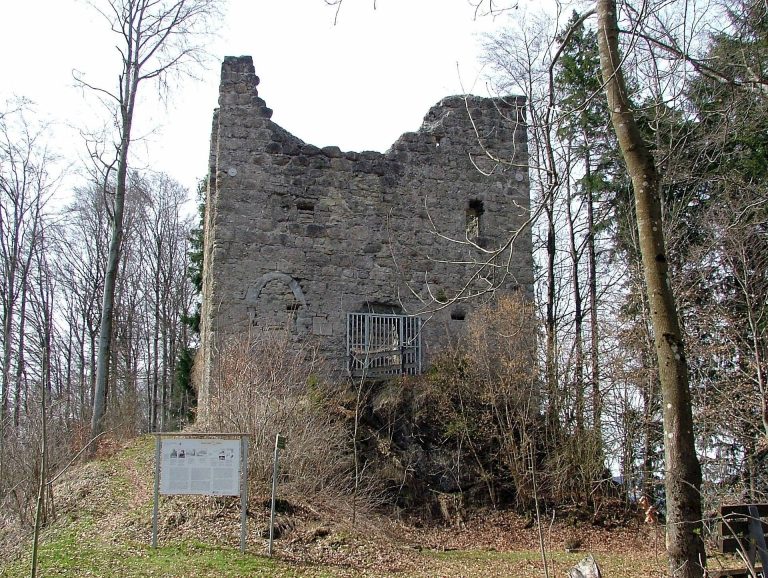
Since early 2013, extensive closure has followed the danger posed by falling masonry. The surviving walls remain severely endangered, and substantial conservation work has not become evident. The ruin therefore faces the prospect of complete loss in the medium term.
Remains
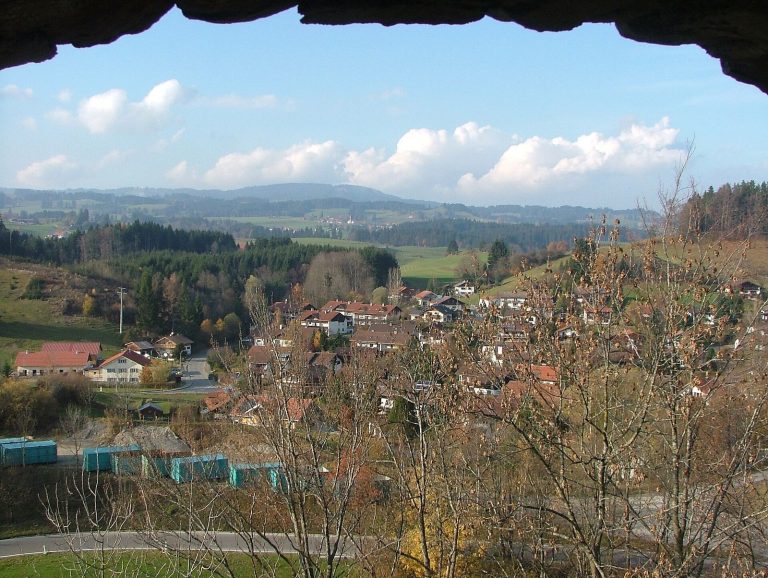
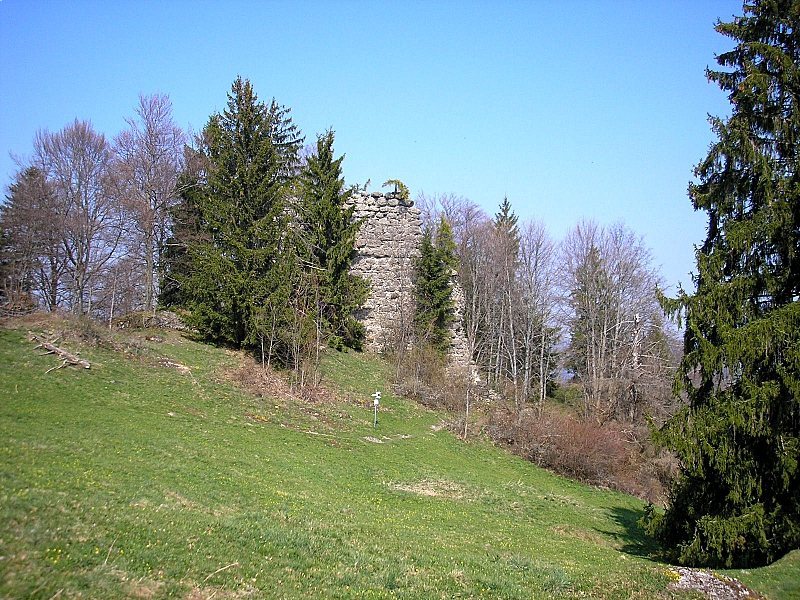
Burg Rettenberg is a spur castle, a fortification built on a projecting ridge and protected by its slopes and cliffs. It occupies a rocky summit at about 1,020 metres above sea level, at the northern end of the Rottachberg ridge and approximately 600 metres northwest of Großdorf. The spur overlooks the Iller valley, about 300 metres below it, while a high valley borders the Rottachberg to the east.
Main castle
Walls and defensive position
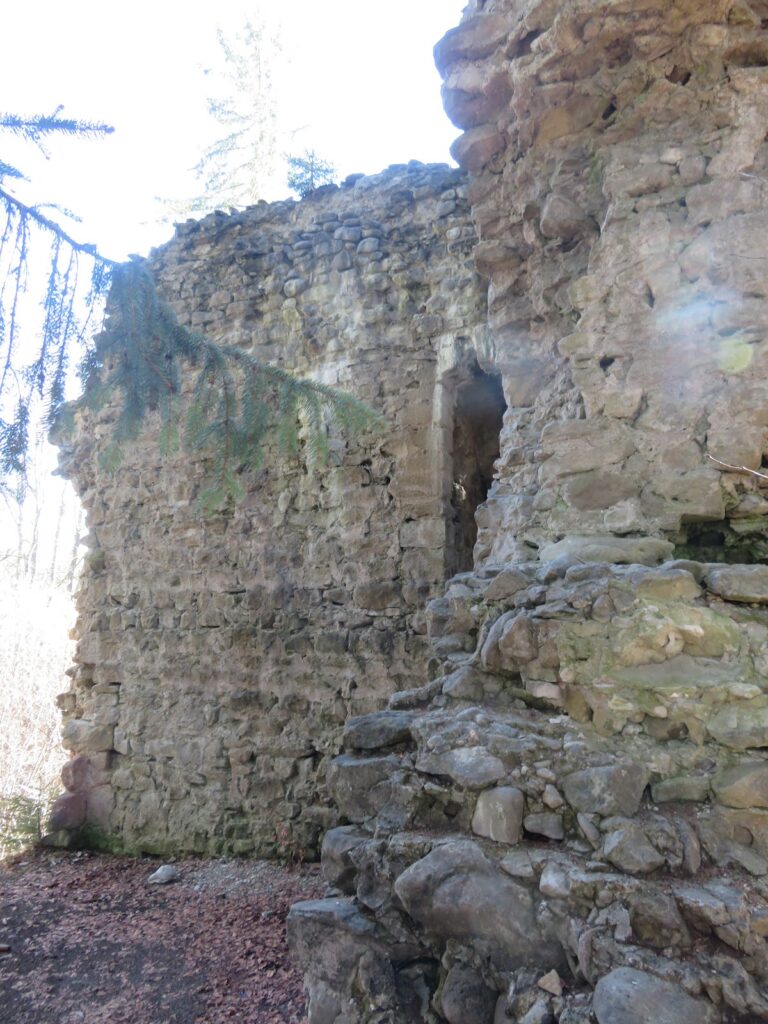
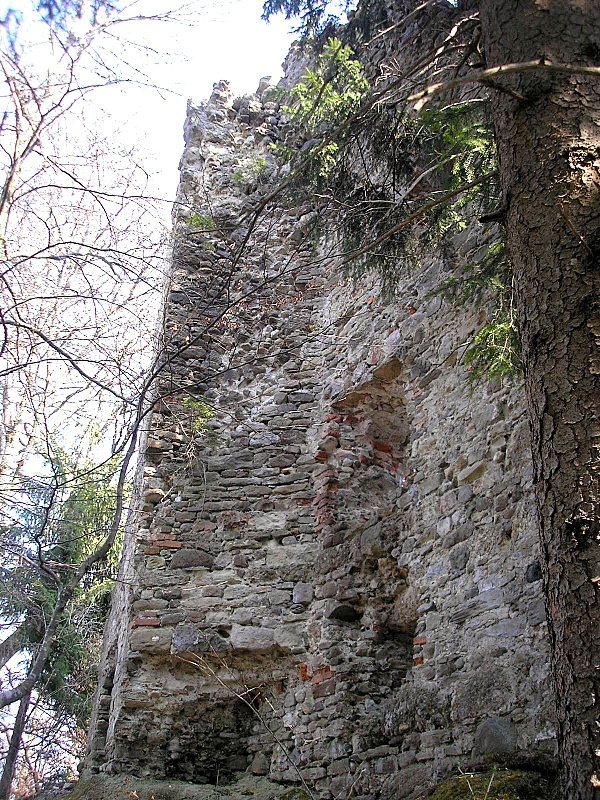
The main castle occupies an approximately square rocky summit measuring about 30 by 30 metres. The southern and western sides retain parts of the principal enclosure. The southern wall, about 18 metres long and facing the direction of attack, is windowless. The western wall extends for about 9 metres and contains several window openings. A near-vertical rock face strengthens the western approach, and the western building corner is rounded.
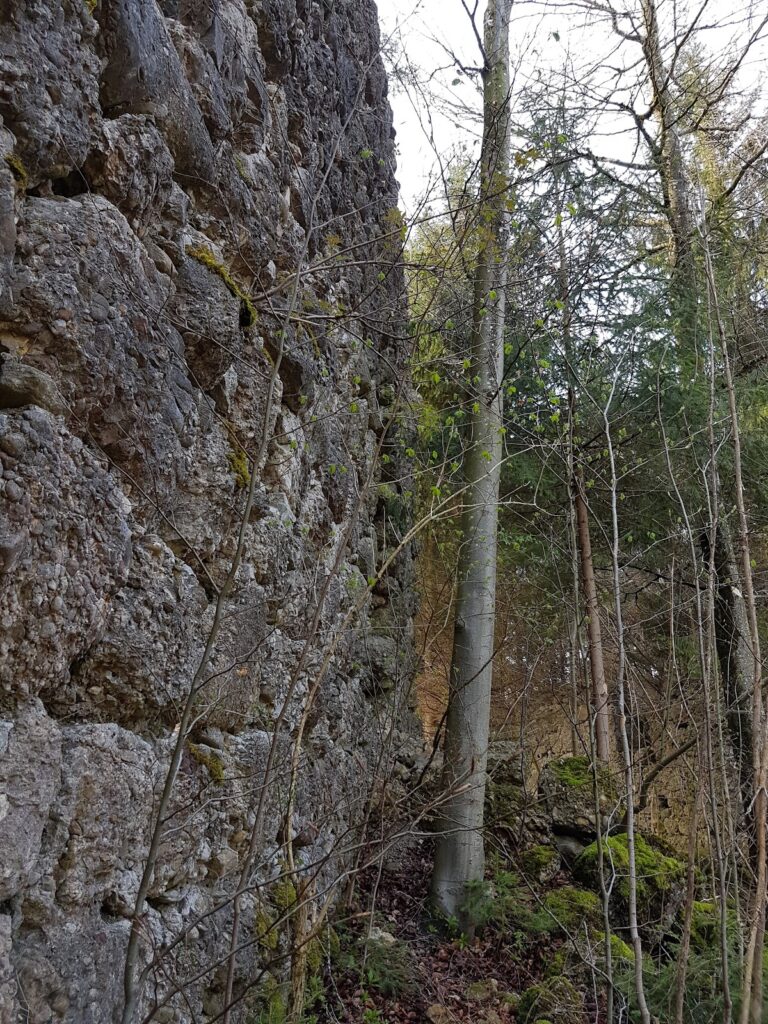
The surviving masonry rises to about 9 metres. The ruin is now formed mainly by two high wall sections in a severely endangered condition. The outer shell consists of large blocks of locally available Nagelfluh, a conglomerate of rounded stones cemented together, with smaller rubble used in parts of the joints. Narrow sandstone slabs were inserted between some courses. Nagelfluh forms much of the Rottachberg and occurs there with other rock types.
Residential tower and internal rooms
The main castle apparently centred on a single powerful residential tower or tower house. A 1562–63 estimate provides the basis for reconstructing the building before the fire. It had a cellar partly cut into the rock, three storeys above it, and a steep roof that included a grain store. Each storey contained a large hall measuring approximately 10 by 20 metres, enclosed by massive walls.
Smaller chambers with timber-frame walls, made from wooden structural frames with infill between the members, were attached to the internal dividing walls along the outer shell. Service and economic rooms occupied the ground floor. The middle level contained the administrative rooms of the Rettenberg office. The steward lived on the upper floor, which also held the representative great hall known as the “large Soller.” A spiral staircase led to the attic. Beside the entrance stood a panelled chapel and a stable for horses.
Entrance and outer defences
Gate enclosure
A narrow gate zwinger, or fortified entrance enclosure placed before a gate, projected to the southeast of the main building. Its position formed part of the approach to the residential tower and helped organize access to the summit. The southern wall and its gate were recorded in two drawings made by the draftsman Georg Weidenkeller in 1837. The drawings are held in the Kempten City Archive.
Outer bailey
A small outer bailey, or secondary fortified court, probably occupied the plateau to the southwest. Slight traces in the terrain preserve evidence of this part of the castle’s organization, extending the defended complex beyond the principal rocky summit.