Castle of Silvano Pietra: A Medieval Fortification in Italy

Site at a Glance
- Rating
- 4.5
- Popularity
- Very Low
- Country
- Italy
- Primary era
- Medieval
- External website
- Open
- Eras represented
- Medieval, Early Modern
- Civilizations
- Duchy of Milan
- Site type
- Military
- Remains
- Castle
On this page7 sections
History
Beccaria foundation
Castle of Silvano Pietra is a medieval fortification in Italy, located in the village of Silvano Pietra in Lombardy. Built for defense, it was begun in 1329 by the Beccaria, an aristocratic Ghibelline family of Pavia. The Ghibellines were the faction traditionally associated with support for the Holy Roman Emperor in medieval Italy, in opposition to the pro-papal Guelphs. Construction continued through the fourteenth century, and the castle was used as a prison during its early years.
The village remained under Beccaria control during the fourteenth century. The family was represented by Manfredo, a Beccaria leader described as the conqueror of Mortara and Novara and the founder of the branch connected with San Gaudenzio, Mortara, and Silvano. An inscription cut into the original fourteenth-century wall reads “Prijonie,” supporting the castle’s early association with imprisonment.
Changes of lordship
The fief, a territory held by a feudal lord in return for service or allegiance, changed hands several times after the Beccaria period. In 1468 it passed to the Bottigella of Pavia, and the village was subsequently known as Silvano Bottigella. The fief was removed from their control by 1483 and briefly passed to the Sanseverino.
In 1528 the fief was granted to Brunorio Pietra, a ducal minister. His descendants retained it until 1797, when feudalism was abolished and the Pietra family’s feudal tenure ended.
Remains
Castle complex
Plan and interior
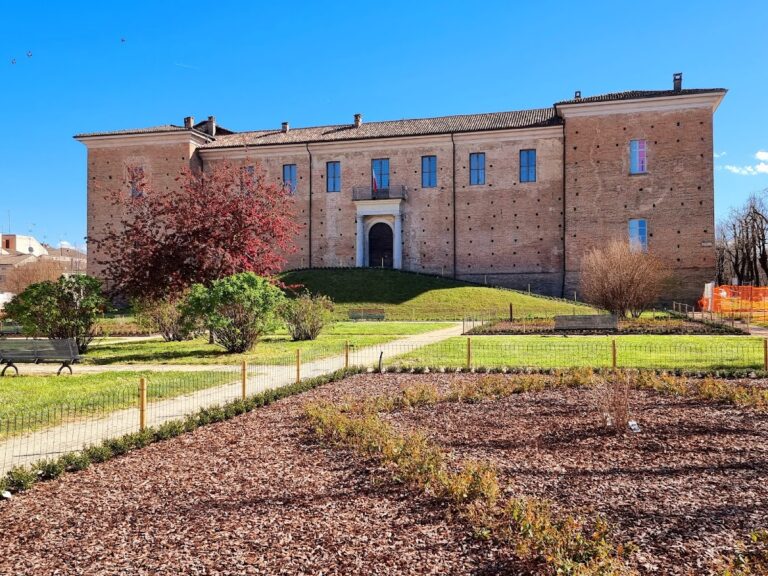
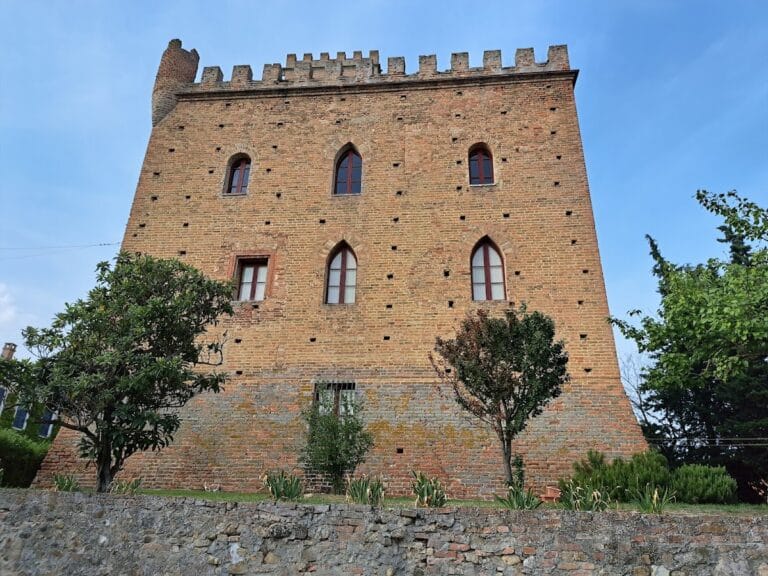
The castle stands at the center of Silvano Pietra, at approximately 83 metres above sea level, in the open Po Plain a few kilometres from the right bank of the Po and between the Staffora and Curone streams. Its surviving complex has a U-shaped plan and is built of brick. Pointed-arch windows, single-light windows, pointed arches, and round arches form its principal architectural features. The interior preserves frescoes dating from 1400 to 1600.
Tower and belfry
The most recognizable portion of the original masonry is the tower rising above the village square. It retains traces of a drawbridge, although only its lower section belongs to the castle tower. A later raising forms the upper section and carries a belfry, the structure that houses bells. The building now serves as the village bell tower. The castle probably originally had three towers measuring 35, 27, and 25 metres in height, while the surviving building is in good condition.