Castello di Barengo: A Fortified Residence in Northern Italy


Site at a Glance
- Rating
- 3.9
- Popularity
- Very Low
- Country
- Italy
- Primary era
- Medieval
- External website
- Open
- Eras represented
- Medieval, Early Modern, Modern
- Civilizations
- Duchy of Milan, Holy Roman Empire
- Site type
- Military
- Remains
- Castle
On this page9 sections
History
Castello di Barengo is a fortified residence at Barengo in northern Italy, standing on a hill above the surrounding plain along an old route linking the Via Francigena, a major medieval pilgrimage and travel road to Rome, with fords on the Sesia River. Its foundation date and original circumstances are uncertain, but the site became part of the town’s fortified history during the fourteenth century.
The fourteenth-century stronghold
The first documented reference to a castrum, meaning a fortified settlement or stronghold, dates from the fourteenth century. At that time, Barengo was moved from the bank of the Agogna River to the foot of the hill. The fortified settlement occupied the elevated position that later accommodated the castle complex.
Its defenses helped Barengo withstand devastation and looting during the wars between Giovanni II of Montferrat and Galeazzo II Visconti in 1358 and 1362. Giovanni II was the marquis of Montferrat, while Galeazzo II ruled the Visconti lordship in northern Italy. Their rivalry shaped the conflicts that reached the settlement.
The Tornielli residence
The present fortified residence was created in the second half of the fifteenth century, at the same time as the castle of Briona. In 1449, Briona, Barengo, and Maggiora became a fief of the Tornielli family, a prominent noble house. Count Giovanni Zanardo began the new construction within the earlier castrum, and his son Melchiorre continued the work.
The building combined military functions with those of a comfortable country residence. After Melchiorre died in 1487, ownership was divided among his younger sons rather than passing to his eldest son, Manfredo, as it did at Briona. This division shaped the later history of the property.
Alteration and restoration
The fifteenth-century structure underwent many changes and was already partly ruined at the beginning of the nineteenth century. A restoration carried out in 1849 altered its original arrangement. During the first postwar period, ownership passed to Count Gaudenzio Tornielli of Borgolavezzaro, who commissioned the architect Carlo Nigra to reconstruct the complex in forms modeled on medieval architecture.
The Boroli family later undertook further restoration and are identified as the current owners. Castello di Barengo is recognized as an Italian cultural-property site.
Remains
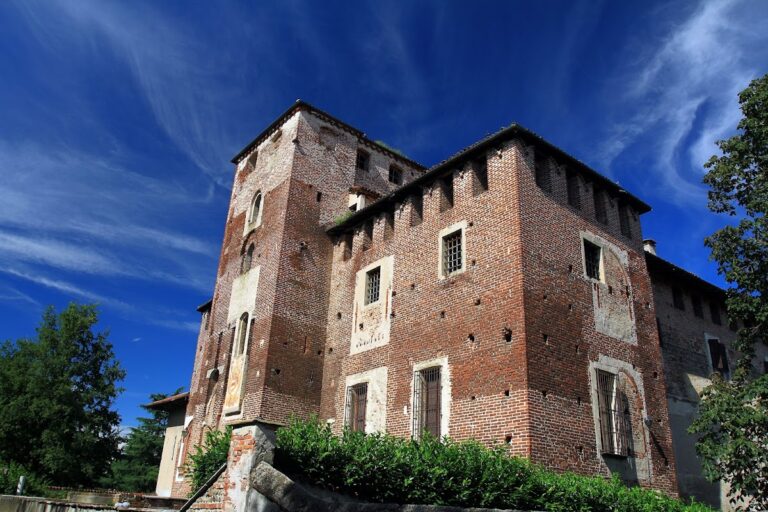
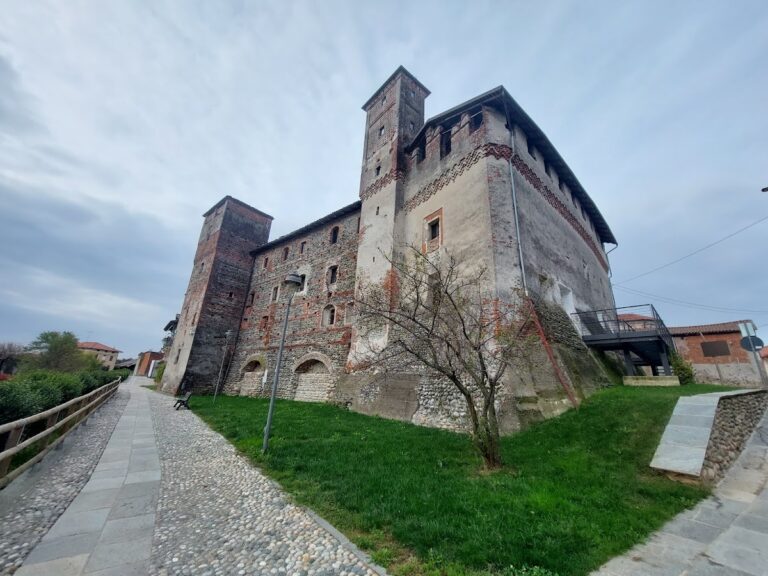
The complex occupies the northern part of the earlier fortified settlement and originally covered about one-third of its area. Built almost entirely of brick, it centers on a trapezoidal main building whose eastern and western sides run parallel, while the southern side is inclined to provide more sunlight to the interior rooms. The entrance lay on the northeastern side, beyond a moat and reached by a drawbridge.
Fortified residence
Walls, foundations, and entrances
Later reconstruction changed the appearance and arrangement of the residence, but rampart walls, foundations, and several entrance doors preserve evidence of its original construction. Two corner towers formerly occupied the western side facing the hill, forming part of the initial defensive design.
Garden within the defenses
A large garden extends inside the southern perimeter walls. Its centuries-old plants occupy an enclosed area that remains part of the fortified complex.
Palace-villa
At the base of the fortress, beside the parish church, stands a palace-villa that once belonged to a junior branch of the Tornielli family. The rectangular building has three storeys arranged around a large central courtyard. Its eastern side includes a three-bay loggia, while a small dovecote tower rises at the southeastern corner. The villa’s present appearance is principally the result of restoration in the eighteenth century.