Heukelum Castle: A Medieval Fortress and Later Residence in the Netherlands


Site at a Glance
- Rating
- 4.2
- Popularity
- Very Low
- Country
- Netherlands
- Primary era
- Early Modern
- External website
- Open
- Eras represented
- Medieval, Early Modern
- Civilizations
- Dutch
- Site type
- Domestic
- Remains
- Castle
On this page10 sections
History
Heukelum Castle is a fortress and later residence in the Netherlands, east of Heukelum, whose origins are associated with the Lords of Arkel around 1280. Also known as Merckenburg, it formed part of a network of nine strongholds along the border between Holland and Gelderland. The castle expressed the authority of its noble owners and was traditionally linked to an apparition of the archangel Gabriel to Jan van Arkel, who is identified with its foundation.
Foundation and medieval conflicts
The original fortress was destroyed and rebuilt during the fourteenth century. It survived the Wars of Arkel, a regional conflict in the Low Countries fought between 1401 and 1412. Other strongholds in the same defensive group, including Hagerstein and Everstein, were destroyed during the first decade of the fifteenth century.
Destruction and rebuilding
From 1567, Heukelum Castle belonged to the De Thiennes family, Counts of Rumbeke. French troops besieged the castle in 1672, looted it, and demolished it, leaving the gate tower standing. A double moat was laid out around the surviving tower in 1732. Two years later, the remains passed to Johan van der Stel, who commissioned a new residence partly within the former courtyard and partly on the foundations of the medieval castle. The new building probably incorporated the surviving thirteenth-century tower.
Later ownership and protection
The Van Gennep family acquired the castle in 1788 and occupied it until 1813. Adriaan Cornelis Fabricius, a justice of the peace from Amsterdam, then acquired the estate and had all the building’s windows renewed in 1821. The Fabricius family retained ownership until 1988. A major flood in the 1920s led to the construction of an embankment on the castle island. Heukelum Castle and its associated estate are protected as a Dutch national monument, a legal designation for a building, site, or landscape recognized for cultural and historical value. The protection includes several outbuildings, the surrounding park, and the avenue layout. During restoration of the retaining walls in 2003, the outline of the medieval northeastern round tower was found and partly rebuilt.
Remains
Castle island and approach
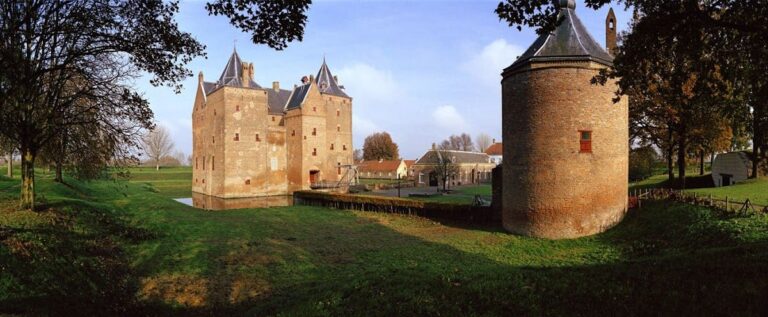
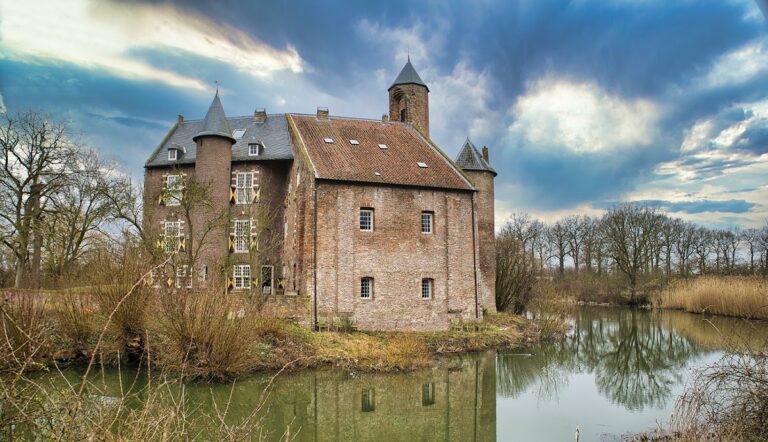
Heukelum Castle stands on the southern bank of the Linge, landward of the Lingedijk, between Heukelum and Asperen and about one kilometre from each town centre. The present building is a square or quadrangular structure made of brick, stone, and wood. It is surrounded by a broad moat and reached by a drawbridge. The medieval complex was enclosed by two moats, with a gatehouse between them. The moat immediately around the castle survives, together with remains of the outer moat.
Medieval structures
Courtyard and western hall
The medieval castle consisted of four wings arranged around a courtyard. A hall occupied the western side, while the later residence was built partly within this former courtyard and partly over the medieval foundations. A small museum occupies the basement of the present building and contains rare coins formerly used in Heukelum.
Towers and gate tower
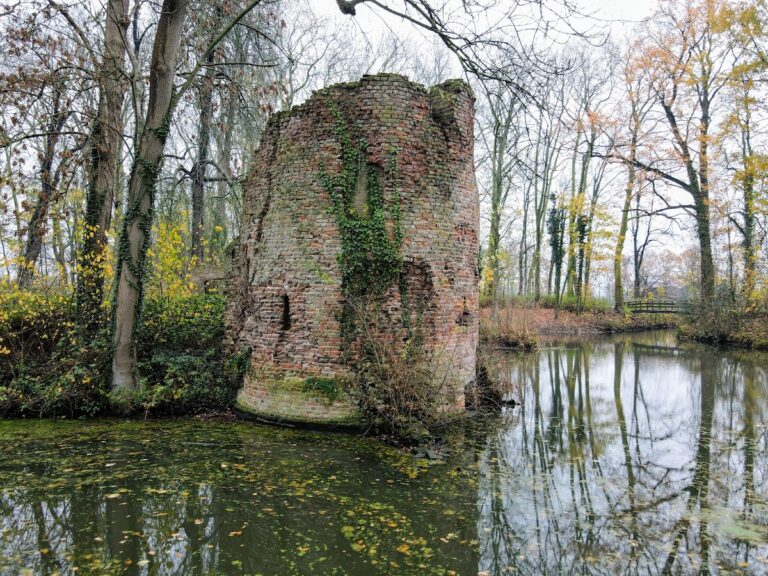
A substantial round tower stood at the northeastern corner of the medieval complex, and a gate tower occupied its southern side. The surviving gate tower remained after the seventeenth-century demolition. The outline of the northeastern round tower was revealed during work on the retaining walls in 2003, after which part of the tower was reconstructed.
Park and avenue system
Two outbuildings stood outside the castle, and a park laid out in the eighteenth and nineteenth centuries surrounds the house. An avenue from Heidensweg toward the Lingedijk turns at the castle and approaches the drawbridge directly. It continues beyond the castle toward the Asperense waterway on the eastern side. The avenue is documented as existing since the Middle Ages. The road and embankment system, with open spaces between the castle and Heukelum, appears on Jacob van Deventer’s map of around 1560 and remains in existence. The castle tower and the church tower face one another.