Burg Hütting: A Medieval Castle Ruin in Germany


Site at a Glance
- Rating
- 4.3
- Popularity
- Very Low
- Country
- Germany
- Primary era
- Medieval
- Eras represented
- Medieval
- Civilizations
- Holy Roman Empire
- Site type
- Military
- Remains
- Castle
On this page6 sections
History
Burg Hütting is a high- to late-medieval castle ruin in Germany, above Hütting, a district of Rennertshofen in Upper Bavaria. The castle was established around 1060 by the Counts of Lechsgemünd, a medieval comital family associated with the region around the Lech and Danube. Built on a steep rocky ridge at the entrance to the Wellheim Dry Valley, it occupied a defensible position overlooking the surrounding landscape.
The Lords of Hütting
Administration of the castle was entrusted to a ministerial family. A ministerial was a dependent noble or administrative official who served a higher lord, often managing estates or castles. The family later adopted the name Hütting, and the Lords of Hütting held the castle rock until around 1342.
After the death of the last count, the county passed to the dukes of Bavaria. The dukes used the lordship several times as a pledge, reflecting its place within the changing territorial administration of the Bavarian ducal lands.
Destruction and later conservation
Around 1421 to 1422, Burg Hütting was burned during one of the conflicts between the Bavarian partial duchies, separate territories ruled by different branches of the Bavarian ducal house. The castle was then abandoned. In the following centuries, villagers used the ruins as a convenient source of stone. The last surviving section of the ring wall collapsed in the nineteenth century, while the remaining part of the palas, the principal residential building of a medieval castle, was conserved at the end of the twentieth century.
The ruins are protected as an architectural monument and are also listed as an archaeological monument. The castle rock is additionally recognized as a significant geotope, a geologically important natural feature valued for scientific, educational, or conservation purposes. Together with nearby Wellheim Castle, Burg Hütting is among the lesser-known Bavarian fortifications and has only rarely been discussed in specialist literature.
Remains
Burg Hütting is a spur castle, built on a projecting ridge, at an elevation of about 440 metres above sea level on the limestone Jura massif. The ridge extends eastward, while the castle rock falls almost vertically into the valley to the north, south, and east. The approach is therefore possible only from the west. The main castle and its outer bailey were divided by a partly levelled section ditch, while a second neck ditch in front of the outer bailey has also been largely levelled.
Main castle
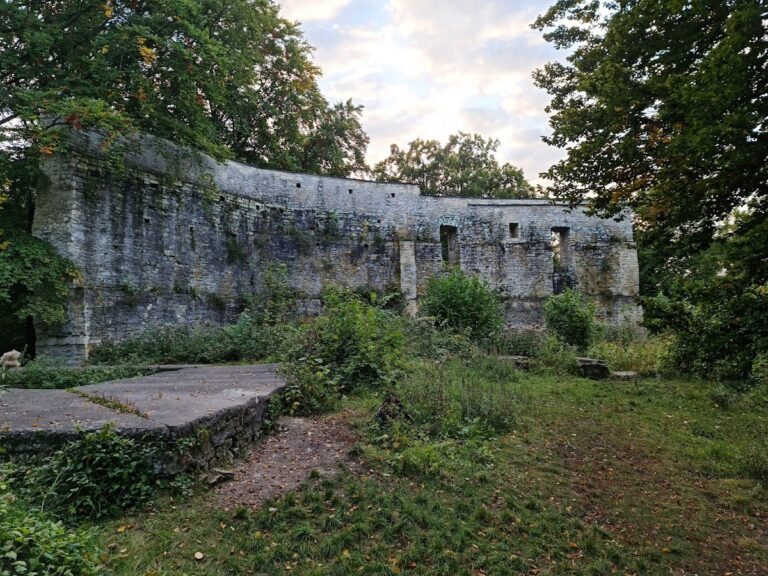
The main castle appears to have consisted chiefly of a small residential tower or palas on the rocky summit. Only the eastern wall and the southeastern corner of the principal building survive. The eastern wall is approximately seven to eight metres high and contains five window openings. Its masonry is about one metre thick and is made of irregular rubble stone. Other remains of the main castle survive mainly as traces in the terrain.
Outer bailey
A small outer bailey, a subordinate fortified enclosure outside the main castle, occupied the ground west of the summit. The foundations of an approximately square building can still be traced there. Its position beyond the section ditch formed part of the castle’s divided arrangement, with the residential center on the rocky high point and the subordinate enclosure farther along the ridge.