Schloss Lautenbach: Historic Estate Castle in Germany


Site at a Glance
- Rating
- 4.9
- Popularity
- Very Low
- Country
- Germany
- Primary era
- Modern
- External website
- Open
- Eras represented
- Early Modern, Modern
- Civilizations
- German, Holy Roman Empire
- Site type
- Domestic
- Remains
- Castle
On this page11 sections
History
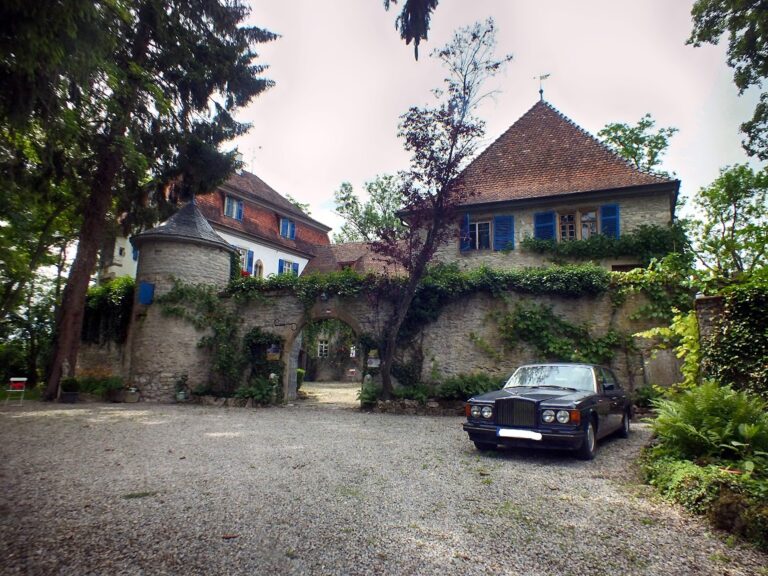
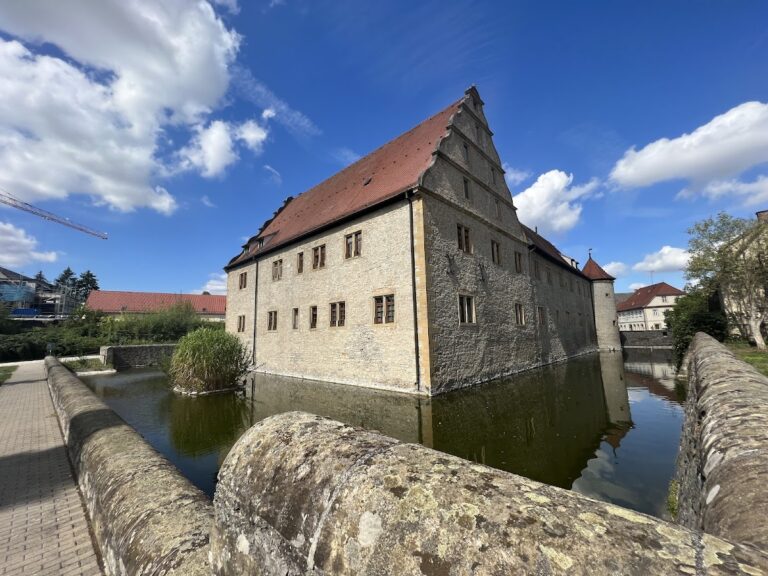
Schloss Lautenbach is a historic estate castle in Germany, at Lautenbach near Oedheim. Its architectural core derives from buildings of the seventeenth or eighteenth century, while its present appearance took shape in the nineteenth-century Neo-Renaissance, a style that revived Renaissance forms through ordered façades and historicizing ornament. The castle formed part of an estate with its own territory, farms, residences, and agricultural lands.
Early settlement and medieval ownership
The Lautenbach area preserves evidence of Mesolithic settlement, including pottery fragments, a flint knife, and a grave. North of the present estate, Neolithic remains include a settlement with pottery fragments, tools, and burial mounds. The name Lautenbach first appears in 1254 in connection with Lichtenstern Abbey, while a village is mentioned in 1335. In that year, Engelhard VII of Weinsberg sold the lordship of Scheuerberg, including the Lautenbach territory, to the Archbishopric of Mainz.
Lautenbach passed to Hans von Sickingen in 1467 and reached the Teutonic Order in 1484 through an exchange. The Teutonic Order was a medieval religious and military order that controlled estates in central Europe, including agricultural and administrative properties. The village was destroyed sometime afterward, possibly during the German Peasants’ War, and its inhabitants moved to Oedheim and Dahenfeld. Fourteenth-century landholders had also included the Wimpfen collegiate foundation, Schöntal Abbey, the lords of Sindringen, and the Capler family of Oedheim.
From village to divided farms
After the village disappeared, the territory was described as two hamlets or farms, the Lautenbacher Hof and the Mönchhof, also known as the Helmstadter Hof. The Lautenbacher Hof remained under the Teutonic Order until 1687, whereas the Mönchhof changed ownership several times.
In 1419, Philipp von Wittstatt received the Mönchhof from the Count Palatine as a reward for loyal service. He sold it in 1490 to the Carmelite monastery in Heilbronn. A Carmelite monastery was a Catholic religious house whose members combined communal religious life with pastoral and scholarly work. The monastery renovated the farm and later leased it to officials of the Teutonic Order’s Scheuerberg district.
Philipp’s son Wilhelm von Wittstatt unsuccessfully sought the farm’s return in 1525. The Carmelites sold it in 1537 for 2,500 gulden to Eberhard von Gemmingen of Bürg. It then passed by inheritance to Reinhard von Gemmingen and his son Hans Wilhelm von Gemmingen. After Hans Wilhelm’s death, his daughters Helena Elisabeth and Maria Felicitas inherited it.
War, restoration, and the 1687 sale
The sisters pledged the farm to the Teutonic Order. When interest payments stopped in 1631, the Order occupied it completely during the Thirty Years’ War, a prolonged European conflict. Helena Elisabeth had fled to Worms with her husband, Georg Philipp von Helmstatt. After his death in 1634, she returned to the Heilbronn region. Her second husband, Karl Friedrich von Helmstatt, unsuccessfully sought restitution in 1643, and their cousin Weiprecht von Gemmingen made another unsuccessful claim after the Peace of Westphalia.
Around 1664, the Teutonic Order restored the two farms and united them. On 18 August 1687, citing poor returns, it sold the entire Lautenbach territory to the later Heilbronn mayor Johann Esaias von Rühle.
The Frederking and Heilbronn periods
In 1726, Lautenbach passed by inheritance to Johanna Elisabeth von Rühle, widow of the Prussian chief war commissioner Daniel Heinrich Frederking, and later to their son, Imperial Lieutenant Colonel Johann Friedrich von Frederking. Through land purchases and substantial investment, the Frederking family brought the estate to economic prosperity, and Lautenbach came to be regarded as a model agricultural enterprise.
Beginning in 1747, the Teutonic Order contested the 1687 sale in a prolonged legal dispute. The Imperial Chamber Court at Wetzlar ruled in favor of the Frederking family on 9 June 1777. By then, however, the family had sold Lautenbach to the city of Heilbronn on 14 January 1772. Georg Heinrich von Roßkampff represented the city in the transaction, and Heilbronn leased the farms from 1772 to 1823. In 1780, the Lautenbach territory covered 926 morgen of land.
The von Wächter estate
After proposed sales in 1814 and 1818 failed, Legation Councillor August Heinrich Christoph von Wächter acquired Lautenbach on 1 August 1823 for 75,000 gulden. His son, Johann August Freiherr von Wächter, applied in 1855 for Lautenbach to be incorporated into the municipality of Oedheim so that he could obtain Oedheim civic rights. Lautenbach and Willenbach became a submunicipality with its own territorial district in 1860, a status that continued until 1936.
The von Wächter family held hunting rights in the territories of Lautenbach, Willenbach, and Oedheim. Under its administration, the estate continued to prosper as a progressive agricultural operation. Johann August Freiherr von Wächter supported the Bethesda children’s health resort in Jagstfeld and organized an annual children’s festival. In 1860, he founded a foundation for a new school, whose assets were later used to build Oedheim’s Backhaus School in 1909.
The von Wächter family transferred the farm to the Mennonite tenant Heinrich Landes in 1869. After his death in 1886, his family continued to operate the property for four generations. A first tractor entered service in 1923, followed by a steam plough in 1925. The estate eventually included about 240 hectares of cultivated land and facilities for 300 fattening pigs. It is no longer operated as a farm.
After the estate was leased, its owners lived mainly in Stuttgart but returned to their country residence during the summer. Freifrau Josephine von Wächter, born Lee, was widowed in 1879. Her sister Mary Esther married Count Alfred von Waldersee at Lautenbach in 1874, and he later visited Schloss Lautenbach several times with his wife. Josephine and August von Wächter’s children were Wilhelmine Pauline Blanche and Oleg-Ludwig, also called Louis, von Wächter-Lautenbach. Blanche married Julius Friedrich Eli Freiherr von Palm, a Württemberg chamberlain and cavalry captain, at Lautenbach on 2 October 1879.
When Blanche von Palm died on 15 November 1941, she was the last representative of the von Wächter family. The property then passed to the Freiherr von Palm heirs’ community in Künzelsau. During the von Wächter period, Schloss Lautenbach and the estate buildings were renovated and embellished, giving the castle its present Neo-Renaissance character. The field road to Oedheim was also upgraded to a permanent road in 1856.
Remains
Estate complex
Schloss Lautenbach stands beside the watercourse of the same name as part of a wider estate complex. The castle’s building core belongs to the seventeenth or eighteenth century, while later work produced its Neo-Renaissance appearance. Residential and farm buildings are also arranged within the estate and were renovated and ornamentally improved under the von Wächter family.
Castle
The castle combines an older building core with nineteenth-century historicizing treatment. Its present form reflects the period when the von Wächter family invested in the estate and developed the residence as the centre of a prosperous country property.
Park and avenues
The grounds were shaped into a park-like landscape containing a pavilion and avenues of trees. These landscaped elements form part of the estate’s residential setting alongside the castle and its agricultural buildings.
Agricultural buildings and land
The agricultural complex supported a substantial operation. In 1843, the estate included 4,226 fruit trees, 131 cattle, and 203 sheep, with 18 permanent workers and numerous day laborers from surrounding communities. In its later phase, the Lautenbacher Hof encompassed approximately 240 hectares of cultivated land and facilities for about 300 fattening pigs. The estate’s farming activity has since ended.