Castle of Ruesta: A Medieval Defensive Enclave in Spain


Site at a Glance
- Rating
- 4.4
- Popularity
- Very Low
- Country
- Spain
- Primary era
- Medieval
- External website
- Open
- Eras represented
- Medieval
- Civilizations
- Kingdom of Navarre
- Site type
- Military
- Remains
- Castle
On this page8 sections
History
Castle of Ruesta is an 11th-century fortress in Spain, located in the uninhabited village of Ruesta in Zaragoza Province. Built as one of Aragon’s four defensive enclaves, it occupied a strategic position on the eastern frontier and guarded territory contested by the kingdoms of Navarre and Aragon.
Navarrese frontier fortress
After the kings of Navarre expanded eastward from about 850, a castle was established at Ruesta to defend the conquered territory. Between 905 and 925, it already served as the seat of a royal territorial holding responsible for protecting the areas of Yesa and Arrés. Its position gave the fortress an administrative as well as military purpose.
The military commander Almanzor, the commonly used name of Muhammad ibn Abi Amir and the de facto ruler of the Caliphate of Córdoba, destroyed the castle between 996 and 999 during a campaign against the eastern frontier. His operations followed tensions involving the king of Navarre and Catalan counts, who were believed to be attempting to stop paying tribute to Córdoba.
Rebuilding and transfer to Aragon
Sancho Garcés III of Pamplona rebuilt the castle between 1016 and 1018. Pamplona was the medieval kingdom also known as Navarre, and Sancho’s reconstruction restored the fortress after its destruction under Almanzor. Following Sancho Garcés III’s death, the castle was granted to his successor on the Navarrese throne.
In 1056, Sancho Garcés IV of Pamplona, king of Navarre, granted the town of Ruesta to his uncle Ramiro I, an early king of Aragon. The castle subsequently remained in Aragonese hands. Its later administration included the local Jewish community, which was recorded in 1294 as guarding and managing both the castle and its oven.
In 1381, Pedro IV of Aragon sold the castles and settlements of Ruesta, Artieda, Pintano, and Osia to Pedro Jordán de Urriés, lord of Ayerbe and Sigüés. The sale of the settlements and castles of Ruesta was temporarily revoked in 1385. The castle received protected cultural-heritage status in Spain on 22 May 2006, under a declaration whose resolution was dated 17 April 2006.
Remains
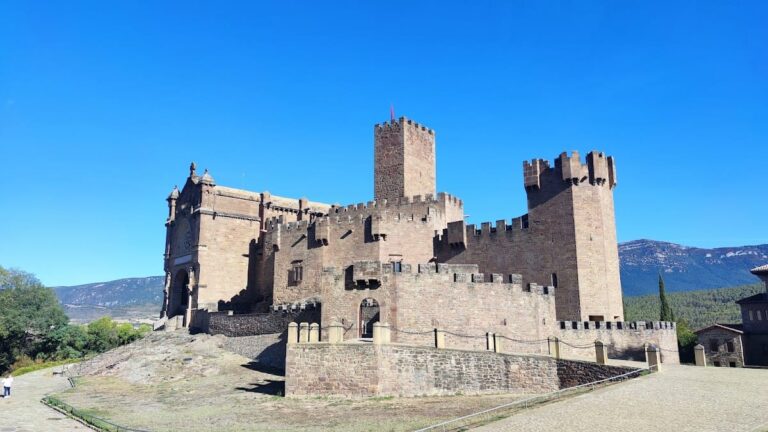
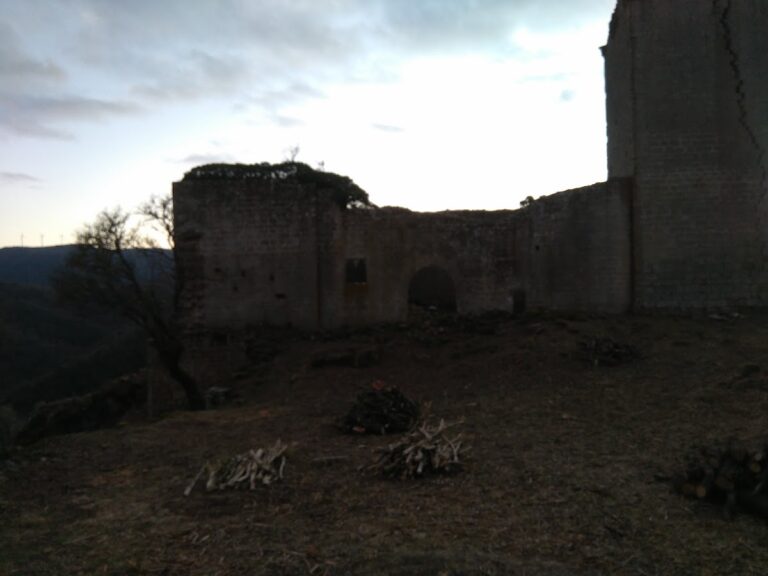
The castle occupied a rectangular enclosure measuring approximately 45 by 20 metres. Two towers of different sizes survive, connected by a wall whose preserved upper sections retain part of their crenellations, the regularly spaced raised sections along a defensive wall or tower.
Fortified enclosure
The enclosing wall defined the castle’s rectangular plan and linked the two surviving towers into a single defensive structure. Portions of the crenellated tops remain, giving evidence of the defensive arrangement along the wall and towers.
Surviving towers
The keep
The keep, the principal fortified tower of the castle, was the taller and more robust of the two towers. It is preserved only in part, with its upper section lost and the remaining structure in ruins. Its original height is estimated at about 25 metres, and it is thought to have contained four floors. The former entrance doorway is still preserved.
The smaller tower
The second surviving tower is smaller and may have had a rectangular plan. It remains joined to the keep by the surviving wall, forming part of the castle’s principal defensive group.