Twizell Castle: A Medieval Tower House and Unfinished Gothic Revival Mansion


Site at a Glance
- Rating
- 4.2
- Popularity
- Very Low
- Country
- United Kingdom
- Primary era
- Early Modern
- Eras represented
- Medieval, Early Modern
- Civilizations
- British, English
- Site type
- Domestic
- Remains
- Castle
On this page6 sections
History
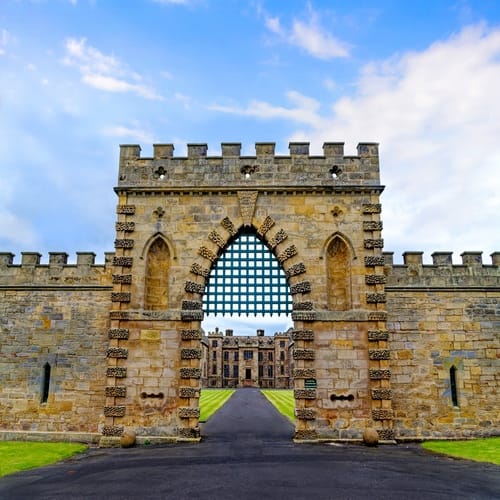
Twizell Castle is a medieval tower house site and unfinished Gothic Revival mansion in the United Kingdom, at Tillmouth Park in Northumberland. A tower house stood here by 1415, when it was held by Sir John Heron, a local landholder. The later mansion was begun from about 1770 in the Gothic Revival style, an architectural movement that revived medieval forms such as towers and castle-like compositions.
Medieval Tower House
In 1496, a Scottish army led by James IV of Scotland and accompanied by Perkin Warbeck destroyed the tower house. James IV, who had been king of Scotland since 1488, returned to Twizell on 24 August 1513 while preparing to besiege Norham Castle. He held a council or parliament at Twizell during that campaign.
The Heron estate passed to a member of the Selby family through a sale made around 1520. A survey in 1561 described the surviving remnants of the tower house and a barmkin, a fortified enclosure around a residence. John Selby appears to have repaired the buildings. An inventory made after his death in 1595 listed a new chamber, a gallery, and chambers within the tower.
The Blake Estate and Gothic Revival Project
Sir Francis Blake purchased the estate from the Selby widow in 1685 for £1,944 and a £100 annuity. Blake died in 1718, while the Blake family continued to live at Twizell until 1738, when they moved to nearby Tillmouth Hall.
From about 1770, another Sir Francis Blake, who died in 1780, worked to recreate Twizell as a Gothic Revival mansion. The project continued for about forty years but was never completed. After the Blakes built a new mansion at Tillmouth Park in 1882, much of the unfinished castle was demolished. Its stone was reused in the new construction or sold.
Twizell Castle is a Grade II* listed building, a designation for a structure of particular importance with more than special architectural or historic interest. It is also a Scheduled Ancient Monument, meaning that it has legal protection as an archaeological or historic site of national importance in England. The property was placed on the English Heritage Heritage at Risk Register in 2008 and was in poor condition.
Remains
Twizell Castle stands on a bend of the River Till at approximately 39 metres above sea level, within predominantly flat agricultural surroundings. Twizell Bridge, a medieval bridge spanning the river, lies below the castle. The gardens contain earthwork remains of the deserted medieval village of Twizell, extending the archaeological setting beyond the surviving buildings.
Medieval Fabric and Setting
The visible medieval fabric consists of blocked windows, a chamfered doorway, and the original quoins at the north-east angle. These surviving elements belong to the earlier tower-house phase and remain within the later castle setting.
Unfinished Gothic Revival Mansion
The eighteenth-century project survives as a large rectangular ruin with circular towers at its angles and two wings on the north side. It was designed to rise to five levels but remains as a two-storey folly, a deliberately picturesque building whose principal purpose is ornamental rather than practical. Basement rooms in the main block contain stone and brick vaults, constructed as a precaution against fire.