Radcliffe Tower: The Surviving Tower of a Medieval Manor House


Site at a Glance
- Rating
- 4.3
- Popularity
- Very Low
- Country
- United Kingdom
- Primary era
- Medieval
- External website
- Open
- Eras represented
- Medieval
- Civilizations
- English
- Site type
- Domestic
- Remains
- Castle
On this page6 sections
History
Radcliffe Tower is the surviving tower of a medieval manor house in Radcliffe, United Kingdom. The manor complex was established by Nicholas de Radeclive in the late eleventh or early twelfth century, and James de Radcliffe, lord of the manor, substantially rebuilt it in 1403.
Medieval manor and fortification
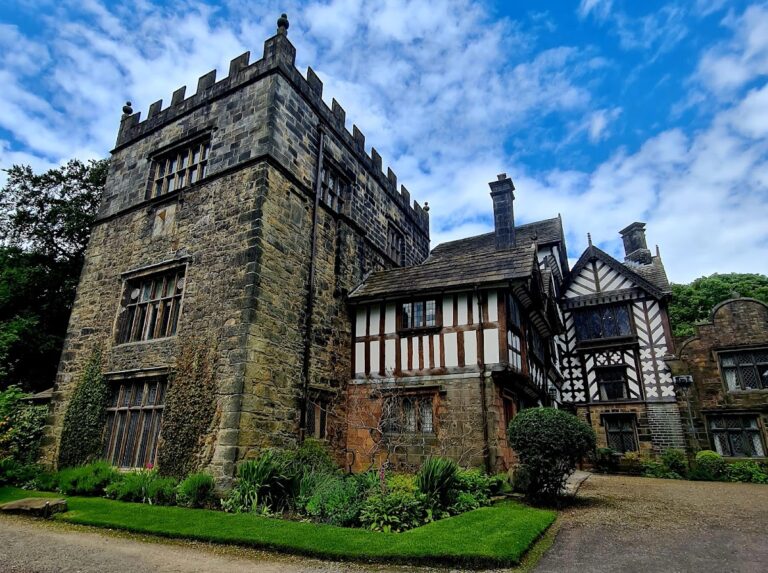
The rebuilt complex contained a principal hall and one or two towers, together with parkland. Its construction combined stone-built and timber-framed elements. The surviving tower was probably built from ashlar, regularly cut stone blocks laid in even courses. After James de Radcliffe obtained a royal licence to fortify the site, the tower received crenellations, the raised sections and open gaps along a defensive wall, together with battlements.
The Radcliffe family were the local landholding family associated with the manor. As lord of the manor, James de Radcliffe held the estate and exercised authority over it. The complex formed part of the medieval landed landscape of Radcliffe, historically in Lancashire and now within the Metropolitan Borough of Bury, Greater Manchester.
Demolition and preservation
By 1833, the former great hall was being used as a barn and cowshed, while the tower served as a pigsty. The timber framing had apparently been infilled with brick, and substantial black-oak beams and boards from the manor were reused elsewhere. The structure was abandoned in 1844 and later deteriorated. During the nineteenth century, the hall and other parts of the manor were demolished, leaving the tower as the sole surviving part of the complex.
The remains were acquired by Bury Council and the ruin was later restored. Plans developed in 2009 placed the tower within a wider project involving Radcliffe E’es, Close Park, and the parish church of St Mary. Archaeological excavations funded by the Heritage Lottery Fund have taken place since 2012. Radcliffe Tower is owned by Bury Council, protected as a scheduled monument under United Kingdom law, and designated a Grade I listed building, the highest level of listing protection in England. The tower received its Grade I listing in 1966.
Remains
The surviving ruin is a rectangular tower measuring approximately 10 metres by 17 metres and standing about 6 metres high. It represents one part of a larger manor arrangement that included a principal hall, one or two towers, parkland, and both stone-built and timber-framed construction. The former hall lies approximately 100 metres southwest of the parish church of St Mary. The tower is also about 3.3 kilometres south of Bury Castle, a late-fifteenth-century moated manor house.
Surviving tower
The tower was probably constructed from ashlar blocks. Its licensed defensive character was expressed through crenellations and battlements along the top. The remaining structure is a restored ruin, while its rectangular dimensions preserve the scale and basic form of this surviving part of the manor house.
Former manor and archaeological finds
The wider site includes the location of the former great hall, whose later agricultural use as a barn and cowshed formed part of the manor’s changing physical history. Excavations since 2012 have brought fifteenth-century medieval glazed floor tiles, roof tiles, and pottery to light. These finds relate to the period when James de Radcliffe’s rebuilt manor complex was in use.