Pleujouse Castle: A Medieval Fortified Castle in Switzerland


Site at a Glance
- Rating
- 4.6
- Popularity
- Low
- Country
- Switzerland
- Primary era
- Medieval
- External website
- Open
- Eras represented
- Medieval
- Civilizations
- Holy Roman Empire
- Site type
- Military
- Remains
- Castle
On this page6 sections
History
Pleujouse Castle is a medieval fortified castle in Switzerland, built of stone around 1100 and associated with Lutfridus as its builder. It served first as the residence of the local lord, while the village of Pleujouse developed around it. The name Pleujouse appears in written records in 1105, when it referred to a noble family that owned the fortress, linking the history of the castle, its lords, and the settlement for several centuries.
Lordship and Medieval Ownership
During the thirteenth century, the castle came under the authority of the Bishopric of Basel, a Christian ecclesiastical jurisdiction governed by a bishop. It later passed through the hands of several powerful families and counts, including the Mörsbergs, the counts of Fribourg, the counts of Neuchâtel, and the counts of Ortenburg.
Jean d’Ulrich d’Asuel, a medieval noble associated with Asuel, held Pleujouse Castle from 1380. He was killed at the Battle of Sempach, a major fourteenth-century conflict, after which the castle reverted to his lord, Jean de Vienne.
Decline, Restoration, and Later Use
After the widow of the last Ortenburg owner died, the fortress entered a period of decline from 1660 and stood in ruins by the seventeenth century. During the French Revolution, it was sold as national property. The Association for the Conservation of Pleujouse Castle, a Jura historical society, acquired it in 1924.
A fire in January 1980 destroyed part of the castle and its valuable furnishings. The building was subsequently restored and reconstructed with the involvement of the Canton of Jura. In 1988, it was converted into a restaurant. Pleujouse Castle is classified as a class B protected property and recognized as a Swiss cultural property of regional significance.
Legend of Alie d’Asuel
Pleujouse Castle is associated with the legend of Alie d’Asuel, known as the “White Lady,” and her lover, Huson de Pleujouse. The story says that Alie’s father’s men killed the couple as they tried to flee after the announcement of her impending marriage to Count Robert de Malroche, lord of Lorraine.
According to the same tradition, the lovers lie beneath a mound topped by a wooden cross on the road from the castle toward the village of Charmoille. They are said to return at midnight four times a year and walk by moonlight.
Remains
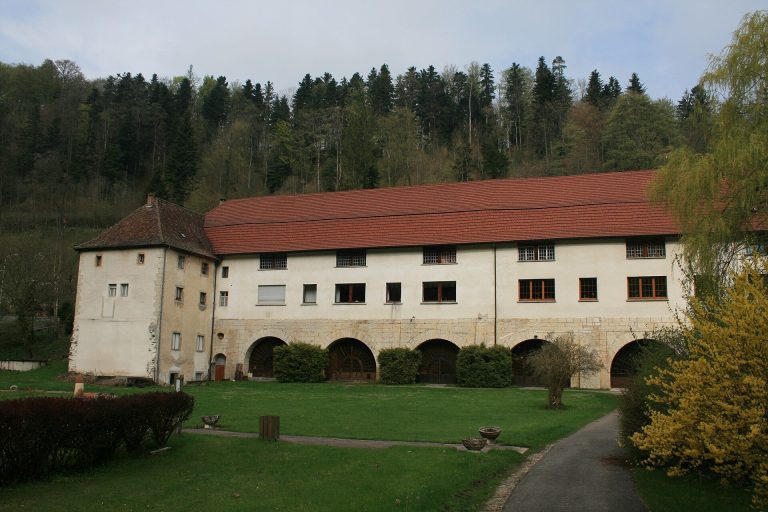
Pleujouse Castle survives as a partially reconstructed medieval stone fortress. Its physical remains include a tower rising 9 metres, with an observation platform positioned 7.5 metres above the ground. The castle was partly destroyed by the 1980 fire, and the later rebuilding shaped its present form.
Castle Tower
The tower’s observation platform is reached by 37 steps and overlooks the villages of Pleujouse and Fregiécourt. The restored castle building now accommodates a restaurant, giving the surviving fortress a continuing use within the reconstructed structure.