Former Premonstratensian Abbey and Abbey Church: A Baroque Monastic Complex in Switzerland


Site at a Glance
- Rating
- 4.2
- Popularity
- Low
- Country
- Switzerland
- Primary era
- Early Modern
- External website
- Open
- Eras represented
- Early Modern
- Civilizations
- Holy Roman Empire
- Site type
- Religious
- Remains
- Monastery
On this page9 sections
History
The Former Premonstratensian Abbey and Abbey Church in Bellelay, Switzerland, was a Catholic monastery of the Premonstratensian order, whose communities combined religious life with pastoral and educational work. Traditionally founded in 1136, it remained active from the twelfth through the eighteenth century, while the present Baroque abbey church was built between 1708 and 1714. Pope Innocent II confirmed the monastery in 1142.
Foundation and medieval lordship
Tradition attributes the foundation to Siginand, provost of Moutier-Grandval Abbey. According to the foundation legend, he became lost in the High Jura while hunting a wild boar and vowed to establish a monastery if he returned safely. He found his way back to Moutier four days later and founded Bellelay. Another tradition credits Adalbero III, Bishop of Basel, with establishing the monastery on the diocese’s southwestern frontier, using land separated from the estates of Moutier-Grandval Abbey.
The name Bellelay is explained in two ways. The legend connects it with a “beautiful sow,” while the historical etymology derives it from the Vulgar Latin bella lagia, meaning “beautiful forest.” The monastery held widely scattered estates and became the mother house of Grandgourt Priory, Gottstatt Abbey, and Himmelspforte Abbey at Grenzach-Wyhlen in Baden-Württemberg.
Bellelay remained under the authority of the Prince-Bishopric of Basel but operated as an autonomous lordship within it. By 1414 at the latest, it had concluded protection agreements with Bern and Solothurn, and in 1516 it reached a similar agreement with Biel. The agreement with Solothurn was renewed repeatedly until the French Revolution.
The abbot exercised low jurisdiction, meaning authority over lesser civil and criminal cases, in both secular and ecclesiastical matters across Bellelay and the surrounding Courtine de Bellelay. At the Council of Constance in 1414, he received the right to use a ring, mitre, and cross, symbols of ecclesiastical and temporal authority. Bellelay was nevertheless apparently never an Imperial abbey.
War, Reformation, and eighteenth-century growth
The monastery buildings were plundered during the Swabian War in 1499. Some local residents adopted the Protestant faith during the Reformation, a movement that divided Western Christianity and created Protestant churches. Bellelay itself was spared the effects of the Thirty Years’ War because of its treaty with Solothurn.
The monastery flourished particularly during the eighteenth century as an educational centre for the sons of European nobility. A boarding institution opened in 1772 and had 62 pupils from across Europe by 1779. A new dormitory wing followed in 1782, and the student population had reached about 100 by 1797.
Cheese production at the abbey is documented from 1192. The cheese now called Tête de Moine was traditionally associated with the abbey’s canons and circulated in the region as a form of payment. Its present name, however, dates only from the nineteenth century. Forty-two abbots are recorded between the foundation of the monastery and its suppression.
Secularization and later uses
French troops occupied the buildings in 1797, and the monastery was secularized. Its valuable furnishings were sold, while an altar from Bellelay was transferred to the parish church of Our Lady of the Assumption in Saignelégier. The former monastic territory became part of France’s Département du Mont-Terrible in 1797. In 1815, Bellelay became part of the Canton of Bern.
During the nineteenth century, the former monastery premises were successively used as a watch factory, brewery, and glassworks. The church was used temporarily as a stable and barn, and the complex passed through varying degrees of decay. The Canton of Bern acquired the site from the bankrupt glassworks for approximately 150,000 Swiss francs around 1890. The buildings were then used as a psychiatric clinic, a function that continued until the end of 2021; the transfer of psychiatric services to Moutier was confirmed in 2022.
The complex is recognized as a heritage site of national significance and is included in the Inventory of Swiss Heritage Sites. Since the late 1960s, the abbey church has also hosted concerts and exhibitions organized by the Fondation de l’Abbatiale de Bellelay. Part of the complex has been used by the Swiss Red Cross for a nursing-assistant training course for refugees.
Remains
The surviving complex consists of the abbey church and associated Baroque monastic buildings, including the dormitory wing added in 1782. Its present form reflects the early eighteenth-century rebuilding as well as later industrial and institutional adaptations. The church preserves Baroque decorative work, reconstructed and historicizing organs, and altars acquired from other churches after the original furnishings were dispersed.
Abbey church
Baroque structure and decoration
Dedicated to the Assumption of the Virgin Mary, the present abbey church was built by Franz Beer between 1708 and 1714 according to the Vorarlberg cathedral scheme, a church-building tradition associated with builders from the Vorarlberg region and known for monumental plans and strongly articulated facades. Two squat towers rise on the western facade. They originally carried onion domes, but their metal covering was stripped in 1801 and sold, after which the twin towers partly deteriorated.
The interior contains painted stucco decoration made by the Wessobrunn School in 1713. This southern German tradition was especially influential in the design of Baroque ecclesiastical interiors. The altars now in the church belong to the same stylistic period as the original altars but were acquired from other churches after the 1797 secularization. The church was restored and reinstated in 1956.
Organs
The former abbey organ, made by Joseph Bossard in 1721, was reconstructed by the Swiss firm Orgelbau Kuhn and inaugurated in 2009. The historically reconstructed main organ has 26 stops distributed across three manuals and pedal, with mechanical action and registration mechanisms. It retains short octaves, an early keyboard arrangement that provides commonly used bass notes within a compact range, in the main, positive, and pedal divisions, as well as subsemitones, additional keys or divisions for selected chromatic pitches, in the manuals. Its Echo division has a reduced compass and one stop. The instrument also has the couplers I/II and II/P and the effect stop “Saint Francois.”
A second Kuhn organ serves the choir. Constructed in 2014, it is a historicizing instrument based largely on the workshop book of the Bossard family of organ builders. It has 15 stops on one manual and pedal, a short low octave, and mechanical action and registration mechanisms.
Monastic buildings
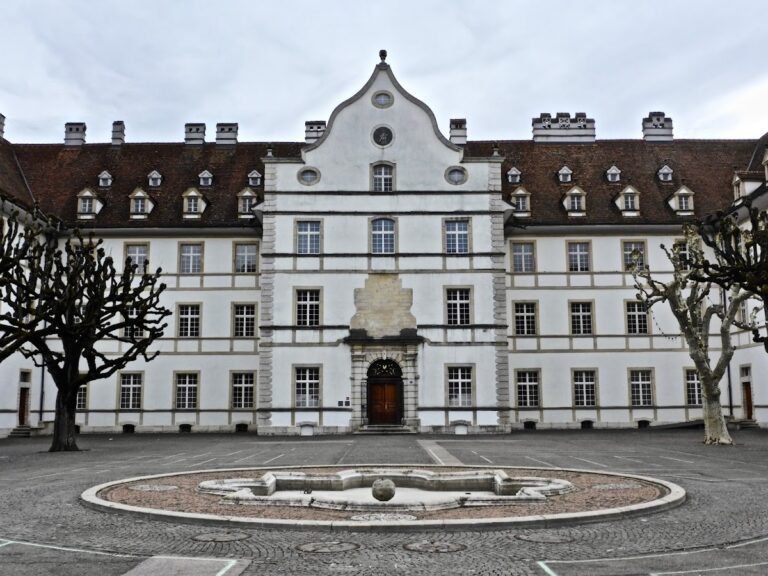
The monastery buildings were constructed or rebuilt in the Baroque style during the early eighteenth century. The complex includes the dormitory wing added in 1782, which belonged to the period when Bellelay operated a boarding institution for pupils from across Europe. Nineteenth-century conversion into a watch factory, brewery, and glassworks altered the buildings’ functions, followed by their later use as a psychiatric clinic.