Castello di Cavernago: A Baroque Noble Residence in Italy


Site at a Glance
- Rating
- 4.4
- Popularity
- Low
- Country
- Italy
- Primary era
- Early Modern
- External website
- Open
- Eras represented
- Medieval, Early Modern
- Civilizations
- Venetian
- Site type
- Domestic
- Remains
- Castle
On this page5 sections
History
Medieval origins and the Colleoni family
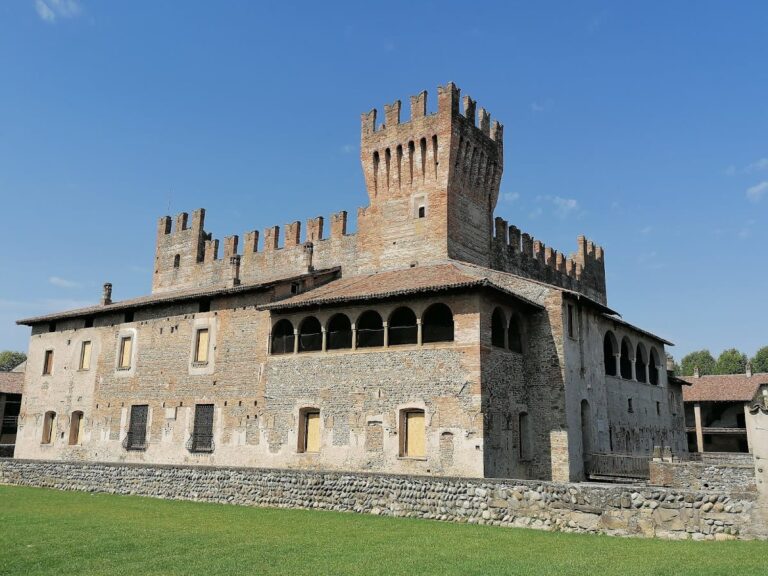
Castello di Cavernago is a historic castle in Cavernago, Italy, whose present construction dates to the seventeenth century and is characterized by Baroque architecture. Its origins reach back to 1243, when the canons of Bergamo Cathedral acquired an ancient structure at Cavernago. The site stood at a strategic crossroads between the provinces of Milan, Bergamo, and Brescia.
In 1470, Bartolomeo Colleoni, a prominent fifteenth-century Italian condottiero, or professional military commander, obtained the structure and its dependencies through a public deed. He then undertook major alterations. After his death, the fief of Cavernago and the castle passed to Gherardo Martinengo-Colleoni, the husband of Colleoni’s daughter Ursina, and to their son Alessandro Martinengo Colleoni.
Rebuilding and later ownership
Francesco Martinengo rebuilt the castle in 1597. The property subsequently passed first to the Giovanelli counts and later to Count Mazzotti Biancinelli. It is now owned by the Gonzaga family of Vescovato, specifically an heir of the Gonzaga prince of Vescovato. The Gonzaga family was an important Italian ruling dynasty associated particularly with Mantua and its surrounding territories. Castello di Cavernago is designated Italian national heritage.
Remains
Baroque residence
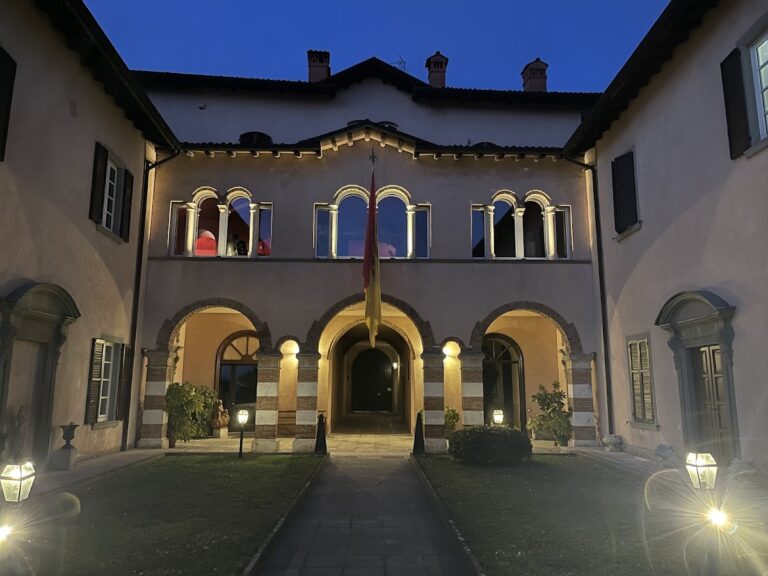
The castle has a square plan, a large courtyard, and a double loggia, a roofed open-sided gallery supported by columns or arches. Its seventeenth-century Baroque character reflects its development as a noble family residence rather than as a military fortress. The building lacks battlements, the raised protective sections of a defensive wall, and a wall-walk, a passage along the top of such a wall. These features distinguish it from the nearby Castle of Malpaga and indicate that domestic comfort shaped its design.
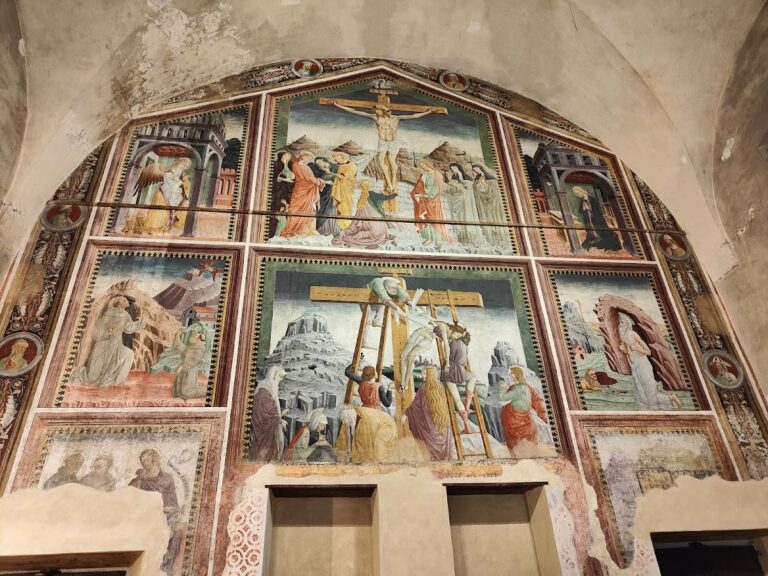
The complex included a drawbridge, a moat that is now dry, a central well, and a large garden. Inside, frescoes cover the walls and ceilings, adding to the architectural character of the residence.