Monastero di Santa Chiara: A Former Poor Clare Monastery in Martinengo
Site at a Glance
- Rating
- 4.4
- Popularity
- Very Low
- Country
- Italy
- Primary era
- Medieval
- Eras represented
- Medieval, Early Modern, Modern
- Civilizations
- Italian, Venetian
- Site type
- Religious
- Remains
- Monastery
On this page11 sections
History
The Monastero di Santa Chiara is a former Poor Clare monastery in Martinengo, Italy, founded in the fifteenth century as part of Bartolomeo Colleoni’s religious foundations. Its surviving church paintings are associated with the early Renaissance in Lombardy, while the complex later became a college, school, library, and cultural center.
Foundation and religious use
In 1471, Bartolomeo Colleoni, a fifteenth-century Italian condottiero, or military commander-for-hire, received authorization from Pope Paul II to establish a male convent and a female convent at Cantone Spineto in Martinengo. The foundations fulfilled a vow connected with the death of his wife, Tisbe Martinengo. Colleoni bought land and buildings for the two institutions in 1472.
Work on the female monastery began in 1474, and Poor Clare nuns from the Monastery of Rosate moved into it in 1479. The Poor Clares are the female branch of the Franciscan tradition founded by Saint Clare of Assisi. On 18 September 1475, Pope Sixtus IV issued a bull granting graces and indulgences to the two institutions, Santa Chiara for the Poor Clares and the Monastery of the Incoronata for the Friars Minor. Both were active before Colleoni’s death.
Suppression and changing uses
Jurisdiction over the convent passed to the Bishop of Bergamo on 26 October 1592. The monastery was suppressed in 1810 under Napoleonic laws and converted into a college and boarding school.
During the Fascist period, major alterations changed the internal arrangement. The dividing wall between the church halls was demolished to create a theater, destroying the church hall. Other rooms were later adapted as a gymnasium and sports facilities. In 1936, the public part of the former church and the courtyard became a memorial to the fallen, with five large arches in Fascist architectural style and a sculptural monument by Giuseppe Siccardi.
Recovery and restoration
After the Second World War, the municipality recovered the premises. The former monastery then accommodated a school, cultural associations, and the municipal library. Restoration of the frescoes began in the 1960s and continued until 1984; Giuseppe Arrigoni restored the paintings in the aula magna in 1963. The complex continues to house schools and cultural associations.
Remains
The former monastery was organized around a large cloister, an enclosed garden, and a church with a single nave divided into two halls. The surviving spaces combine fifteenth-century religious foundations with later rebuilding, alterations, memorial use, and restored wall paintings.
Cloister and garden
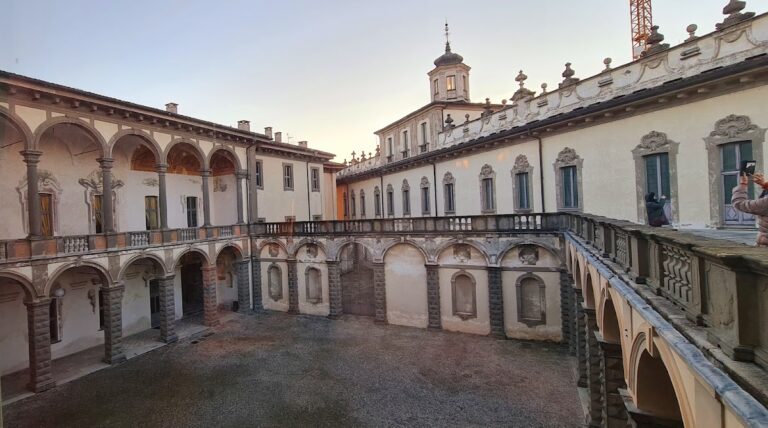
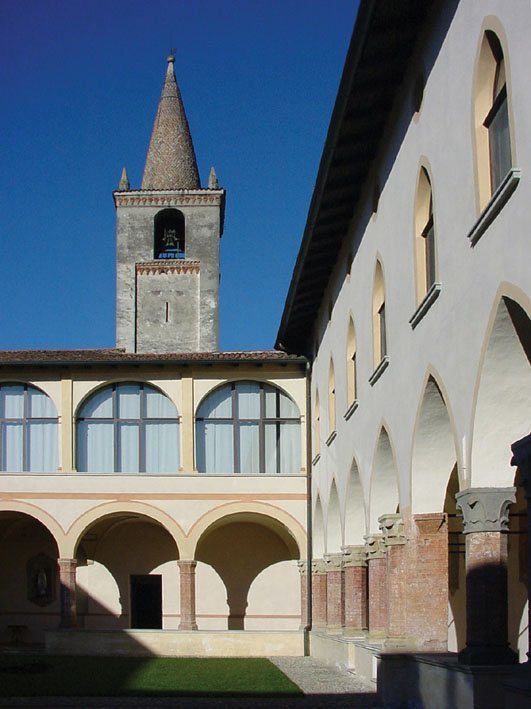
The large cloister had arcaded loggias on two levels, supported by masonry pillars. It was rebuilt in the seventeenth century. An enclosed garden extended beside it, bounded on three sides by a high wall made of pebbles. A loggia with round arches and small sandstone columns formed the fourth side.
Former church
Bell tower and divided nave
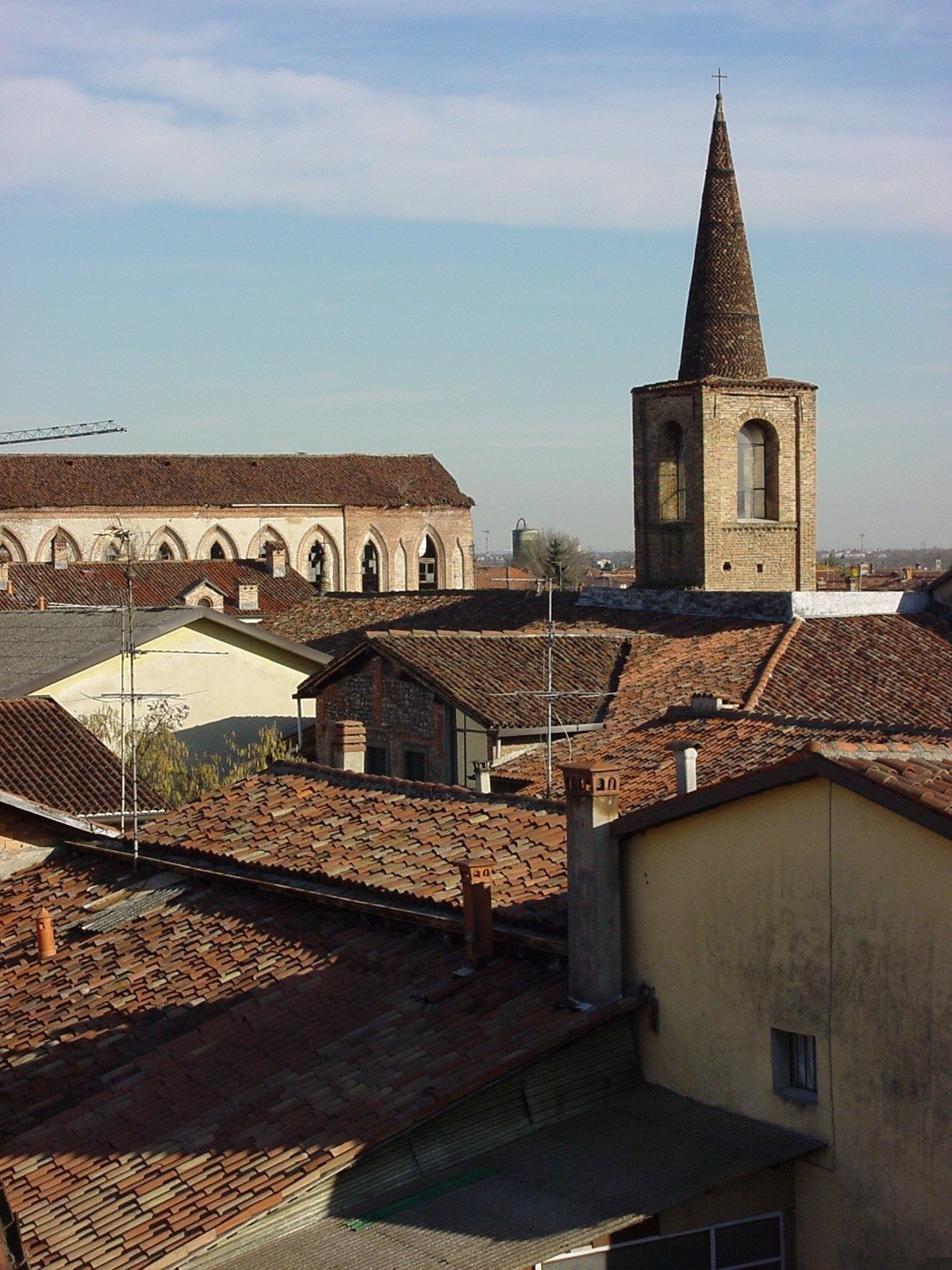
The church’s bell tower was built with the monastery and ended in a conical spire copied from the spire of the Monastery of the Incoronata. The single nave was divided into two halls, a configuration associated with fifteenth-century churches. The hall for the faithful faced Via Allegreni and now contains the memorial to the fallen. The hall used by the cloistered nuns was accessible from Piazzetta Padre Orisio and now houses the municipal historical archive, whose documents date from the fourteenth to the nineteenth century.
Frescoes in the nuns’ hall
The frescoes in the nuns’ hall are arranged in two central registers and three lateral registers. The upper register shows the Annunciation, the Crucifixion, and the Descent from the Cross. The middle register includes paintings inspired by Andrea Mantegna, the fifteenth-century painter whose strongly modeled figures and perspective-based compositions influenced northern Italian Renaissance art. These scenes include Saint Francis receiving the stigmata, the wounds understood in Christian tradition as corresponding to Christ’s crucifixion wounds, and Saint Jerome as a penitent. This section retains its original color values, while the lowest lateral register is now almost illegible.
Frescoes in the hall for the faithful
The hall for the faithful contains scenes from the life of Saint Clare. One depicts Saint Francis clothing her as a nun: Clare holds a candle while Francis offers a scapular and blesses her, with her freshly cut blond locks placed on an altar beside two saints. To the left, a family group has been identified as Bartolomeo Colleoni, wearing a captain’s cap, his wife beneath a white veil, and their three legitimate daughters, Isotta, Caterina, and Orsina.
Another fresco shows Saint Clare receiving Pope Innocent IV, who asks her to bless bread on the altar. The bread bears a cross. The cycle also includes a representation of Clare’s funeral and presents the miracle of the bread through a sequence of scenes. The fifteenth-century paintings occupy the lateral parts of the hall, while the central area is covered by works from substantially later periods. Their figures have angular, dry features, and the landscapes are open and brightly lit.
Later artworks
The surviving fifteenth-century paintings are attributed to the Master of Martinengo, an art-historical name for an unidentified painter associated with frescoes in the Martinengo area. Fragments attributed to the same painter remain in the public hall, where many paintings have been lost. The marble altar was made by Bartolomeo Manni and dated 1698. Francesco Paglia’s altarpiece, Immaculate in Glory with Saints, was removed in 1936 and placed in the library’s conference hall.
The former monastery also contains an image of Christ supporting a foot soldier wounded in battle, painted by Girolamo Poloni, who was born in Martinengo.