Castle of Bornato: Medieval Fortress and Villa in Italy


Site at a Glance
- Rating
- 4.5
- Popularity
- Low
- Country
- Italy
- Primary era
- Medieval
- External website
- Open
- Eras represented
- Medieval, Early Modern
- Civilizations
- Holy Roman Empire, Venetian
- Site type
- Military
- Remains
- Castle
On this page9 sections
History
Castle of Bornato is a medieval fortress in Italy, located in Bornato, a hamlet of Cazzago San Martino in Lombardy. Built in 1280 in the Gothic style, it occupies a site previously used by a Roman castrum, a fortified military settlement.
Medieval foundations
The surrounding fortifications date to 1275 and are attributed to Inverardo da Bornato, a local lord and military commander. The castle itself was built five years later at the initiative of Everardo Bornato, a member of the local Bornato family.
Villa and changing ownership
Between the seventeenth and eighteenth centuries, the Gandini family, successors to the Bornato family, constructed a villa within the castle walls. The noble Mondella family owned the property for an unspecified period and retained it until the nineteenth century, when Giuseppe Mondella, known as “Pinotto,” lost the castle in a card game.
In 1938 the property passed to the Orlando family. Luigi Orlando completed the purchase, and his daughter Luisa later established an agricultural enterprise at the castle. The site remains privately owned.
Wine production
Ancient wine cellars beneath the main tower produced the castle’s wine for approximately 700 years. Their operation continued until the early 2000s, linking the fortress’s long history with the agricultural use developed under the Orlando family.
Remains
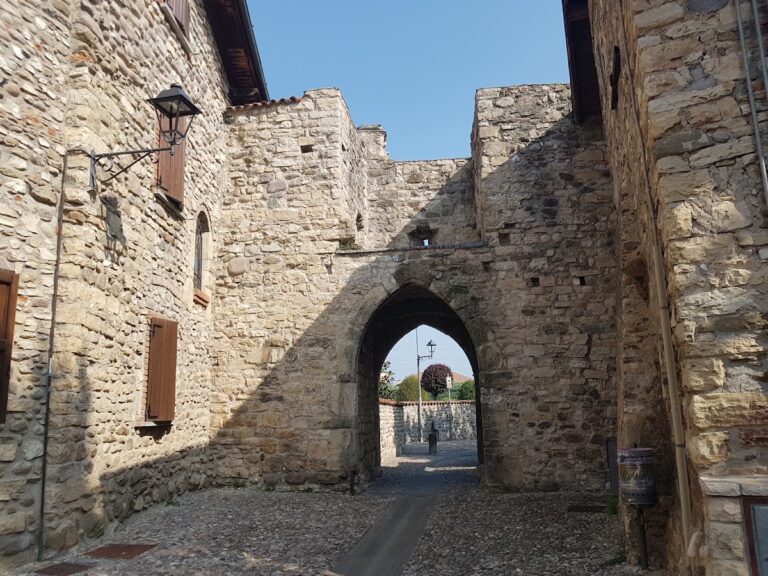
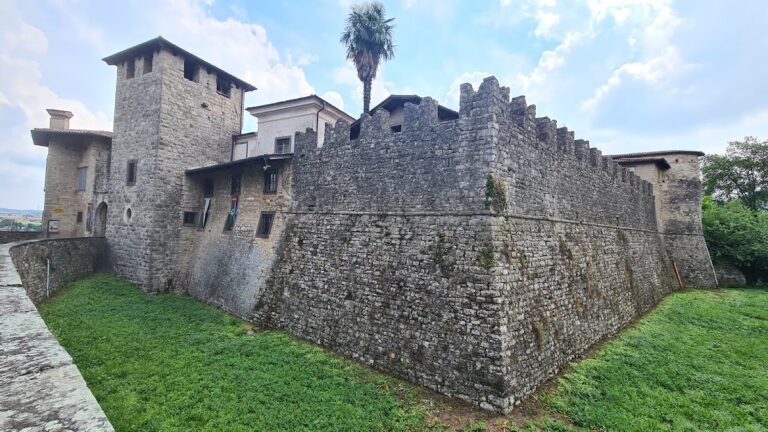
The castle survives as a medieval defensive enclosure built from pebbles and mortar. Rough-stone crenellated walls surround towers, buttresses, moats, and a drawbridge, forming the principal fortified structure.
Fortified enclosure and villa
Defensive walls
The enclosure combines crenellated masonry with towers and buttresses. Moats and a drawbridge formed part of its defensive arrangement, while the rough stone and mortar construction give the surviving fortress its medieval character.
Villa inside the walls
Within the defensive enclosure stands a linear villa. Its halls contain eighteenth-century frescoes, and its rooms have coffered ceilings. In the assembly hall, work completed in 1669 included figural decoration by Pompeo Ghitti, assisted by P. A. Sorisene, who created the ornamental decoration.
An Italian-style garden surrounds the castle. Its formally arranged design includes centuries-old plants and architectural landscaping.
Wine cellars
The ancient wine cellars lie beneath the castle’s main tower. They form a subterranean part of the site associated with the long production of the castle’s wine.