Palazzo Colleoni alla Pace: A Fifteenth-Century Residence in Brescia
Site at a Glance
- Popularity
- Low
- Country
- Italy
- Primary era
- Medieval
- Eras represented
- Medieval
- Civilizations
- Venetian
- Site type
- Domestic
- Remains
- Elite Residence
On this page14 sections
History
Colleoni’s residence
Palazzo Colleoni alla Pace is a fifteenth-century residence in Brescia, Italy, built for Bartolomeo Colleoni, a professional military commander from Bergamo who served under contract. The Republic of Venice, a maritime state that governed territories in northeastern Italy, granted him land west of the old moat, along present-day Via della Pace. The circumstances of the grant and the building project remain uncertain.
Colleoni stayed in Brescia in 1450 with nine other military captains employed by Venice. In a letter dated 7 November 1454, he complained that he had no suitable accommodation in the city. The transfer of the land is tentatively dated to 1455. By early 1456, he was asking the city council to supply water to a fountain at his new residence, suggesting that construction was already well advanced. A chronicle called the palace the Great Palace in 1465. The city began rebuilding and improving its walls in 1467, completing the work by 1483; the palace may have been built before those works, but its construction date is not known.
The palace’s painted decoration was intended to present Colleoni as both a military leader and a patron of culture. Antonio Cornazzano, a humanist writer in Colleoni’s service, probably conceived and organized the decorative program. He lived at the residence until his death in 1475.
Inheritance and later fortunes
In his will of 27 October 1475, Colleoni left the residence to his daughter Caterina, who married the Brescian military commander Gaspare Martinengo. Their marriage established the family branch known as the Martinengo della Pallata. Colleoni directed that the palace should pass to the Hospital of the Pietà, a charitable institution in Bergamo, if that branch died out. The branch ended in 1681, and the hospital sold the property in 1683 to priests of the Oratory of Saint Philip Neri, a Catholic congregation founded in the sixteenth century. The congregation has held the palace since then.
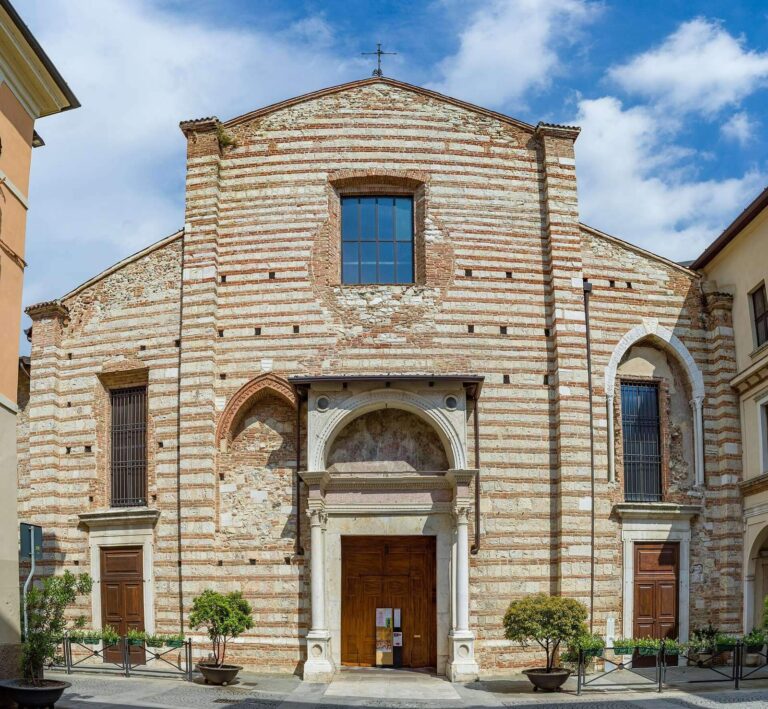
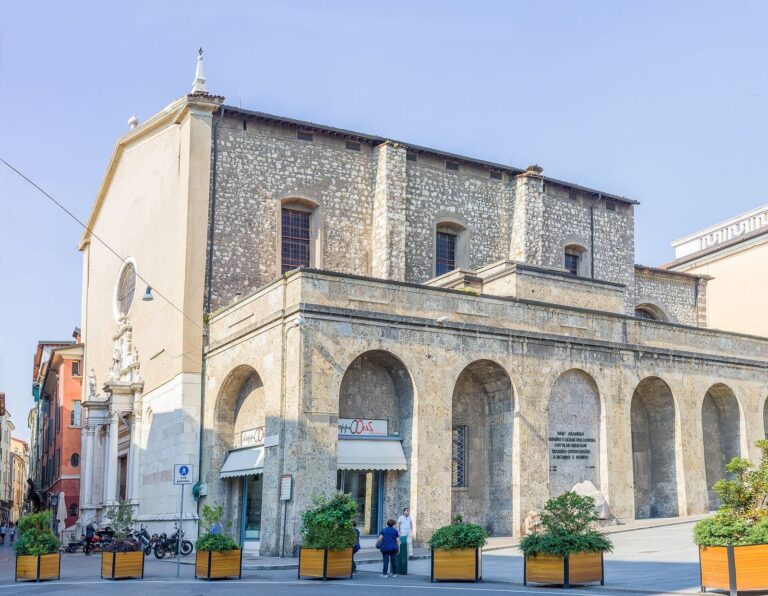
After Colleoni’s death, the Venetian chronicler Marin Sanudo praised the palace for its magnificence and beauty. Pietro Spino described it as a great and noble residence in 1569, and in the early seventeenth century the English visitor Thomas Coryat called it Brescia’s only gentleman’s palace. Later construction changed the building: the church of Santa Maria della Pace was built in the eighteenth century, followed by a theater in the nineteenth. By the late nineteenth century, the palace had largely faded from guidebooks and local descriptions, possibly because its exterior had been altered and reduced.
Remains
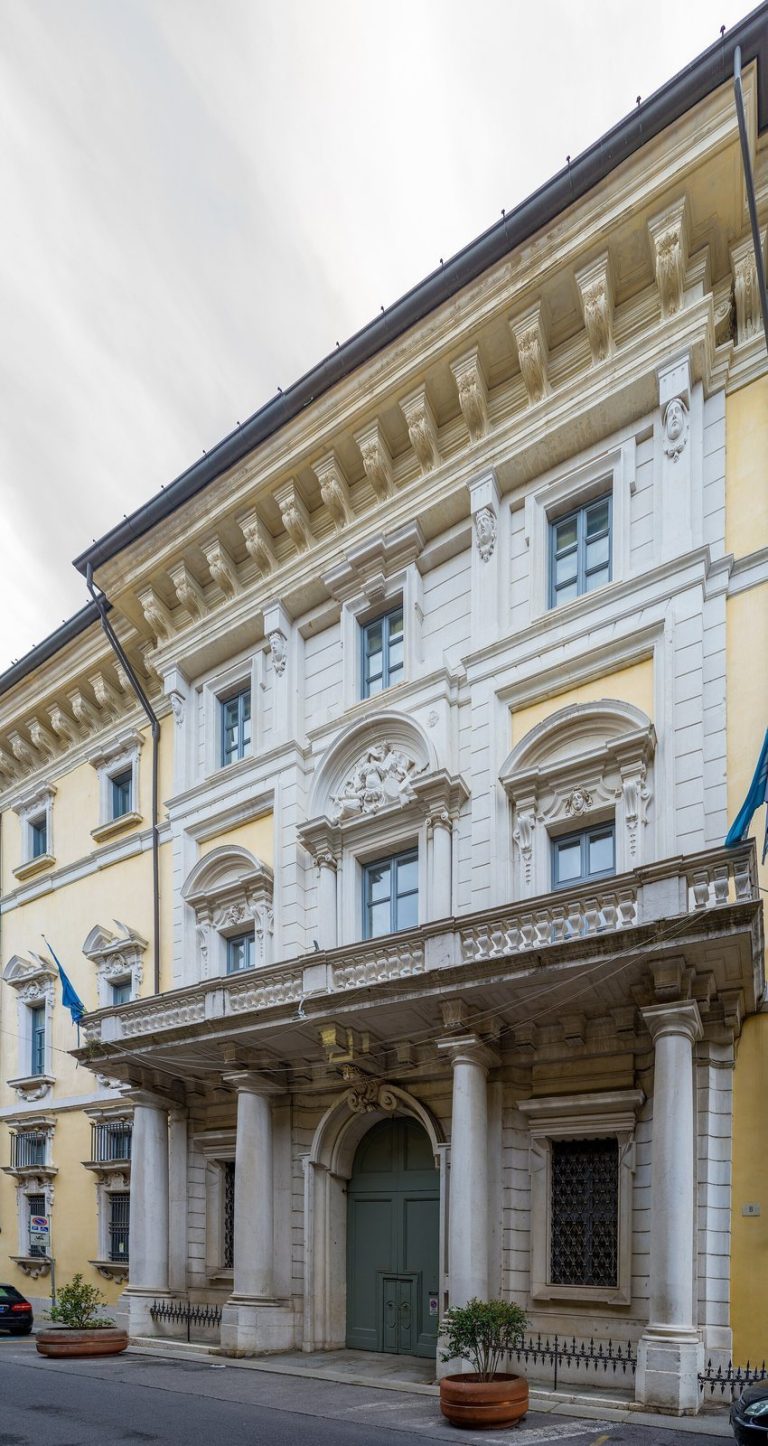
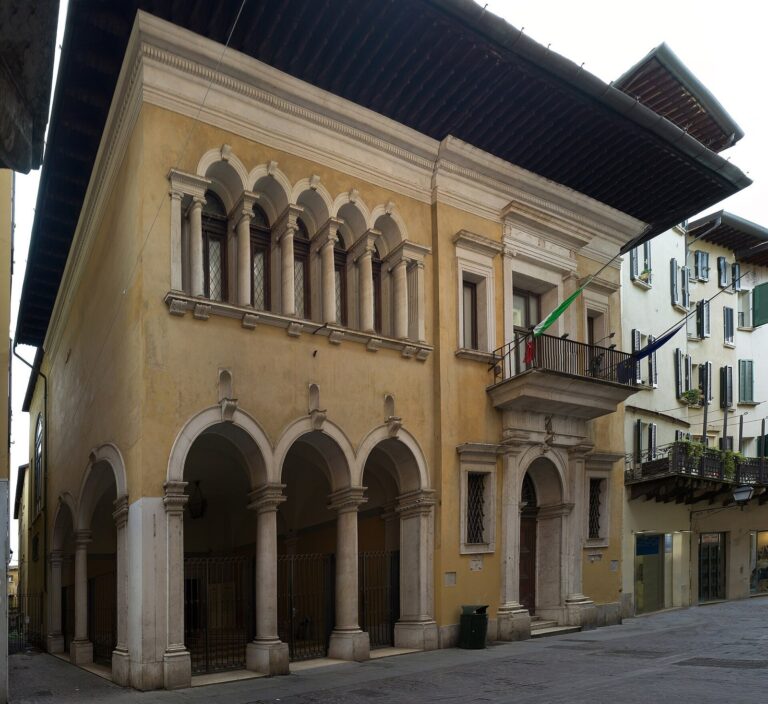
Repeated alterations have reduced Palazzo Colleoni alla Pace from its original form, but it remains one of Brescia’s leading examples of fifteenth-century residential architecture. The palace preserves an extensive cycle of painted wooden ceiling panels, alongside parts of its original plan and courtyard decoration.
Facade and entrance
Facade and original plan
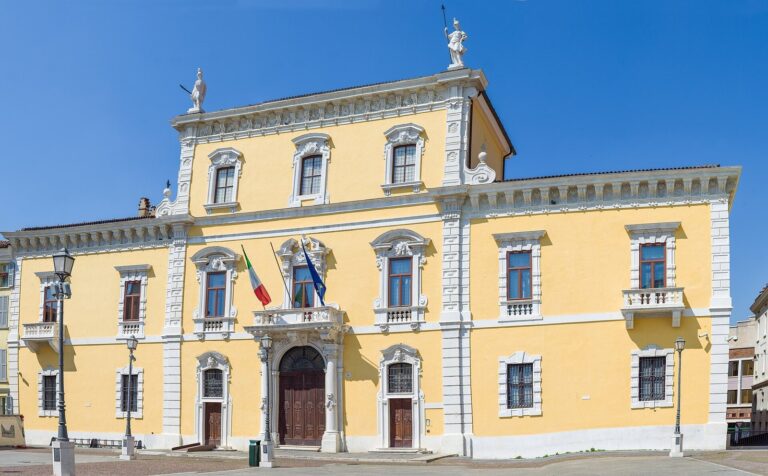
A seventeenth-century depiction provides the basis for reconstructing the original facade and layout. The palace had a ground floor and two upper floors, with a horizontal row of windows and a projecting horizontal molding along each level. Its frontage was wider than it is today; construction of the church and theater narrowed it.
Entrance portal
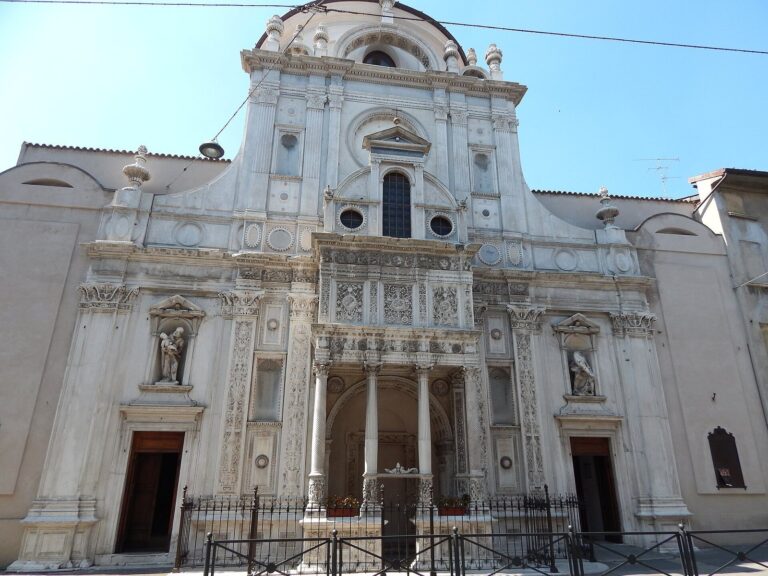
The original entrance stood slightly south of the facade’s midpoint. Marble decoration was added to the portal in the sixteenth century. At the beginning of the seventeenth century, Isotta Martinengo Colleoni took it as part of her dowry when she married Count Gaspare Calini. The portal was installed as the entrance to Palazzo Martinengo della Motella.
Courtyard and interior rooms
Courtyard and other spaces
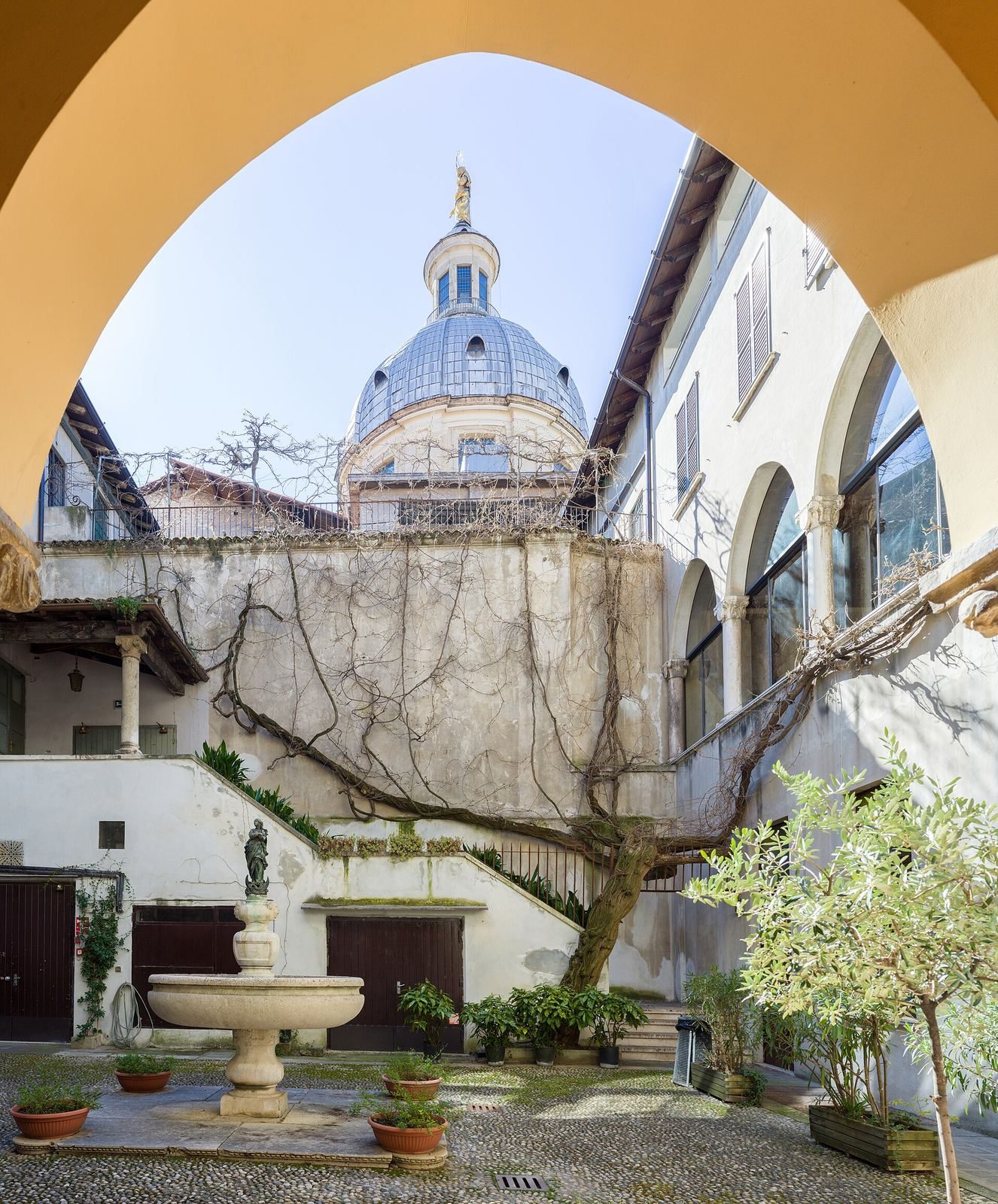
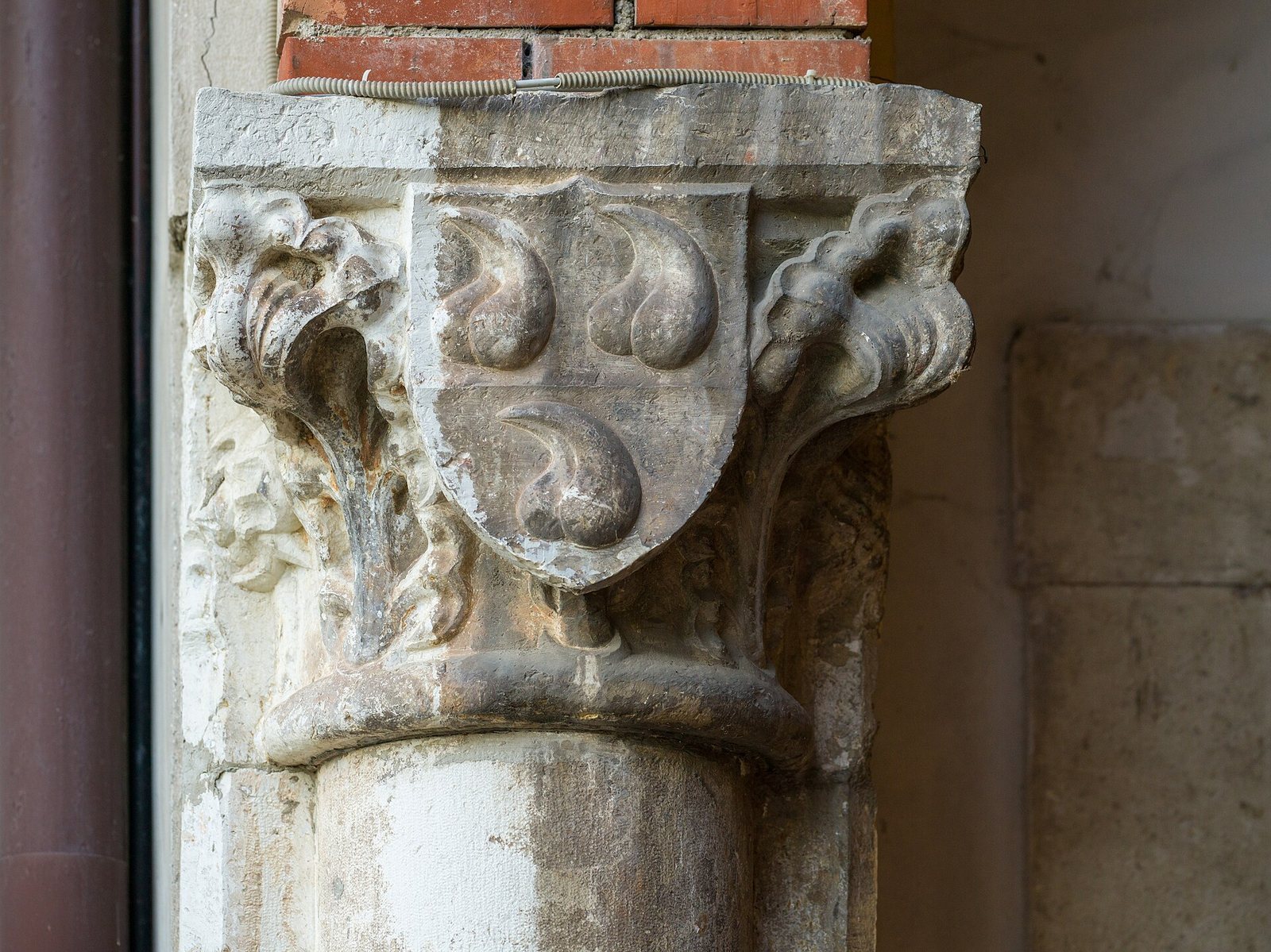
An entrance hall led into the courtyard, which had a colonnade of five pointed arches. Later alterations substantially changed this arrangement, though fragments of painted wall decoration remain visible. The palace also included large horse stables, other lodgings, a substantial library, and a private chapel.
Great Hall and adjoining spaces
The Great Hall, also known as the Bevilacqua Hall, occupied most of the first upper floor in the eastern wing. A staircase at the southern end of the portico, a covered walkway, probably led to a smaller Hall of Honor. The nineteenth-century theater disrupted this part of the plan, removing the staircase, at least two divisions of the inner open-sided gallery, and the smaller hall.
Painted ceilings
Great Hall ceiling
Elaborately worked beams in the Great Hall carried groups of painted panels, with 17 on each side. Their figures, mostly warriors, were finely executed. Monochrome friezes later covered the panels, which were subsequently restored.
First-floor portico ceiling
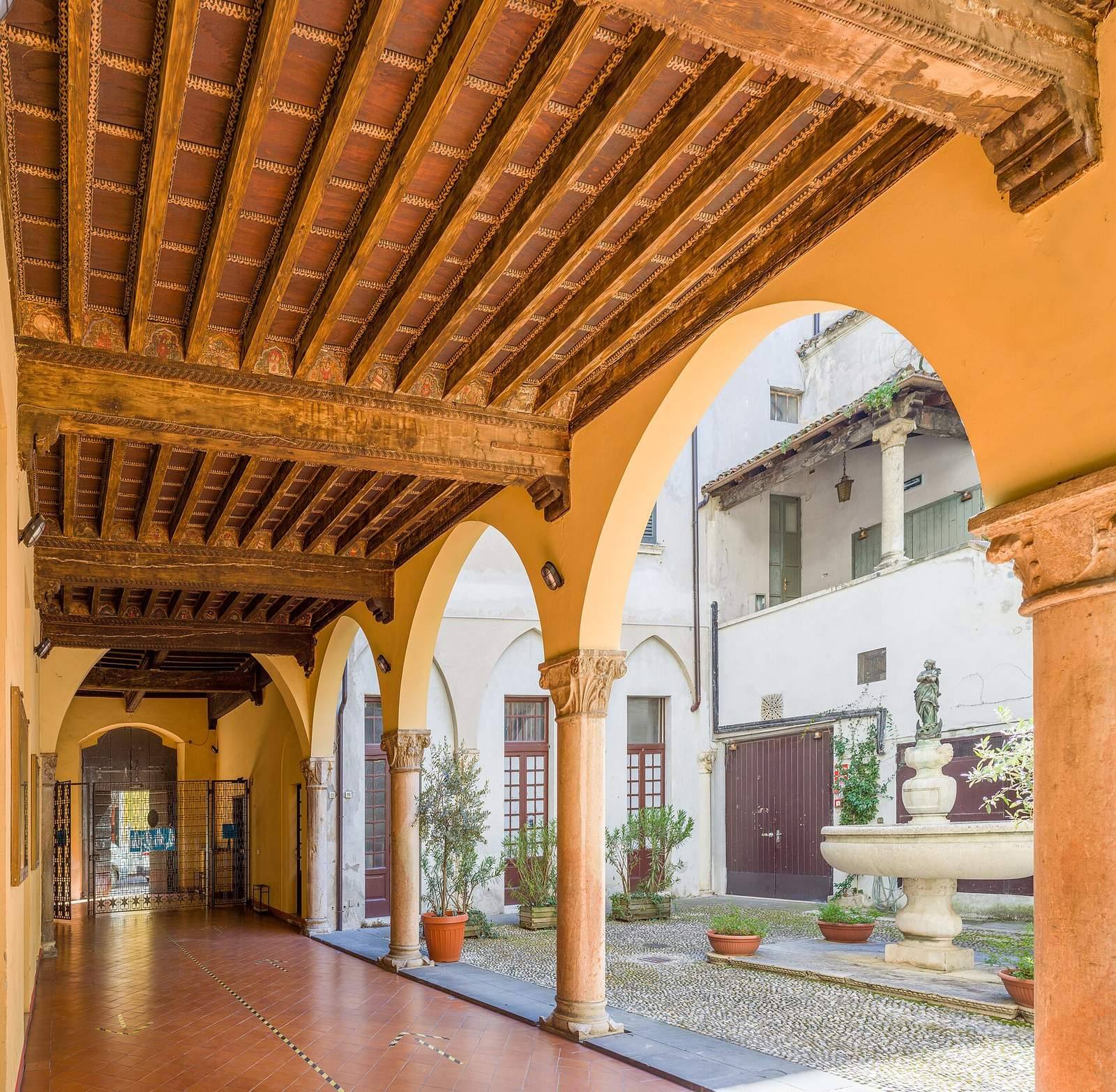
The ceiling of the first-floor portico combines large wooden brackets and dark beams with painted panels. The panels show human figures, animals, flowers, and the Colleoni coat of arms.
The panel cycle
The ceiling decoration comprises 306 wooden panels of broadly similar dimensions, originally arranged across the Great Hall and the smaller room in front of it, which was removed during the theater works. Their arrangement has remained stable. Painted between the 1460s and early 1470s, and certainly before 1475, the panels form a unified composition. Inscriptions identify figures including Hecuba, Andromache, Penthesilea, Cassandra, Helen, and Thisbe from Greek myth and epic; Poppaea, a Roman empress; and Lucretia, a figure of Roman legend. Thisbe appears at least three times, honoring Colleoni’s wife, Tisbe Martinengo, who shared her name. The composition was innovative among fifteenth-century wooden ceilings and moved away from the earlier Gothic tradition, the medieval European artistic tradition that preceded Renaissance forms. Its style reflects the art theory of Leon Battista Alberti and the influence of painter Bonifacio Bembo.