Castello della Porta: A Medieval Fortress in Frontone, Italy


Site at a Glance
- Rating
- 4.5
- Popularity
- Low
- Country
- Italy
- Primary era
- Medieval
- External website
- Open
- Eras represented
- Medieval
- Civilizations
- Duchy of Urbino
- Site type
- Military
- Remains
- Castle
On this page5 sections
History
Castello della Porta is a medieval fortress in Frontone, Italy, whose construction probably began in the late eleventh century and continued through the fifteenth century. Enlarged and strengthened over successive phases, it became a strategically important stronghold on the historical frontier between the Duchy of Urbino and territories controlled by the Malatesta family.
Medieval origins and frontier role
The fortress developed during a period when control of Frontone shifted among Cagli, Gubbio, and Urbino. Its position gained particular importance during the fifteenth and sixteenth centuries, when the Duchy of Urbino, ruled by the Montefeltro dynasty, bordered lands held by the powerful Malatesta family.
In 1445, Sigismondo Malatesta tried unsuccessfully to capture the castle during his war with Federico da Montefeltro, duke of Urbino. After the failed assault, Federico commissioned Francesco di Giorgio Martini, a Sienese architect, engineer, and specialist in military design, to reinforce the defenses and redesign the fortress for contemporary Renaissance requirements.
County of Frontone and later jurisdiction
In 1530, Francesco Maria I della Rovere, a later duke of Urbino, made the castle and the territory of Frontone a county and granted it to the noble Gianmaria Della Porta. The county remained under feudal jurisdiction, meaning that territorial powers and legal privileges were exercised by a local feudal authority.
These jurisdictions ended after Frontone was annexed to the Kingdom of Italy under Napoleon in 1808. Their abolition was reaffirmed by Pope Pius VII in 1816. Castello della Porta is designated Italian national heritage.
Municipal ownership and cultural reuse
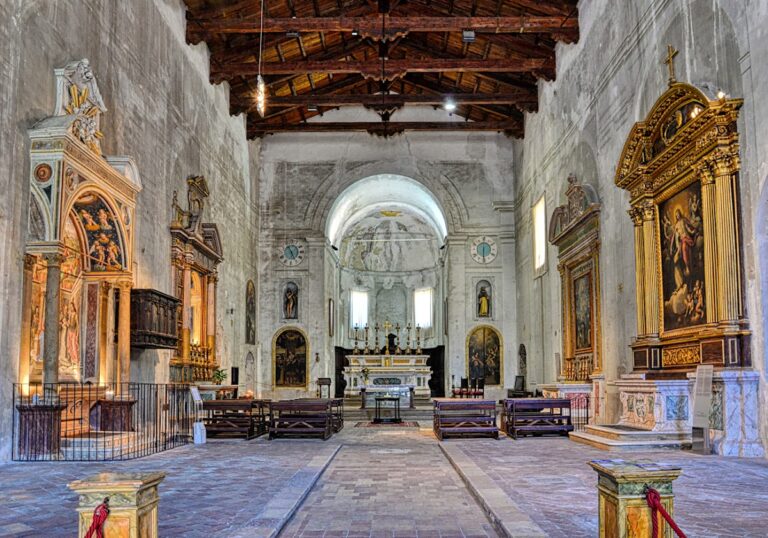
The municipality of Frontone acquired the castle in 1985 and converted it into a cultural center. Restoration was completed in 2001, after which the fortress reopened for exhibitions, performances, and other cultural activities. Its present use combines modern installations and multipurpose spaces with the surviving historic structure.
Remains
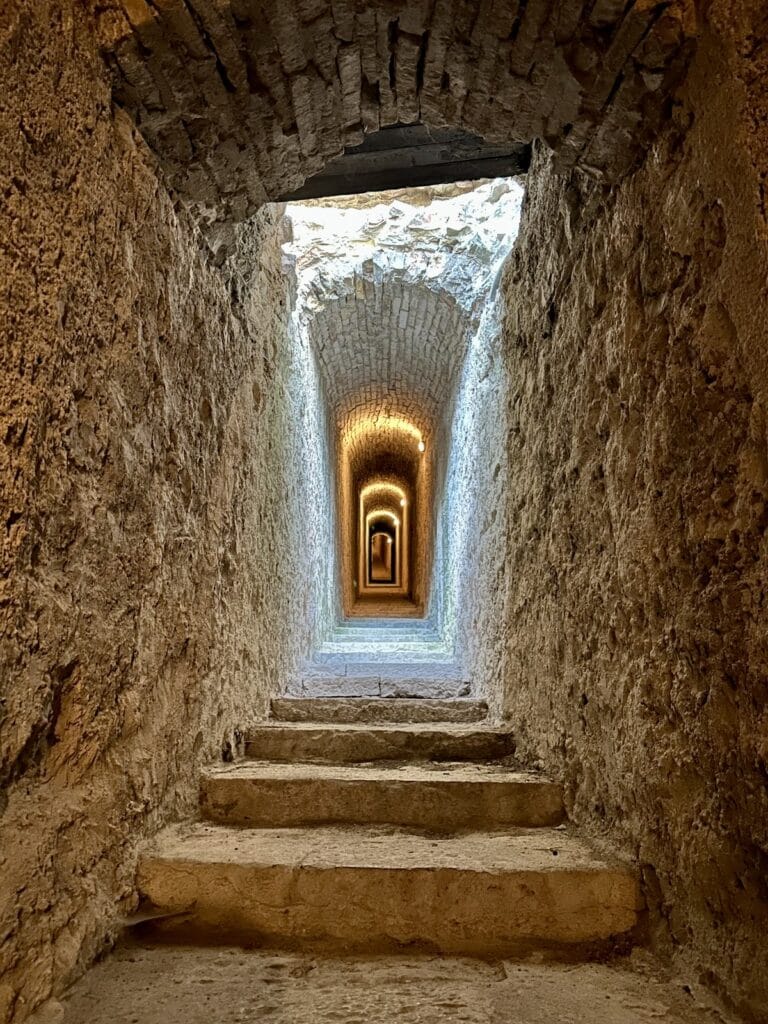
Castello della Porta survives as a medieval fortress incorporating Renaissance architectural elements. Its defensive system reflects repeated enlargement and reinforcement, while the restored interior now accommodates spaces for cultural activities. The castle occupies a position from which views extend from Mount Catria to the sea, San Marino, and Mount Nerone.
The most distinctive surviving feature is the prominent spur, a projecting buttress introduced as part of Francesco di Giorgio Martini’s redesign. The intervention also strengthened the walls, adapting the fortress’s defensive form to the military needs of the Renaissance. The spur remains a defining element of the castle’s architectural appearance.