Castillo de Fuste: An Eighteenth-Century Defensive Tower in Fuerteventura
Site at a Glance
- Rating
- 4.3
- Popularity
- Low
- Country
- Spain
- Primary era
- Early Modern
- External website
- Open
- Eras represented
- Early Modern
- Civilizations
- Spanish
- Site type
- Military
- Remains
- Tower
On this page6 sections
History
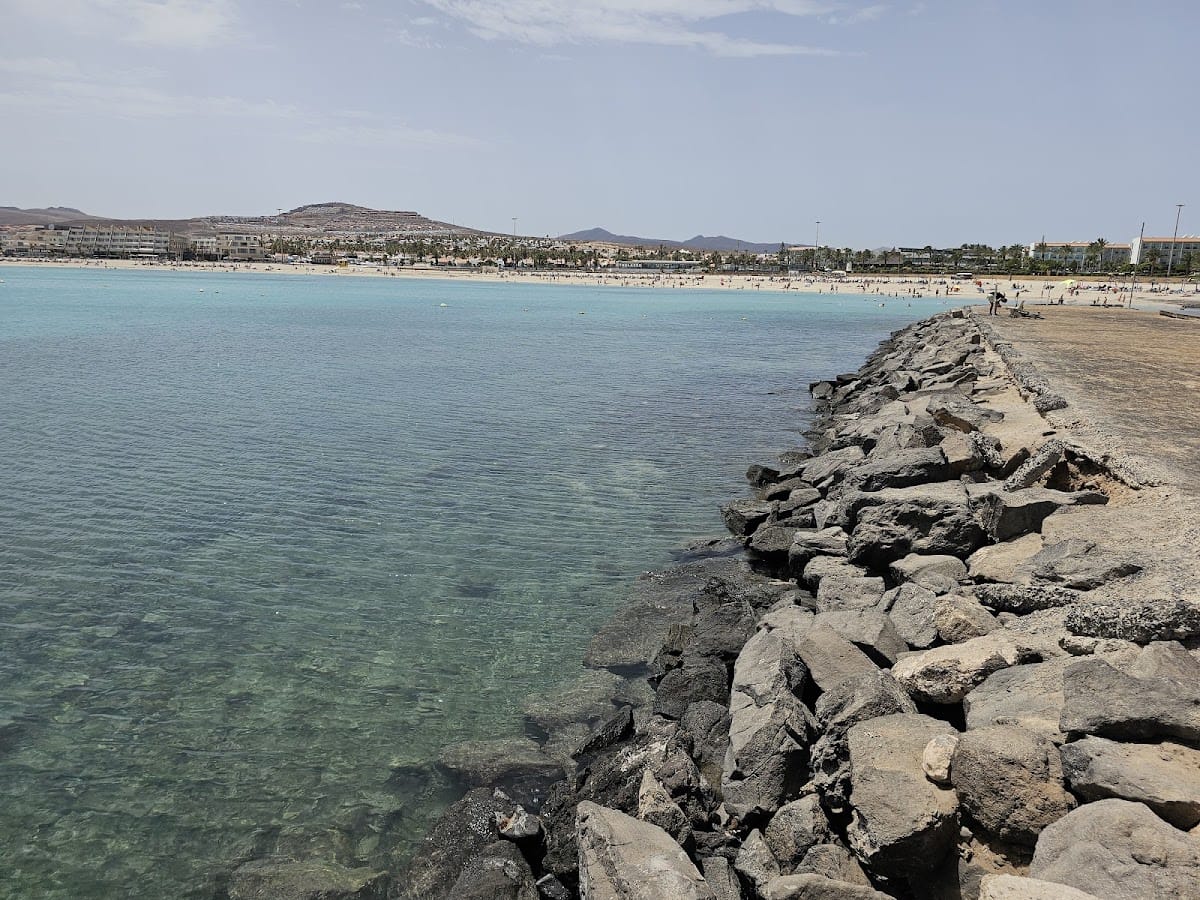
Castillo de Fuste is an eighteenth-century defensive tower in Spain, at Caleta de Fuste on Fuerteventura in the Canary Islands. Also known as the Tower of San Buenaventura, it was built to defend the Bay of Caleta de Fuste, one of the island’s three principal ports.
Construction and Defence
Until the beginning of the eighteenth century, Fuerteventura’s coast had no fortifications and was repeatedly attacked by Berber, English, and French pirates. In response, Andrés Bonito y Pignatelli, commander general of the Canary Islands, requested the dispatch of the military engineer Claudio de L’Isle. De L’Isle built the Tower of Tostón and the Castle of San Buenaventura, associated with the defensive works that protected the island’s coast.
During the tower’s early operational period, its defensive walls were enlarged from about 3 metres thick to nearly 6 metres. Tradition attributes this strengthening to damage caused by cannon fire during a pirate attack. The tower was equipped with two small-calibre iron cannons and a military garrison.
Later History and Protection
In the nineteenth century, Castillo de Fuste passed into private ownership, probably because it had lost its military usefulness. A tourist complex was built around the tower in 1982–1983. In 2013, the Cabildo of Fuerteventura, the island’s elected government, and Antigua Town Council restored the monument and reached an agreement with its owners concerning public opening.
Castillo de Fuste is protected as a Spanish cultural-interest property, a heritage site covered by Spain’s historic-preservation system, and as a historic monument. It has held this status since 1949, while 12 July 1993 is given as its declaration date. The tower is regarded as a structural twin of San Andrés Tower in Tenerife, the towers of Gando and San Pedro in Gran Canaria, the Tower of Tostón in Fuerteventura, and the Tower of the Eagle in Lanzarote.
Remains
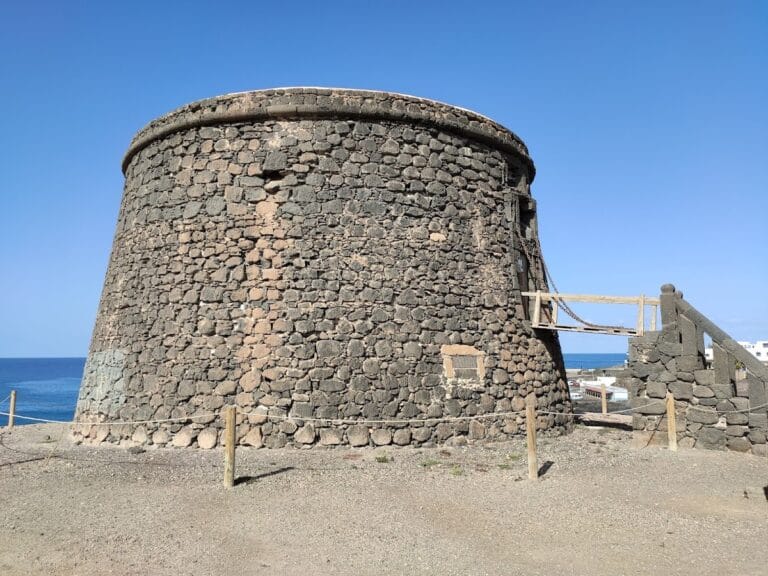
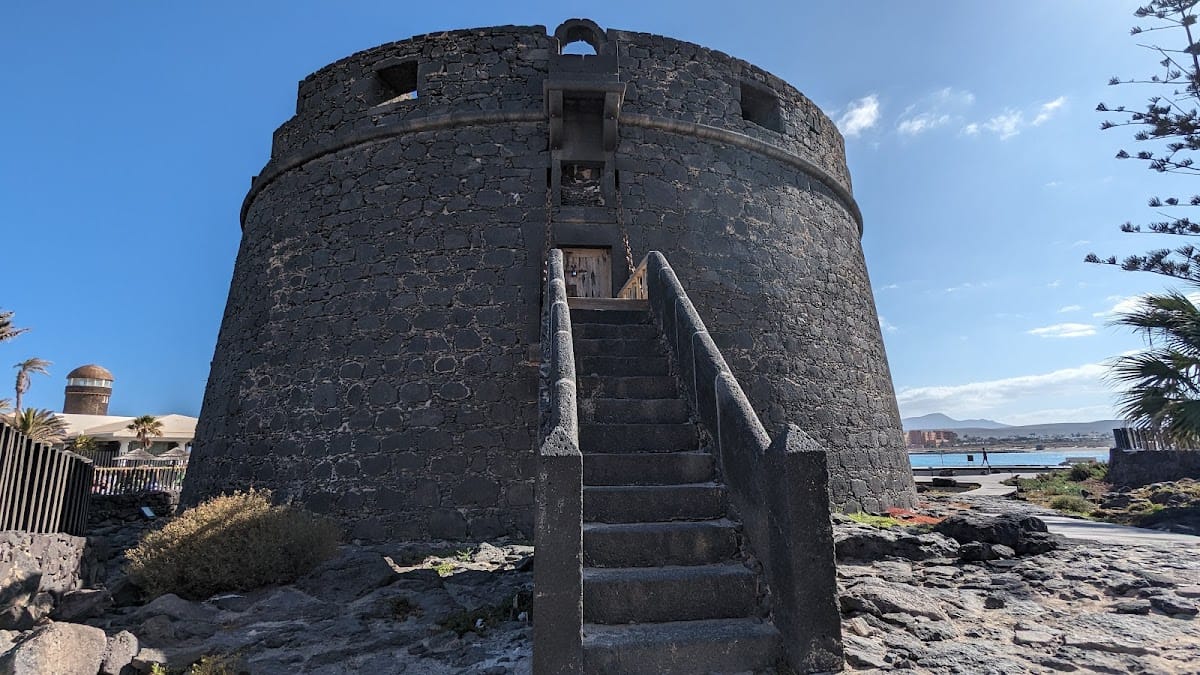
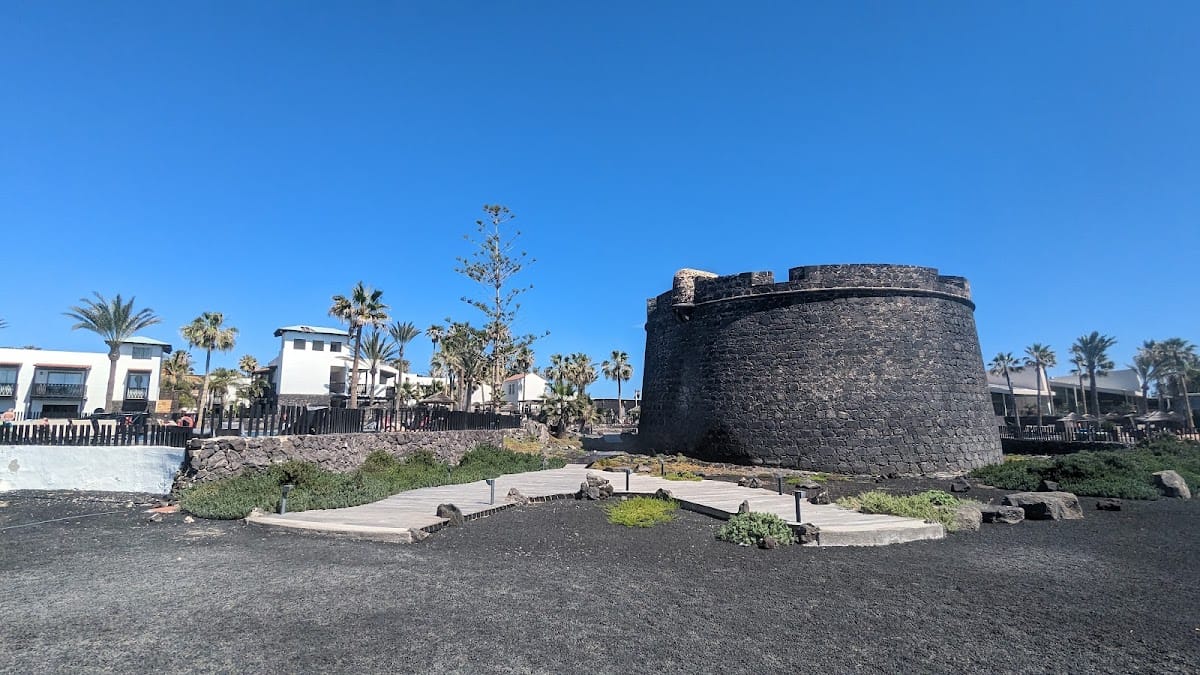
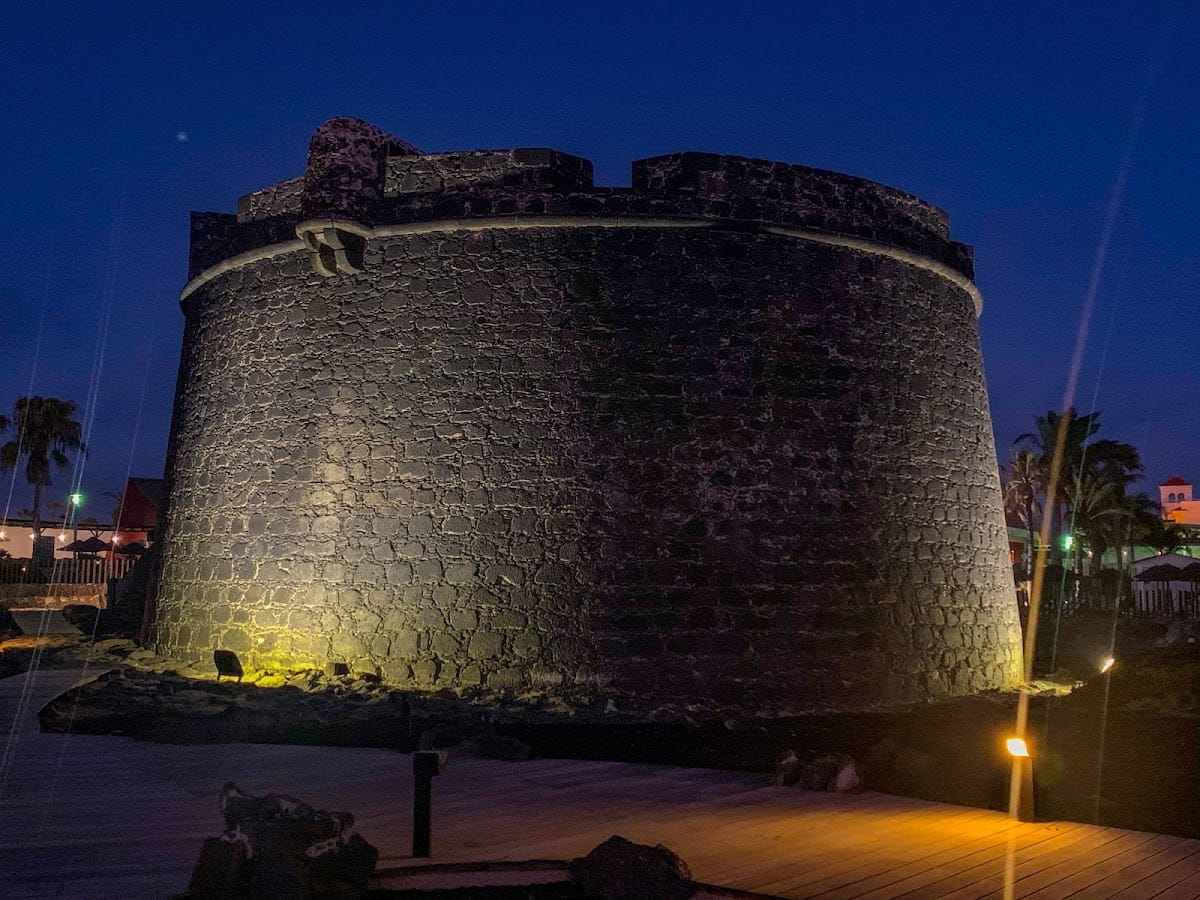
The surviving monument is a circular defensive tower built from black stone, a dark material associated with the manufacture of millstones, or heavy stones used to grind grain. It has two levels, walls nearly 6 metres thick after their enlargement, and a vault supported by a substantial central pillar.
Structure and Access
A masonry staircase provides access to the interior. Above the entrance, a drawbridge with iron chains forms a movable bridge that could be raised to restrict entry into the fortified tower.
Defensive Equipment and Setting
The tower’s military function is reflected in its thickened walls, its two small-calibre iron cannons, and the garrison that served there. The swimming pools of the surrounding tourist complex now encircle the tower.
Nearby sites