Torre del Tostón: An Eighteenth-Century Defensive Tower in Fuerteventura
Site at a Glance
- Rating
- 4.3
- Popularity
- Medium
- Country
- Spain
- Primary era
- Early Modern
- Eras represented
- Early Modern
- Civilizations
- Spanish
- Site type
- Military
- Remains
- Tower
On this page8 sections
History
Torre del Tostón is an eighteenth-century defensive tower at El Cotillo in Spain, built between 1741 and 1743 to protect the natural harbor and the ships anchored there. It was commissioned after renewed pirate attacks and dedicated to Our Lady of the Pillar and Saint Michael. The harbor was known as Puerto del Roque from 1599 to 1626, Puerto del Tostón thereafter, and El Cotillo from the twentieth century.
Fortification after the 1740 attack
The Canary Islands faced repeated attacks by Berber, French, and British pirates until the eighteenth century. Following a British attack in 1740, Andrés Bonito y Pignatelli, captain general of the Canary Islands, ordered further coastal defenses. He assigned the military engineer Claudio de L’Isle to design towers for the harbors of Tostón and Caleta de Fuste. The two structures were built on nearly identical principles, although de L’Isle died shortly before their completion.
The tower was intended to defend the coast and vessels in the harbor from Berber, English, and French raiders. The decline of these attacks coincided with the completion of the building, so it did not have to prove its defenses in active combat. Its planned garrison could contain up to 12 men, who would have operated the guns and maintained the fortification.
The question of Rico Roque
Many travel guides and a local information panel have connected Torre del Tostón with Rico Roque, a fortress said to have been built in 1404 under Jean de Béthencourt, the Norman nobleman who led the conquest of several eastern Canary Islands. According to the tradition, Indigenous Canarians later captured and destroyed that earlier stronghold.
This identification is now regarded as outdated. The French conquest chronicle Le Canarien placed Rico Roque about one league, or approximately 4.8 kilometers, away beside a spring on a steep slope. Torre del Tostón does not match that description, and Rico Roque has instead been located near Pozo Negro on Fuerteventura’s east coast.
Influence and heritage protection
The tower’s construction principle was later adopted for other coastal defenses. It influenced Torre d’Alcalfar and Torre de Son Ganxo on Menorca, both built in 1787. Those Menorcan towers contributed to the development of British Martello towers, small circular coastal forts built between 1798 and 1802 on Menorca and between 1804 and 1805 in Ireland. Martello towers on England’s southern coast were also directly inspired by the Canary Islands towers.
Torre del Tostón has been protected as a monument since 1949. It is registered within Spain’s Bienes de Interés Cultural heritage system as a Monumento under number RI-51-0008264, with the designation also recorded from 12 July 1993. After restoration, the building was adapted to house the local tourist-information office, while its upper floor became a venue for changing exhibitions by contemporary artists.
Remains
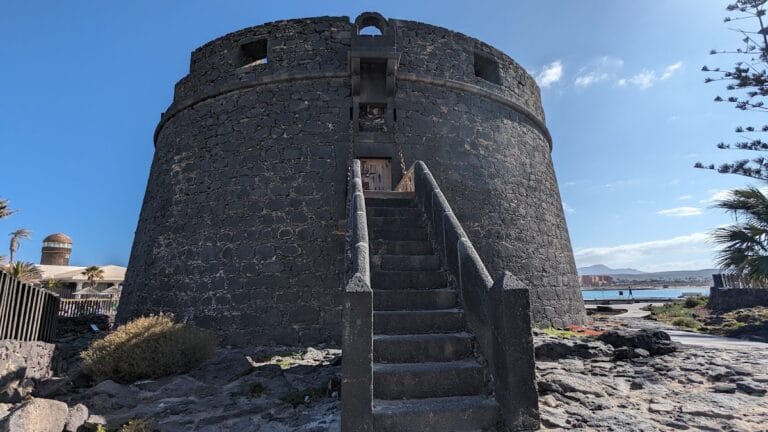
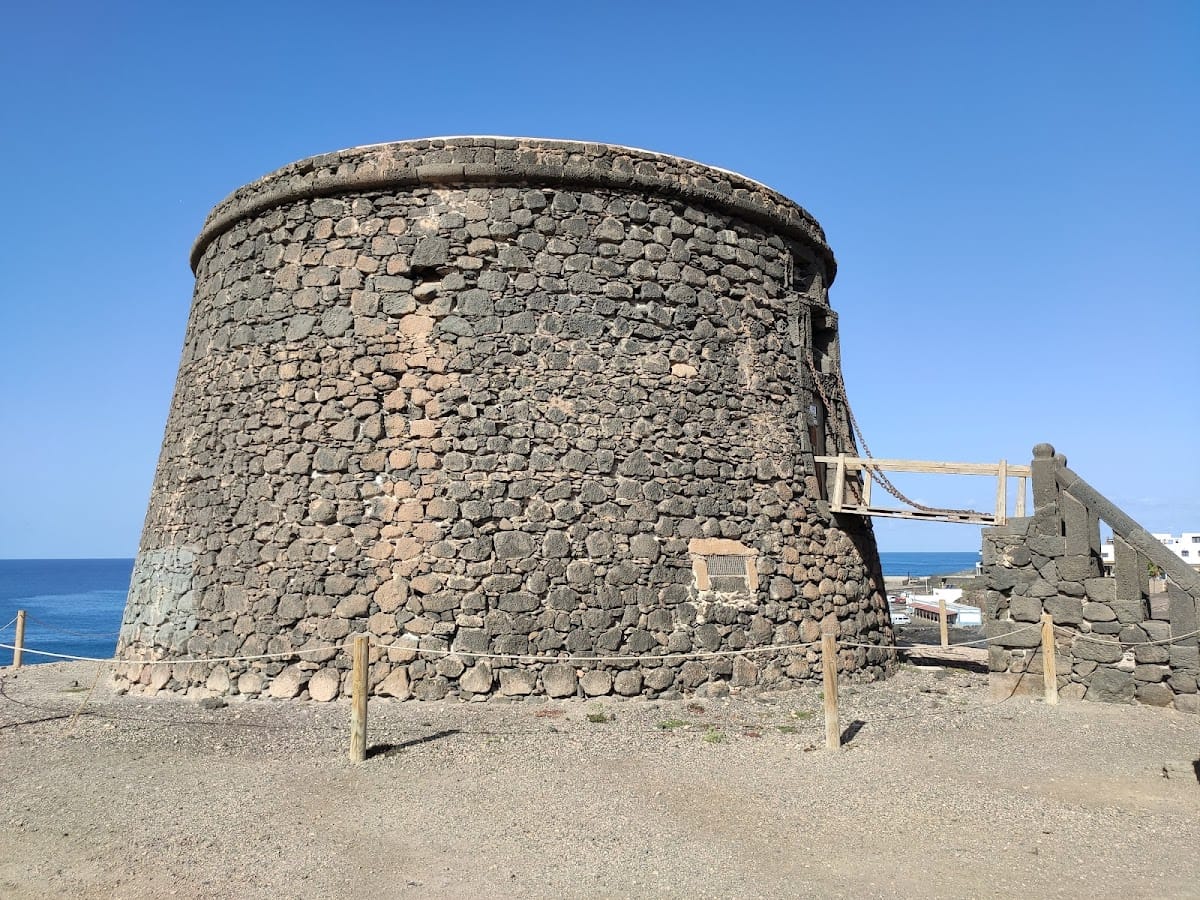
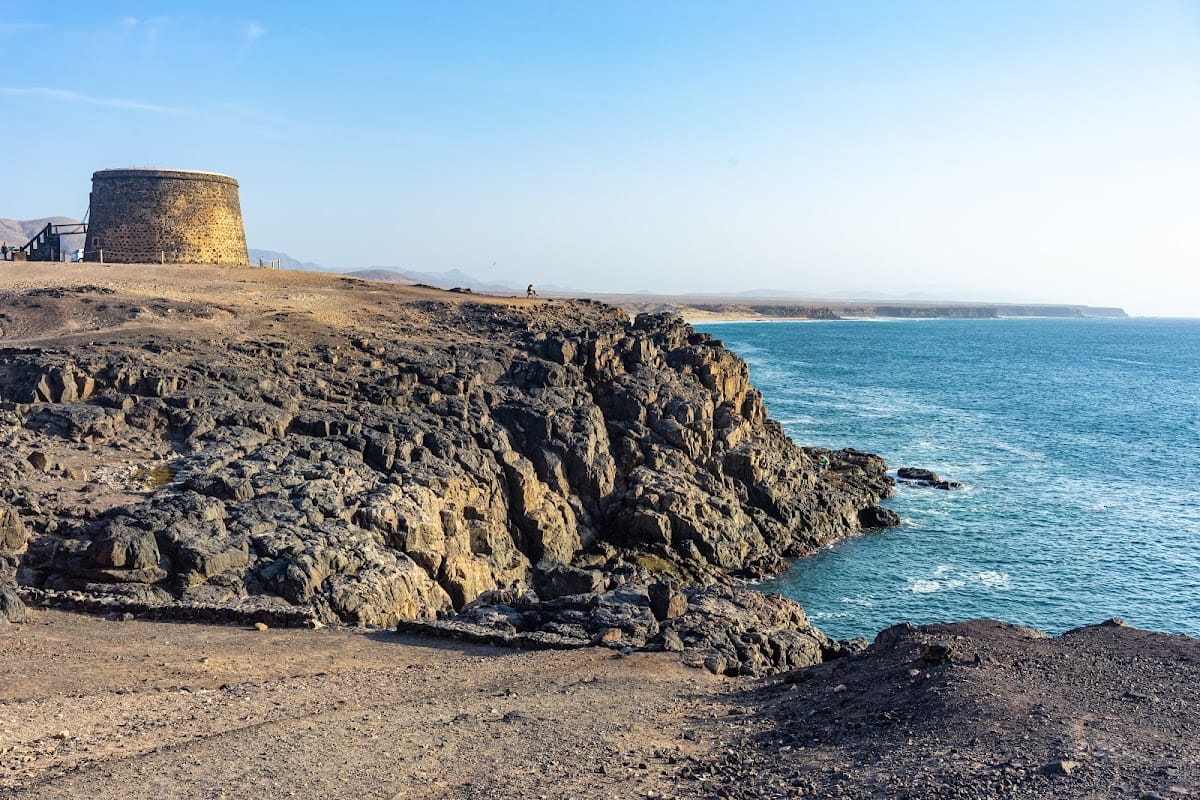
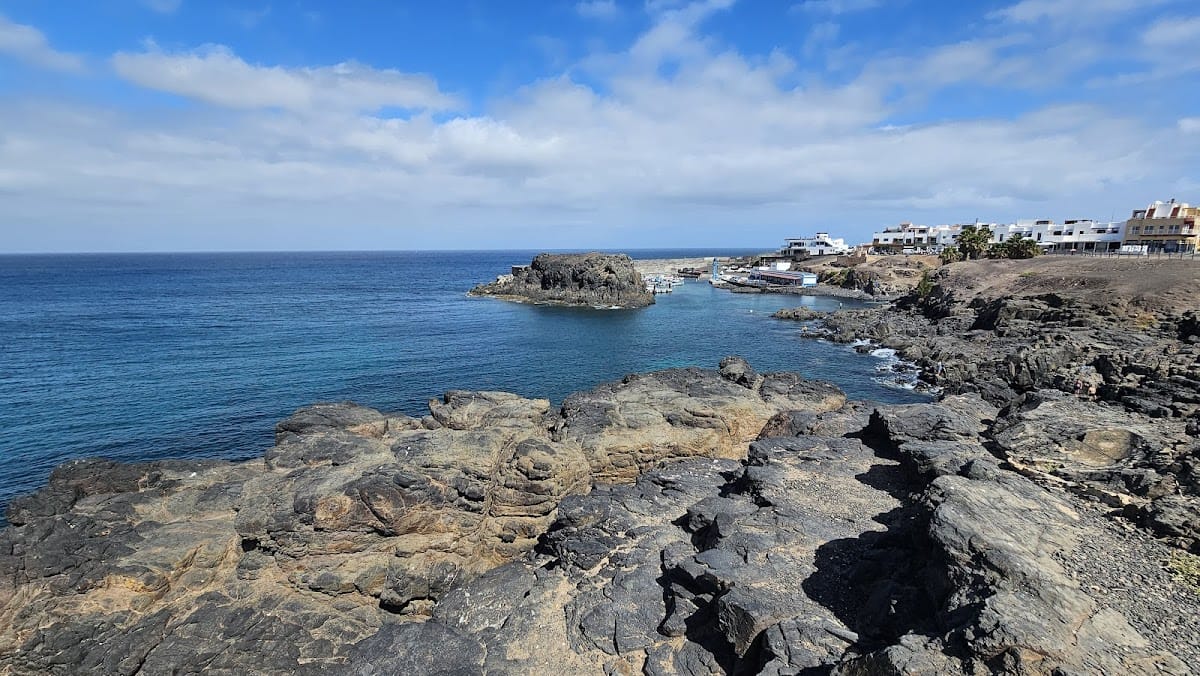
The tower occupies a commanding position on the cliff coast southeast of El Cotillo. Its circular plan narrows upward in the form of a truncated cone, measuring 14.5 meters across at the base and 12.5 meters at the summit. Dark volcanic stone, quarried near the church, forms the structure, whose walls exceed 1.5 meters in thickness. The building has two principal floors and a summit platform.
Interior and entrance defenses
The lower floor contains a powder magazine, a fortified room for gunpowder and ammunition, together with a second storage chamber. The upper floor provided accommodation for the garrison. Access from land was deliberately restricted: the entrance opens at upper-floor level and is reached by an exterior stone staircase and a wooden drawbridge that could be raised on iron chains. A loophole above the doorway allowed the approach to be defended.
Inside, one staircase descends to the lower floor, while another leads upward to the summit. Plans for an additional ditch around the tower were never implemented. The surrounding parapet is described without loopholes, distinguishing the building from some other fortified towers.
Summit platform and artillery
The summit platform contained a cistern that gathered rainwater for the garrison. It also provided positions for three iron cannons, whose role was to defend the coastline and ships anchored in the harbor. The combination of water storage, accommodation, ammunition rooms, and artillery allowed a small garrison to maintain the tower as an independent coastal defense.
Related tower designs
Torre del Tostón is architecturally similar to the Castillo de Caleta de Fuste, which was also designed by Claudio de L’Isle, although Tostón is smaller and lacks loopholes in its parapet. It is also described as a twin or near-twin of the Castillo de San Andrés on Tenerife, the towers of Gando and San Pedro on Gran Canaria, the Castillo de Caleta de Fuste on Fuerteventura, and the Torre del Águila on Lanzarote. These comparisons concern the shared defensive design and form of the buildings.