Wenzelschloss: A Medieval Castle and Imperial Residence in Germany


Site at a Glance
- Rating
- 4.6
- Popularity
- Low
- Country
- Germany
- Primary era
- Medieval
- External website
- Open
- Eras represented
- Medieval, Early Modern
- Civilizations
- Holy Roman Empire, Kingdom of Bohemia
- Site type
- Military
- Remains
- Castle
On this page11 sections
History
Wenzelschloss, also known as Wenzelburg, is a medieval fortified castle and former imperial residence on an island in the Pegnitz at Lauf an der Pegnitz, Germany. Built for Charles IV from 1356 on the ruins of an earlier castle, it became a stopping place for the imperial court during journeys between Prague and Nuremberg. The name Wenzelschloss was used until 2023, while the town now presents the structure as Wenzelburg because it is architecturally a castle rather than a palace.
Staufer and Wittelsbach rule
During the twelfth and thirteenth centuries, Lauf was Staufer imperial property. The Staufer, also called the Hohenstaufen, were the medieval dynasty associated with the imperial property around Lauf. A local imperial ministerial, a medieval official serving an emperor or prince in administrative or military duties, administered the settlement and its surrounding lands.
The castle passed to the Wittelsbachs before 1275. This Bavarian ruling dynasty controlled Lauf during an early phase of its history, but the predecessor castle was destroyed in 1301.
Charles IV and New Bohemia
Charles IV, the Luxembourg ruler who became king of Bohemia, king of the Romans, and later Holy Roman Emperor, acquired Lauf and other territories along the Pegnitz in 1353. He incorporated these lands into Neuböhmen, or New Bohemia, a group of territories brought under the Bohemian Crown.
From 1356, Charles ordered a new castle to rise on the remains of the destroyed predecessor. It served as the final overnight stop on the route from Prague toward Nuremberg, before entry into the imperial city. As elected head of the Holy Roman Empire, Charles could use Nuremberg Castle there. Further building work allowed the new castle to serve the imperial court during its journeys from 1361.
In 1373, the still-incomplete castle and part of New Bohemia were transferred to Otto V of Bavaria, the Brandenburg margrave. The agreement involved the Wittelsbach renunciation of claims to Brandenburg and compensation of 200,000 florins. The castle later passed to Nuremberg in 1504.
Later alterations and modern use
Alterations took place in 1525 to 1527, 1579, 1649, 1679, and 1736. During the seventeenth century, the entrance gate tower received the Bohemian coat of arms and a statue of Saint Wenceslas, the medieval patron saint of Bohemia and an important symbol of Bohemian identity. The statue gave rise to the German name Wenzelschloss.
From 1985 to 2013, the castle housed the Lauf branch of the Nuremberg Academy of Fine Arts and underwent comprehensive restoration during that period. It subsequently stood empty. Since 2014, former Czech honorary consul Hans-Peter Schmidt has advocated restoring the designation Wenzelburg and creating a German-Czech meeting center in the building.
Remains
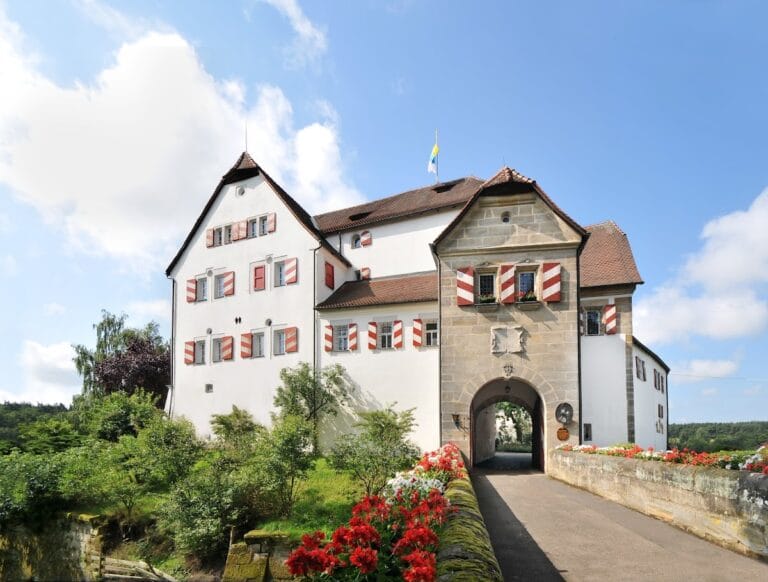
The castle occupies an island in the Pegnitz and retains the arrangement of a medieval fortified complex built over the remains of the older Staufer castle. Its principal elements include a fortified west-side tower, an east-side residential building, an east-side round tower, and a southern entrance reached by a wooden footbridge. The complex also contains a chapel dedicated to Saint Wenceslas.
Walls, towers, and entrance
Fortified towers and residential buildings
The western bergfried, or fortified castle tower, forms one of the complex’s main defensive elements. On the eastern side stands the palas, the principal residential and representative building of a medieval castle, accompanied by an east-side round tower. Together, these structures express the castle’s combined defensive and residential functions.
Entrance gate and Saint Wenceslas
A wooden footbridge leads to the southern entrance gate. The gate tower preserves a statue of Saint Wenceslas on its facade, placed there with the Bohemian coat of arms during the castle’s later history. The statue is closely associated with the building’s traditional name.
Hall of Arms and chapel
Hall of Arms
The most notable interior is the Hall of Arms in the east wing, created around 1360. It probably served as the emperor’s bedchamber. Its ceiling has cross-ribbed vaulting with two surviving keystones, the central stones that lock a vault or arch in place.
The hall contains 112 carved and color-inlaid coats of arms belonging to Bohemian noble families. Each is labelled with a family name. The heraldry may have helped Charles IV learn the shield designs used to identify armoured knights when closed helmets concealed their faces. The collection represents secular and ecclesiastical heraldry from Bohemia, Moravia, and Silesia. The coats of arms were found beneath an older layer of paint in 1934.
Castle chapel
A chapel dedicated to Saint Wenceslas formed part of the castle complex. Its decoration, together with the Hall of Arms, conveyed the authority of the Bohemian king and connected the building’s religious and dynastic imagery with Charles IV’s rule.