Reichenschwand Castle: A Moated Castle and Palace in Bavaria

Site at a Glance
- Rating
- 4.7
- Popularity
- Very Low
- Country
- Germany
- Primary era
- Medieval
- Eras represented
- Medieval, Early Modern, Modern
- Civilizations
- German, Holy Roman Empire
- Site type
- Military
- Remains
- Castle
On this page16 sections
History
Reichenschwand Castle is a former moated castle in Reichenschwand, Germany, built beside the Pegnitz River around 1300 by the Strahlenfels family, a lower-ranking noble family that served a higher lord through military or administrative duties. The castle was first recorded by name in 1312 in a land register. Although the river and four watchtowers strengthened its defensive position, Emperor Charles IV, the fourteenth-century Holy Roman Emperor, did not include it in his wider network of fortifications.
Medieval lordship and Renaissance rebuilding
Knights occupied the Reichenschwand estate between 1515 and 1531. Ulrich von Ratz remained its lord until 1531 and, according to tradition, financed himself by imposing heavy tolls on Nuremberg merchants travelling to Prague. In that year, the wealthy Nuremberg merchant Bonaventura I von Furtenbach purchased the castle, demolished the medieval structure, and commissioned a new Renaissance palace. The Renaissance was a European movement that revived classical forms and proportions. Emperor Charles V reportedly allowed Bonaventura to retain the name “Reichenschwand Castle” as a gesture of gratitude for financial assistance.
Bonaventura I also bought the parish fief from the Bamberg Cathedral Chapter, the ecclesiastical governing body of Bamberg Cathedral and its endowments. He undertook to build and maintain a parsonage and to pay the parish priest’s salary. Through his friendship with Charles V, the sixteenth-century Holy Roman Emperor and Habsburg ruler, he recovered jurisdictional rights that had previously been withdrawn from the von Ratz family. After Bonaventura’s death in 1564, the estate passed to his son, Bonaventura II.
War, expansion, and the Furtenbach estate
The castle and the town of Reichenschwand were largely destroyed during the Thirty Years’ War, the European conflict of 1618 to 1648 that combined religious, dynastic, and political struggles and caused extensive destruction in parts of the German lands. In 1703, plunderers and thieves attacked the castle. Johann Wilhelm von Furtenbach, a great-grandson of Bonaventura I, subsequently remodelled it substantially.
Shortly after 1700, Wilhelm August von Furtenbach commissioned the building known as the “Little Palace” or “New Palace” north of the castle complex beside the country road. It was enlarged and remodelled in 1755 and 1778, then sold separately from the estate after 1808. In 1768, the Furtenbach family of Reichenschwand entered the group of judicially qualified families of the imperial city of Nuremberg. An imperial city was self-governing within the Holy Roman Empire and answered directly to the emperor rather than to a territorial prince. This placed the family in Nuremberg’s second social estate, below the patriciate.
Nineteenth-century transformation
After the French Revolution, Reichenschwand became insolvent because the French king did not repay money borrowed from the town. The castle was sold in 1816 to Royal Bavarian Chief Post Director von Axthelm, who sold it thirteen years later to the knight Franz Otto von Stranski. Stranski had the property remodelled in the Gothic Revival style, a nineteenth-century movement that revived medieval Gothic forms such as pointed arches, towers, and fortified-looking compositions. The architect may have been Carl Alexander Heideloff.
After the work was completed, Stranski sold the castle to Adolf Wilhelm, Prince von Wrede. The prince sold it to Christian Thon in 1854, and Thon and his successors restored the property to the form in which it is preserved.
Twentieth-century uses
A power station was built in 1905 to supply lighting for the castle, park, and avenue, and it remains in operation. In April 1945, during the final stages of the Second World War, American officers directed the fighting around Nuremberg from the castle.
After the war, the property became a sanatorium offering a Schroth cure, a historical naturopathic regime involving dietary restriction, alternating drinking and dry days, and prescribed bodily treatments. It remained a well-known health resort until 1975. The castle has been privately owned since 1986. It now serves as a hotel and restaurant and houses the Wöhrl Academy. Founded in 1988 as an internal training institution for employees of Rudolf Wöhrl AG, the academy has its seat at the castle. Modernisation during the 1990s created facilities for seminars, while further additions included an administration building completed near the castle in 2004. A gourmet restaurant has operated there since 2009.
Remains
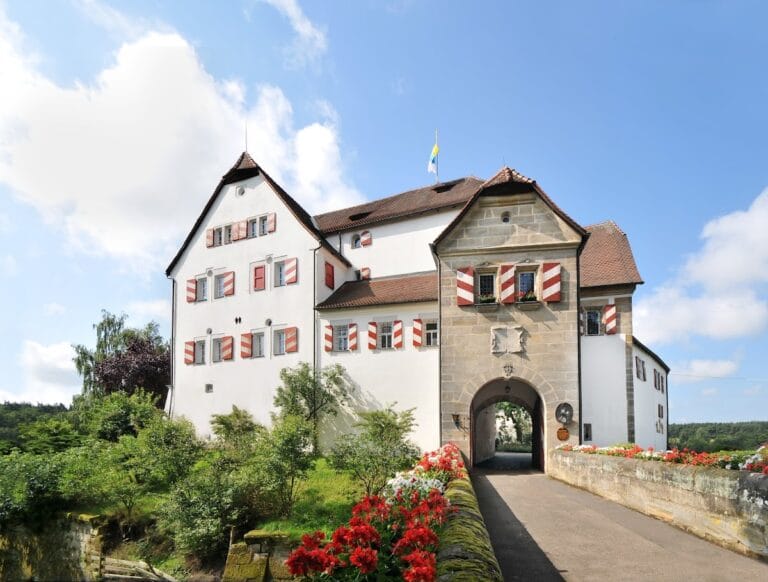
Reichenschwand Castle retains the arrangement of a former water castle and defensive complex associated with the Pegnitz River. Massive connecting walls, surrounding moats, and four towers from the thirteenth century continue to define the complex. The present palace combines the Renaissance rebuilding commissioned in 1531 with later Gothic Revival remodelling and the restoration carried out by Christian Thon and his successors.
Medieval fortifications and towers
Watchtowers and ice store
The four towers are prominent surviving elements of the medieval defensive layout. The northeastern tower was used as an ice store. Large blocks of winter ice were kept there to cool food supplies into autumn, giving the tower a later domestic function within the castle complex.
Former chapel tower
The southeastern tower formerly served as a chapel. Its original religious function forms part of the complex’s later history as the medieval defensive site was transformed into an aristocratic residence.
Western prison towers
The two western towers were known as the “torture towers.” They contained interrogation rooms, torture chambers, and prisons. During the restoration for hotel use, their interiors were converted into suites known as the “Wedding Rooms.”
Palace and associated grounds
Renaissance and Gothic Revival palace
The main palace incorporates the Renaissance rebuilding ordered by Bonaventura I von Furtenbach in 1531. Its later appearance reflects the Gothic Revival remodelling probably undertaken under Franz Otto von Stranski, followed by restoration under Christian Thon and his successors. These successive interventions shaped the preserved form of the residence within the medieval walls and towers.
Little Palace or New Palace
The Little Palace, also called the New Palace, stands north of the main castle complex beside the country road. Built shortly after 1700 for the Furtenbach family’s increased space requirements, it was enlarged and remodelled in 1755 and 1778. The building was sold separately from the estate after 1808.
Park and power station
The castle is surrounded by a park of approximately 33,000 square metres. From the eighteenth century, its owners planted rare trees, including species represented by only a small number of surviving examples in Europe. The power station constructed in 1905 supplied lighting for the castle, park, and avenue and continues to operate.
Modern additions
Seminar and administration facilities
Modernisation in the 1990s created facilities for seminar use within the property. An administration building completed in 2004 stands immediately near the castle and forms part of the later institutional development associated with the Wöhrl Academy.
Nearby sites