Castle of Castalla: A Medieval Fortress in Spain

Site at a Glance
- Rating
- 4.4
- Popularity
- Low
- Country
- Spain
- Primary era
- Medieval
- External website
- Open
- Eras represented
- Medieval, Early Modern
- Civilizations
- Crown of Aragon, Spanish
- Site type
- Military
- Remains
- Castle
On this page8 sections
History
Castle of Castalla is a historic hilltop fortress in Castalla, Spain, first occupied during the Neolithic period and later reused by Iberians, Romans, Muslims, and Christians. An Islamic fortress was built there in the eleventh century over earlier Neolithic and Ibero-Roman remains. The present complex developed mainly from the end of the Late Middle Ages into the early modern period, with most of its surviving medieval fabric belonging to fourteenth-century works.
Christian Conquest and the Barony
In 1251, during the Christian conquest of Valencia, James I of Aragon, the king who established the Kingdom of Valencia under Christian rule, exchanged Castalla and Onil castles with the nobleman Ximen Pérez D’Arenós for the Valencian towns of Cheste and Villamarchante. Castalla was occupied without resistance and became part of the Kingdom of Valencia.
In 1362, Peter IV of Aragon granted the castle to Ramón de Vilanova i Lladró and created the Barony of Castalla, a territorial lordship held by a baron or baronial family. The grant was intended to strengthen and defend the fortress against attacks by Peter I of Castile during the War of the Two Peters, fought from 1356 to 1369. Fourteenth-century defensive works included the construction or substantial remodeling of the palace and the arms courtyard, a military assembly and defense courtyard. Further Christian reforms continued between the fourteenth and sixteenth centuries.
Later Military Use and Ownership
During the War of the Spanish Succession, the early-eighteenth-century conflict over the Spanish monarchy, the surrounding area supported Philip V of Bourbon, Spain’s first Bourbon king. The castle was then used to store food and military supplies. It passed by inheritance to the Marquises of Dos Aguas in 1729, whose ownership continued until the early twentieth century. María Dasí Puigmoltó later donated it to the Church of Our Lady of the Assumption in Castalla, and the castle became municipal property in 1989.
The Battles of Castalla and Abandonment
On 21 July 1812, during the Peninsular War, French troops under General Suchet defeated Spanish forces commanded by General O’Donnell in the first Battle of Castalla and seized the castle. On 13 April 1813, Spanish troops under General Francisco Javier Elio defeated Suchet in the second battle. The victory began the French withdrawal from the region and the wider Kingdom of Valencia.
After the battles, the castle was abandoned and deteriorated. Local residents removed stones for their houses, while excavations sought supposed Moorish treasures that were never found. These changes left the fortress in ruins. Rehabilitation began in the late twentieth century and restored the castle for tourist use. It is protected as a Spanish Historic Heritage monument and an Asset of Cultural Interest, a Spanish designation for sites and monuments recognized for cultural value. Its monument designation dates from 1985. In 1929, a seven-metre-high stone statue of Jesus was installed on the Torre Grossa, standing on a five-metre-high base; it was destroyed during the Spanish Civil War.
Remains
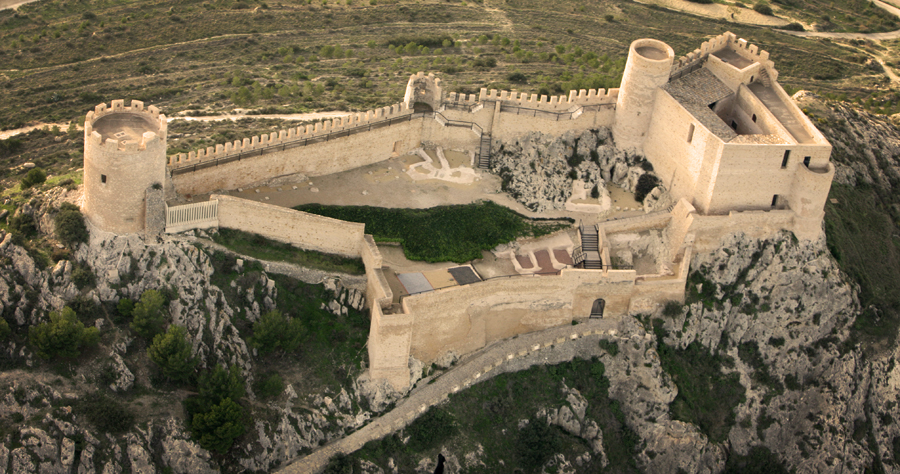
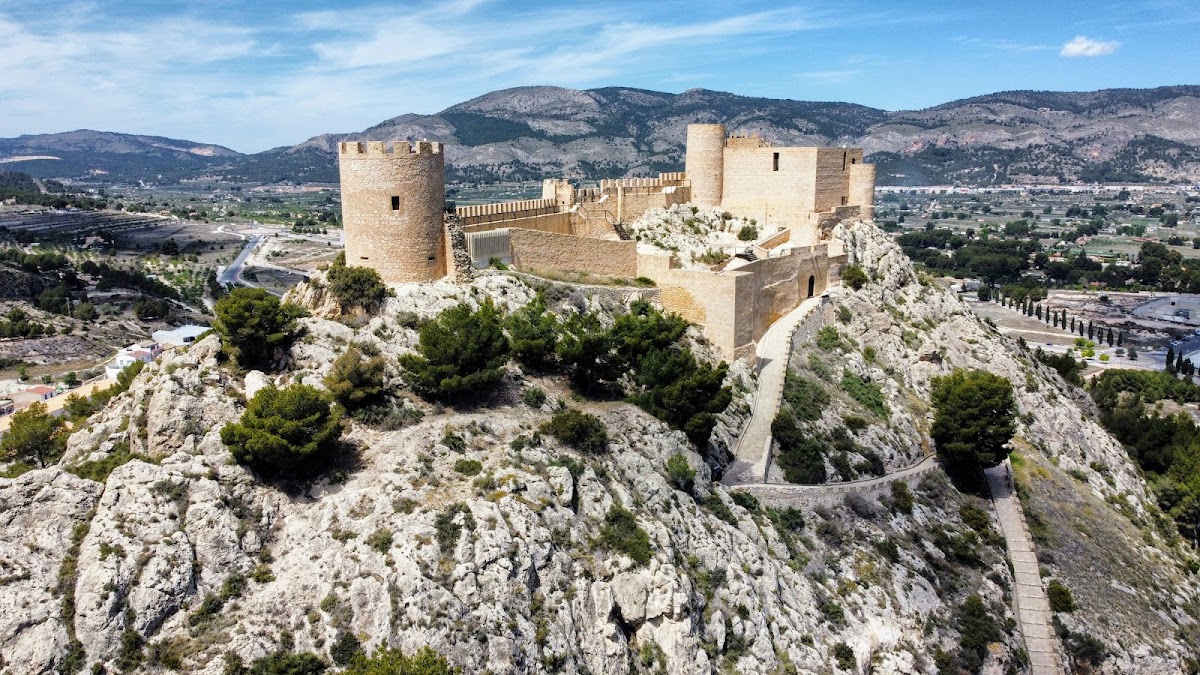
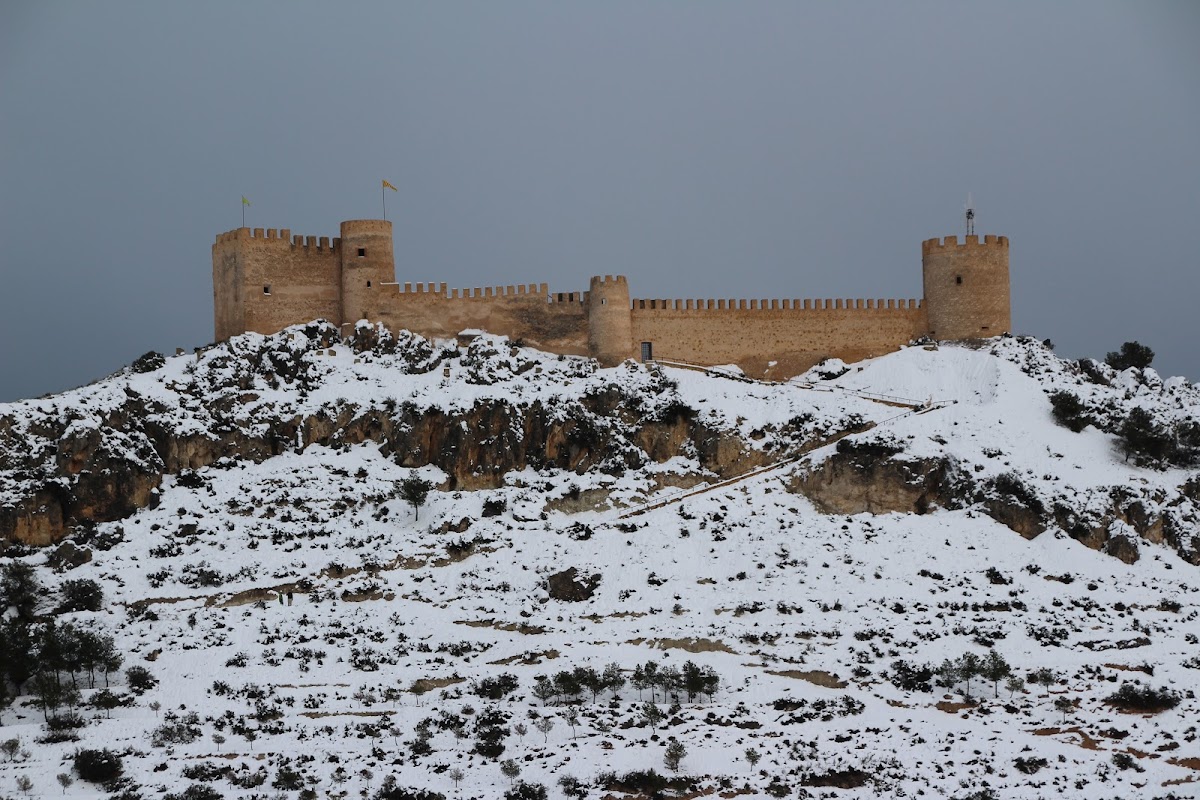
Castle of Castalla stands at approximately 780 metres above sea level on a hill above Castalla, beside the Verde River. Its elevated position overlooks the settlement and the river course. The elongated fortification follows the terrain and covers a large area enclosed by straight sections of rammed-earth wall, a building method in which compacted damp earth forms solid walls. Cylindrical towers reinforce the enclosure, which also contains additional wall sections, towers, and dispersed internal buildings.
Walls and Defensive Towers
The principal wall was the last major element added to the fortification and was completed during the second half of the sixteenth century. Its surviving form is crenellated. The defensive enclosure includes the central Torre Grossa, additional towers, and scattered wall sections that preserve the extended shape of the fortress.
Palace and Torre Grossa
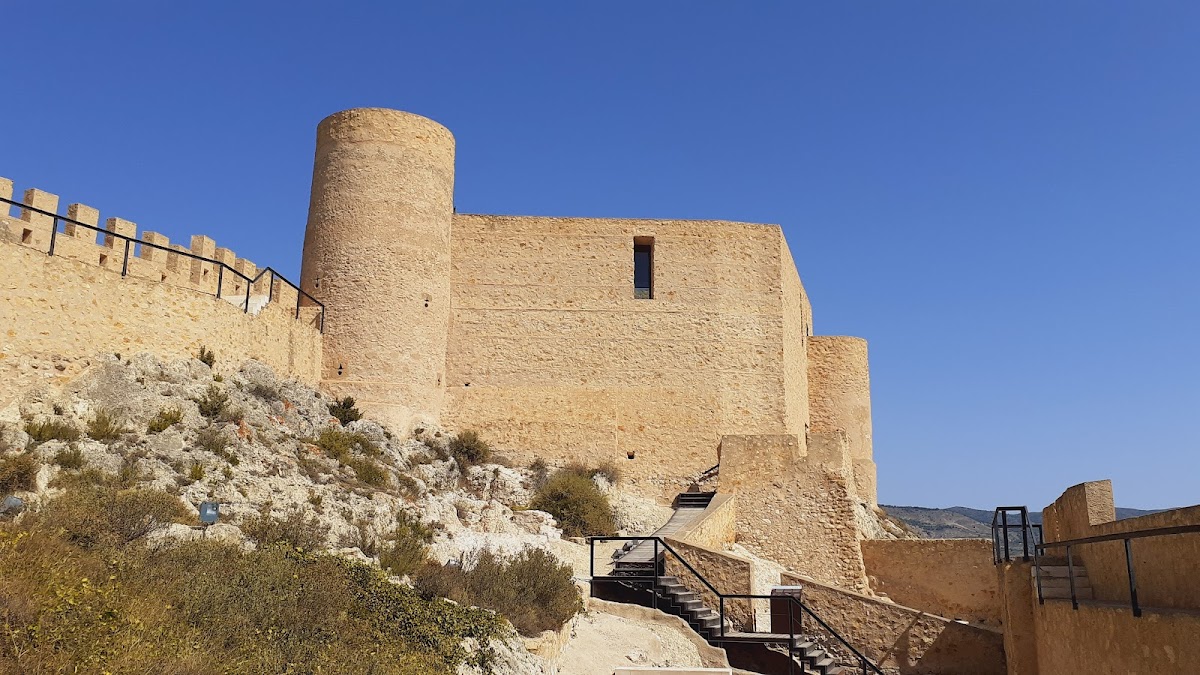
The palace occupies the widest part of the enclosure and dates from the fourteenth and fifteenth centuries. It is an elongated rectangular building with rooms arranged around a courtyard and two circular towers placed diagonally. The Torre Grossa, added in the late sixteenth century, stands in the central part of the enclosure. Circular in plan and built of rammed earth, it served as the keep, the castle’s principal fortified tower, and as a lookout against repeated attacks by pirates from North Africa.
The entrance to the Torre Grossa is emphasized by ashlar masonry, made from carefully cut stone blocks, including large, deep voussoirs, the wedge-shaped stones forming an arch. Remnants of Gothic mouldings survive in parts of the tower. The stone Jesus statue installed there in 1929 formed a later addition to the tower before its destruction during the Spanish Civil War.
Cisterns and Internal Structures
A large cistern for collecting and storing water lies within the enclosure, while another is situated beneath the palace courtyard. Other towers, wall sections, and dispersed central buildings remain visible alongside the palace and Torre Grossa, preserving the complex arrangement of the fortified site.


