Castle Lemberg: A Medieval Hill Castle in Germany


Site at a Glance
- Rating
- 4.4
- Popularity
- Low
- Country
- Germany
- Primary era
- Medieval
- Eras represented
- Medieval, Early Modern
- Civilizations
- Holy Roman Empire
- Site type
- Military
- Remains
- Castle
On this page12 sections
History
Castle Lemberg is a medieval hill castle in Germany, above the town of Lemberg in the wooded Wasgau uplands. Built probably around 1200 for the Counts of Zweibrücken, it secured their territory and provided military training for young nobles. Its first recorded name, Castrum Lewenberc, appears in 1230.
Foundation and early development
In 1198, the abbot of Hornbach Abbey, the head of that monastery, granted the hills of Gutinberc and Ruprehtisberc to Henry I, Count of Zweibrücken. Lemberg Castle and the nearby Ruppertstein outer bailey were probably built on these heights soon afterwards. The first known castellan, Gozo of Lemberg, appears in 1269. A castellan was the official responsible for a castle’s administration and defence.
The castle chapel is first mentioned in 1502, although coins and pottery found there place its construction in the second half of the thirteenth century. The chapel therefore belonged to the castle’s medieval development, before later changes altered the residence.
From noble residence to territorial possession
In 1333, Lemberg passed to Count Simon I, son of Eberhardt of Zweibrücken-Bitsch. Between 1535 and 1541, Simon’s successor, Count James of Zweibrücken-Bitsch, lived at the castle and remodeled it as a Renaissance palace. This type of residence, known in German as a schloss, served courtly and domestic purposes as well as representing noble status, rather than functioning solely as a medieval fortress.
James died in 1570, leaving an inheritance dispute. Charles III, Duke of Lorraine and the castle’s feudal lord, ended the conflict by occupying Lemberg with his troops in 1572. In 1606, he reached an agreement with Count John Reinhard I of Hanau-Lichtenberg, James’s grandson. John Reinhard received the Lemberg estate, while Charles retained the lordship of Bitche.
War, destruction, and administrative change
During the Thirty Years’ War, a European conflict fought from 1618 to 1648 over religious, dynastic, and territorial issues, troops occupied and plundered the castle and village in 1634 and 1635. The castle was burned in 1636 and received only provisional repairs afterwards.
French troops probably demolished the castle in October 1689 during the War of the Palatine Succession, also called the Nine Years’ War, which lasted from 1688 to 1697. The principal defensive tower, or bergfried, was dismantled as well. Lemberg consequently lost its military importance. The remaining walls deteriorated, and usable stone was taken for other building work, including the rebuilding of a village church in 1746.
In 1794, the Barony of Lemberg, an administrative district, last belonged to the Landgraves of Hesse-Darmstadt. It included Pirmasens and 24 villages and was divided into the subordinate districts of Lemberg, Münchweiler, Vinningen, and Obersteinebach. The Lemberg district comprised Burgalben, Donsieders, Fehrbach, Gersbach, Höheinöd, Höhfröschen, Lemberg, Thalfröschen, Thaleischweiler, and Winzeln. Münchweiler included Münchweiler and Ruppertsweiler; Vinningen included Erlenbrunn, Eppenbrunn, Hilst, Kröppen, Riedelberg, Schweix, Simten, Trulben, and Vinningen; and Obersteinebach included Ludwigswinkel, Obersteinbach, and Petersbächel.
Archaeology and modern use
In the twentieth century, the Lemberg branch of the Palatine Forest Club renovated the ruins and established a castle tavern in 1953. Since 2001, a modern extension has housed an information centre for the Palatinate and North Vosges and has provided a setting for medieval events. Excavations in the 1990s examined the cistern shaft and recovered evidence connected with the castle’s seventeenth-century destruction. Graves discovered near the chapel were probably later burials of Lemberg inhabitants rather than those of castle residents, and the bones were reburied elsewhere.
Remains
Hilltop layout and surviving structures
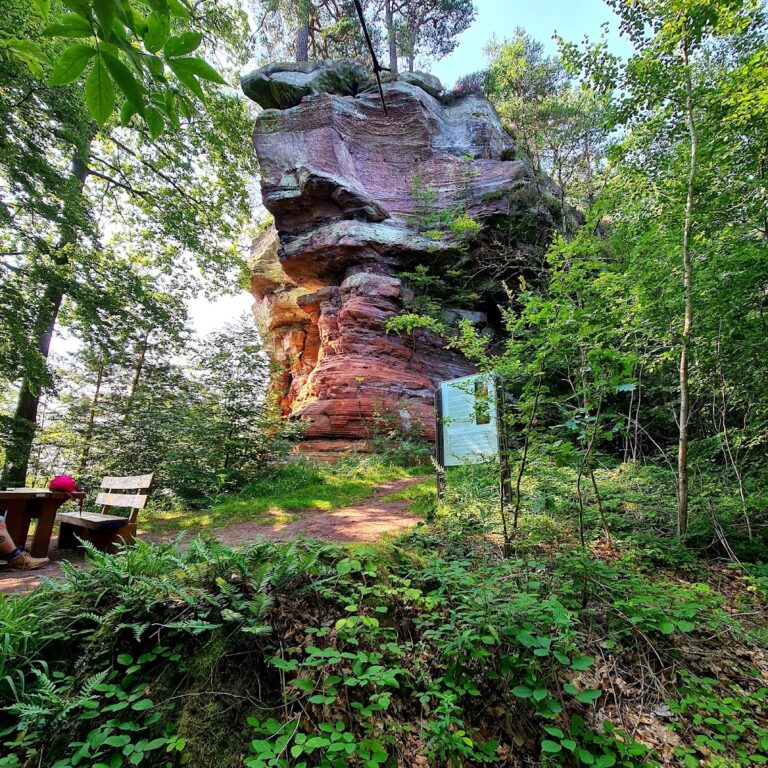
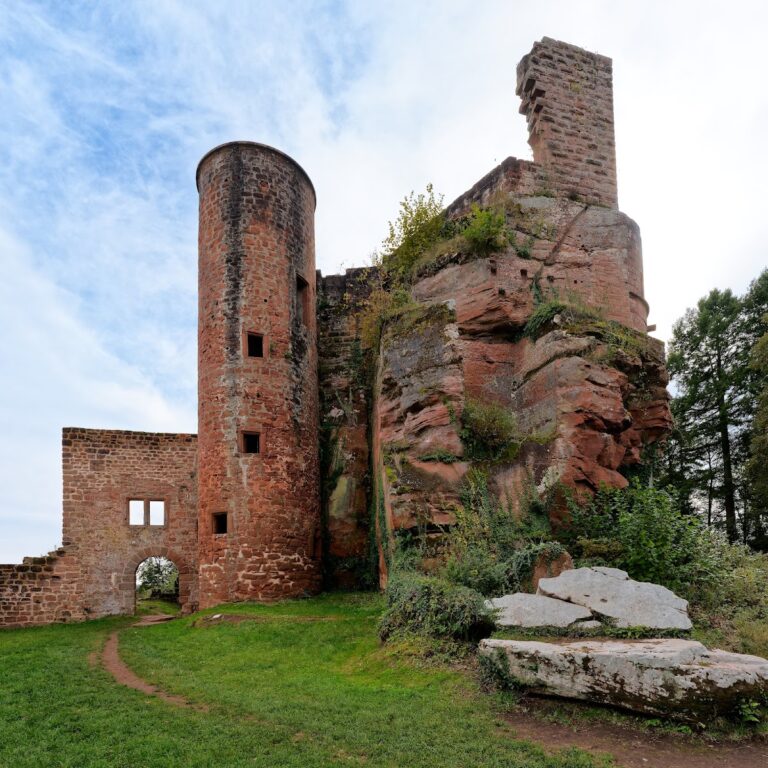
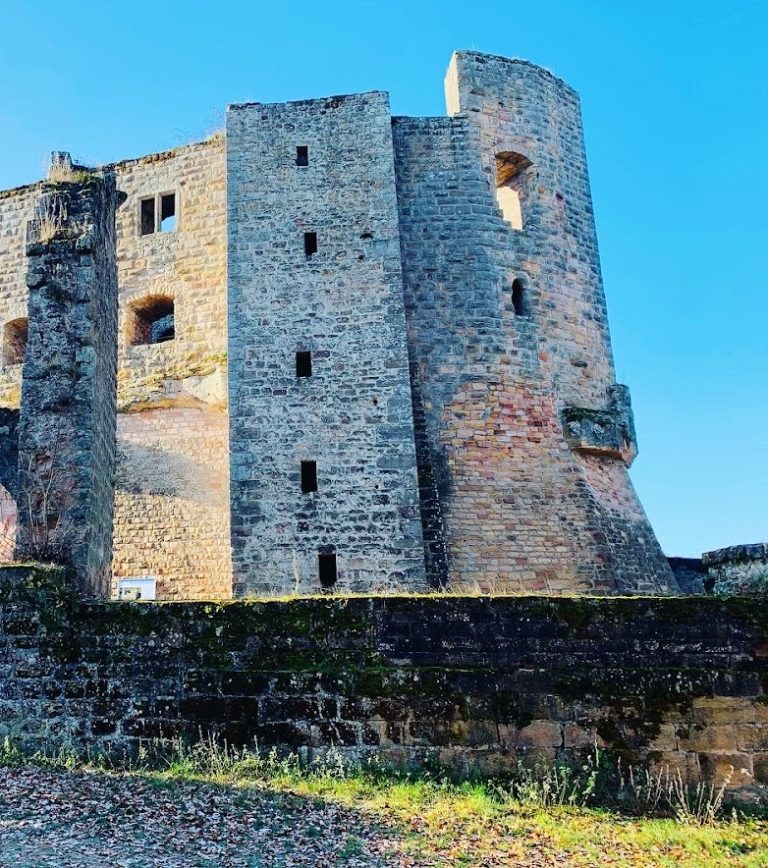
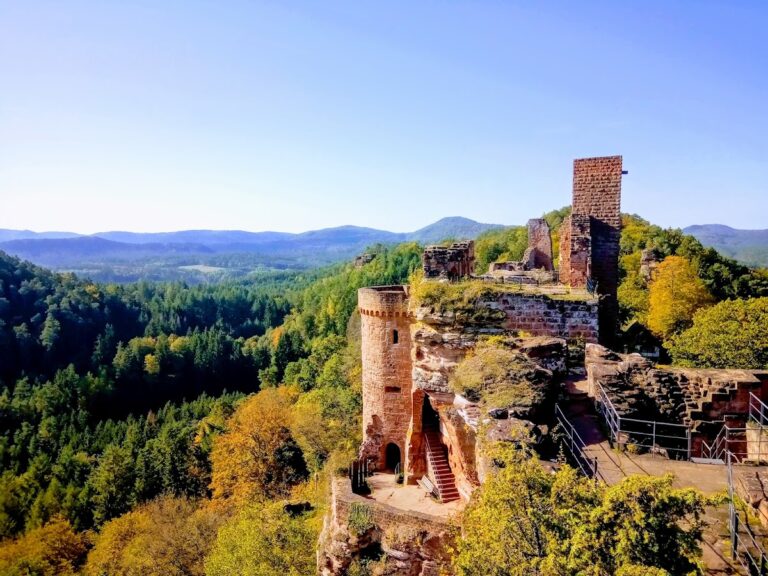
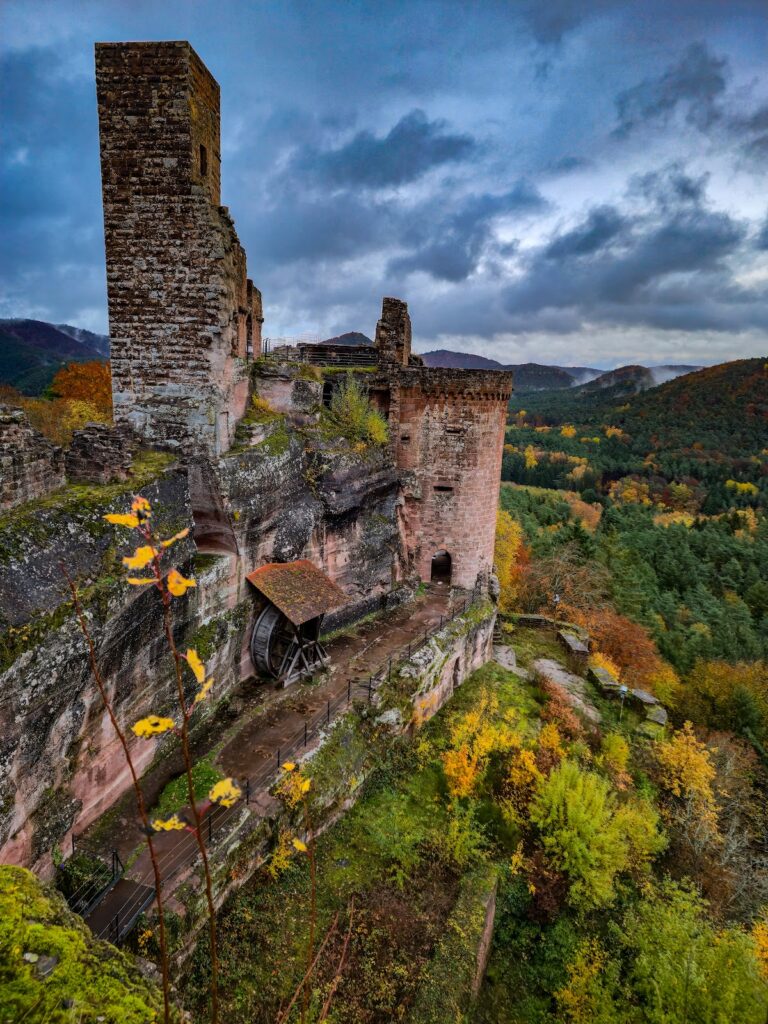
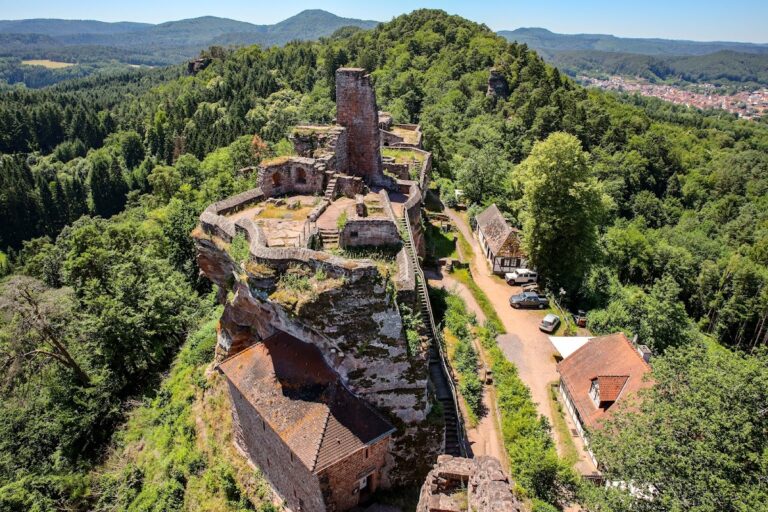
Lemberg Castle occupies Schlossberg at an elevation of 458 metres. Its exposed hilltop position overlooks Lemberg and the surrounding wooded hills of the Wasgau. The upper castle, including a tower, was built directly on existing rock. Below it, a curtain wall made of bossed stone blocks enclosed several buildings or huts, a stable, and the chapel. Access was protected by a gate tower and bridge, creating an organized defensive approach to the upper and lower parts of the castle.
Chapel remains
Wall remains and the foundations of the chapel survive on Schlossberg. A concrete dance floor was laid across the chapel foundations during the twentieth century and later removed during archaeological work. Its removal exposed graves beneath the floor area, adding evidence about later use of the chapel site and its surroundings.
Water supply system
Cistern shaft
The castle’s shaft cistern descends 94.80 metres into the rock. It is sometimes incorrectly described as a well shaft or well tunnel. Excavation had not reached groundwater at that depth, so the shaft served as a cistern, a structure intended to store water. Its construction and later archaeological investigation form an important part of the surviving evidence for how the hilltop castle secured its water supply.
Hillside adit
A nearly horizontal adit, meaning a tunnel driven into a slope or rock, reaches the shaft at a depth of about 60 metres after running for almost 200 metres. A spring on the hillside supplied water through this passage, creating the intended reserve in the shaft. Workers cut both the shaft and the adit entirely with hammers and chisels. Several excavations in the 1990s focused on this water system, with finds particularly relating to the castle’s destruction in the seventeenth century.
Present-day site buildings
The castle site now includes the castle information centre and a café or tavern operated by the Palatine Forest Club. These modern uses accompany the surviving masonry, chapel foundations, and underground waterworks without altering the site’s place in the history of Lemberg’s medieval and early modern castle.