Castillo de San Juan Bautista: A Coastal Fortification in Santa Cruz de Tenerife


Site at a Glance
- Rating
- 4.4
- Popularity
- Low
- Country
- Spain
- Primary era
- Early Modern
- External website
- Open
- Eras represented
- Early Modern
- Civilizations
- Crown of Castile, Spanish
- Site type
- Military
- Remains
- Castle
On this page7 sections
History
Castillo de San Juan Bautista is a coastal fortification in Santa Cruz de Tenerife, Spain, built between 1641 and 1644 to strengthen the city’s defences. Also known as Castillo de San Juan or Castillo Negro, it became the second most important fortification in the defence of Santa Cruz.
Construction during regional tensions
After the English attack on Cádiz in 1625, the Tenerife council agreed to build a fort near Caleta de Junior, following an initiative by Captain General Francisco González de Andía. The Portuguese uprising of 1640 accelerated the project. Construction took place from 1641 to 1644 near Caleta de los Negros under Juan Fernández Franco, Sergeant Major of Tenerife.
Captain General Luis Fernández de Córdoba y Arce personally required local residents to contribute financially. Tenerife was regarded as undefended and vulnerable during the international tensions surrounding the Portuguese uprising, making the new coastal fortification an urgent public responsibility.
The castellan and the defence of Santa Cruz
In 1684, King Charles II gave the Tenerife council authority to appoint the castle’s castellan, the official responsible for a castle’s administration and defence. Local nobility sought the office as an honour and as evidence of status for admission to military orders or the cavalry maestranza, a noble institution whose membership demonstrated aristocratic standing.
The position also carried practical responsibilities. The castellan was involved in public health, policing the port, granting permission for ships to enter and leave, regulating fishing rights, mediating disputes between fishermen and seafarers, managing correspondence, and collecting excise duties on salt and flour.
After about a century, the seaward front had deteriorated so severely that it threatened to collapse. The castle was rebuilt in 1765, creating the form that survives today. It took part in the defence of Santa Cruz during the unsuccessful British attempt led by Admiral Horatio Nelson to capture the city and the archipelago on 25 July 1797.
Military and civic afterlife
Castillo de San Juan Bautista remained a military fort until 1924. In 1948, it was converted into a military museum. Spain designated it a Property of Cultural Interest in the monument category in 1993. The Santa Cruz de Tenerife city council owns the castle, and an annual July recreation commemorates the failed British attack of 1797.
Remains
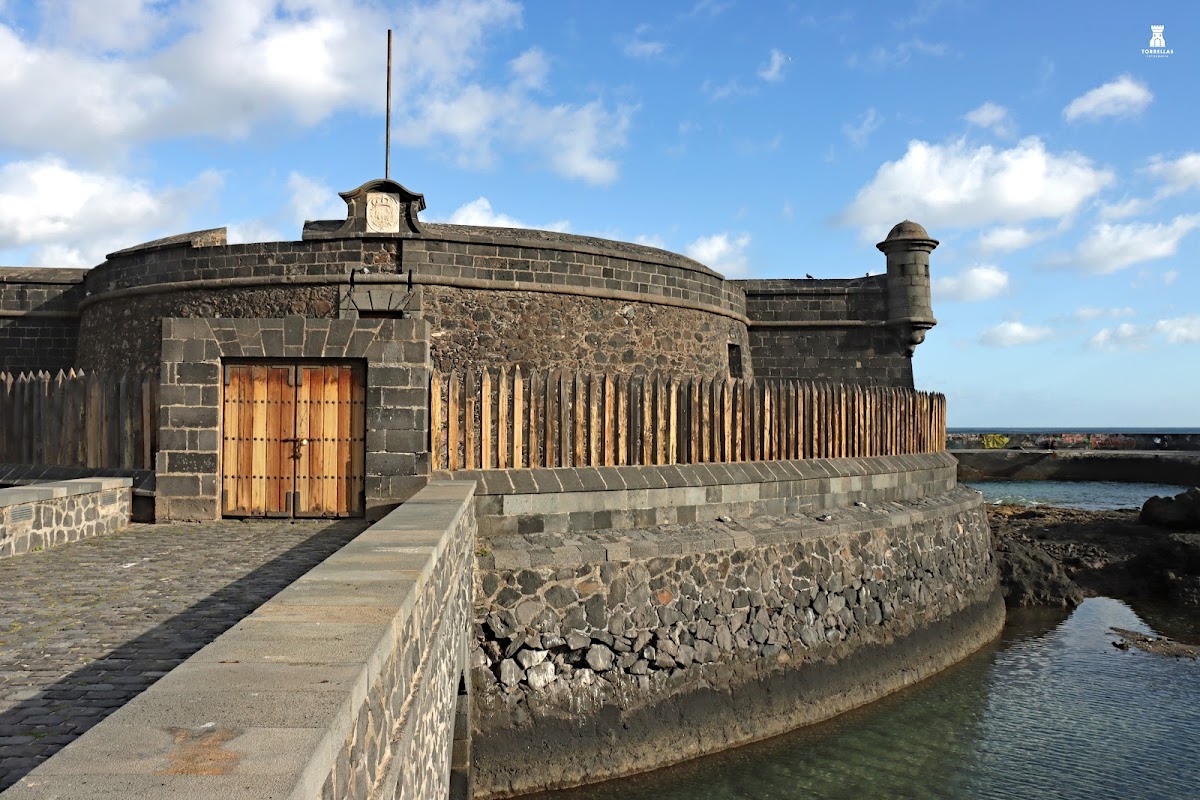
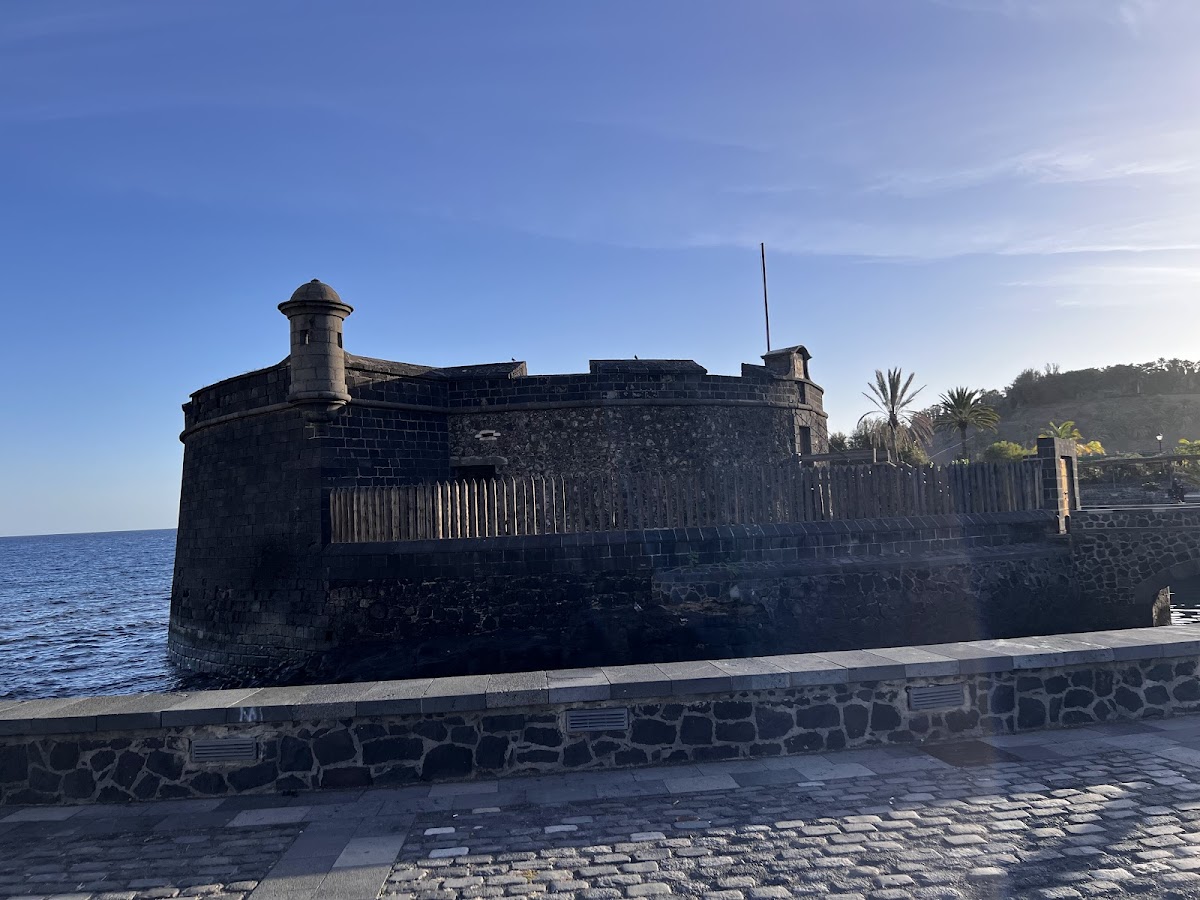
The fort stands in central Santa Cruz de Tenerife, behind the Auditorio de Tenerife and near the Maritime Park and the sea, at approximately 6 metres above sea level. Built from volcanic ashlar, or carefully cut volcanic stone blocks, it has a compact coastal defensive layout organized around an open terreplein, a level artillery platform behind the walls. Parapets surround the platform, with gun embrasures, openings that allow weapons to fire outward, and positions for five artillery pieces.
Sea-facing defences
A cylindrical tower faces the sea and forms the most distinctive element of the present castle. The fort’s defensive arrangement combines this circular structure with the open platform and parapets, allowing the surviving fabric to be understood as a compact coastal artillery position. The castle is described as being in good condition.
Vaulted rooms
Two vaulted rooms lie beneath the terreplein. Together they cover approximately 47 square metres, while the masonry walls are about 1.5 metres thick. These enclosed spaces form part of the robust construction that supports the artillery platform and the sea-facing defensive works.
Nearby sites