Niesytno Castle: A Gothic Fortress in Poland




Site at a Glance
- Rating
- 4.1
- Popularity
- Low
- Country
- Poland
- Primary era
- Medieval
- External website
- Open
- Eras represented
- Medieval
- Civilizations
- Holy Roman Empire, Kingdom of Bohemia
- Site type
- Military
- Remains
- Castle
On this page9 sections
History
Niesytno Castle is a Gothic castle in Płonina, Poland, probably built during the second half of the fourteenth century and expanded into the fifteenth century. It stands in the Eastern Ridge of the Kaczawskie Mountains in the Western Sudetes, west of Bolków, and forms part of the Piast Castles Trail.
Origins and fifteenth-century history
The castle was first mentioned in 1432. In that year, Wrocław Bishop Konrad Oleśnicki wrote to the Grand Master of the Teutonic Order, the highest authority of a medieval German military-religious organization, about the seizure of the fortified site belonging to the knight Hayn von Czirna by burghers from Wrocław and Świdnica. The record demonstrates that the castle existed by that time, although its construction had begun earlier. A thirteenth-century origin is considered unlikely, and the main building phase probably took place in the second half of the fourteenth century, with further work continuing during the following century.
Niesytno’s fifteenth-century history is traditionally linked with the Hussites, followers of the religious reformer Jan Hus whose movement developed in Bohemia and became involved in major conflicts in fifteenth-century Central Europe. The castle was also believed to have housed robber knights. The name “Angstwinkel,” meaning “Corner of Fear,” is probably associated with this period. Members of the von Zedlitz family probably acquired the castle during the 1430s and retained it until the middle of the seventeenth century.
Transformation after 1545
The castle ceased to be the family’s residence in 1545, when the von Zedlitz family constructed a manor immediately east or southeast of the medieval stronghold. Repeatedly altered, that building became known as Płonina Palace. From the mid-sixteenth century, the older castle was probably used mainly for storage and other economic purposes. The knights’ hall was converted into a granary, while four hook guns, early firearms with projecting supports for bracing them during firing, were mounted on the walls and discharged during important holidays or ceremonies.
Conservation and modern ownership
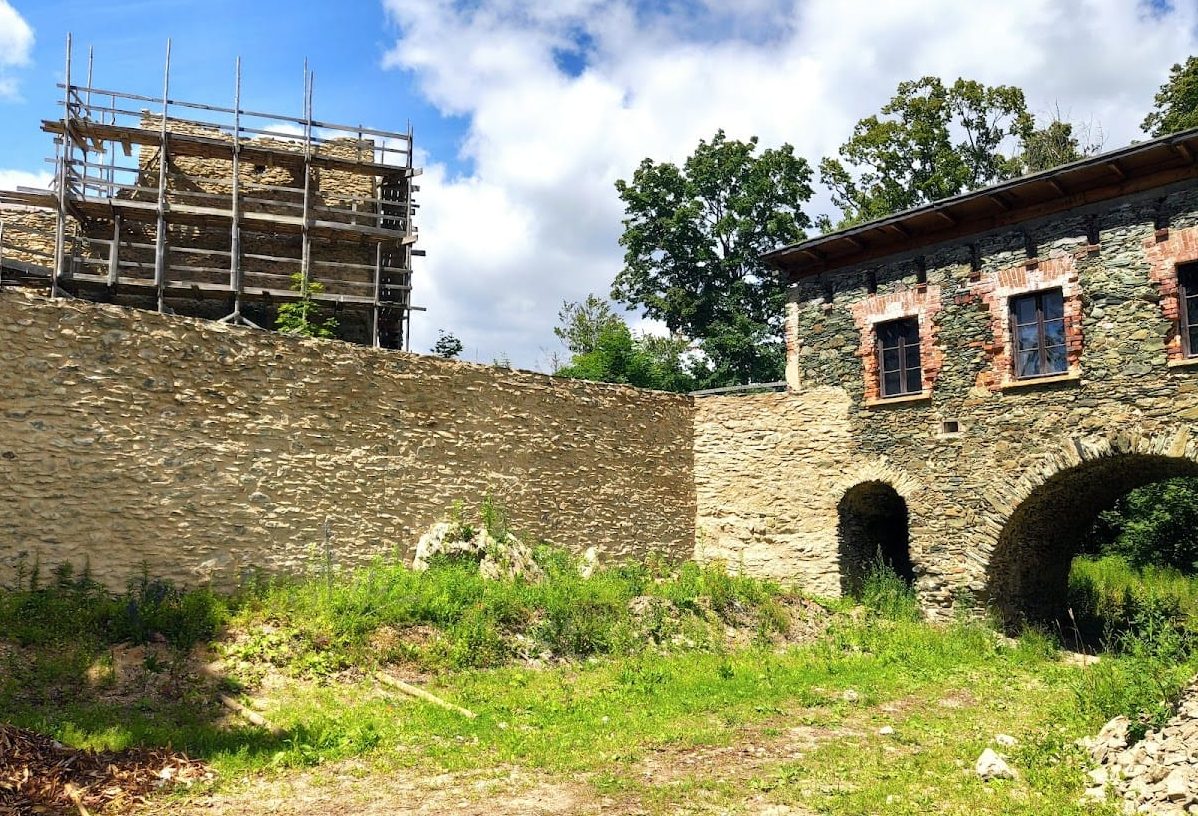
In 1843, Count Julius von Bulow purchased the ruins, secured them, and carried out extensive conservation. At the beginning of the twentieth century, Count Eberhard von Saurma, Baron von Jeltsch, acquired the estate, conserved the upper castle, and opened it to visitors. The castle became privately owned in 2010, when the identified owner was the entrepreneur Krzysztof Harkawy. Rubble removal and reconstruction of the residential building within the medieval castle began in 2012. Niesytno Castle is legally registered as a historic monument and is listed as a Polish cultural-heritage property under registration no. A/3231/962, dated 13 November 1961.
Remains
The castle occupies a rocky promontory at approximately 550 metres above sea level. Its principal surviving element is a polygonal, beaked tower on the summit of the rock. Below it stands a later castle house, while the former residential manor lies to the east or southeast. The complex was expanded and rebuilt several times, leaving a group of structures from different phases of use.
Upper castle
Polygonal tower
The polygonal, beaked tower served as the donjon, the principal fortified tower and defensive-residential core of a medieval castle. Its form is unusual in Poland, with a comparable tower at Bolków Castle. Inside is a so-called warm room, a large chamber lined with wood to provide thermal insulation. Its precise construction date is disputed, but it was probably built during the second half of the fifteenth century.
Castle house
A castle house stands below the tower. It was probably built later than the tower and is partly two storeys and partly three storeys high. Rubble removal and reconstruction of this residential building began in 2012.
Later manor and economic features
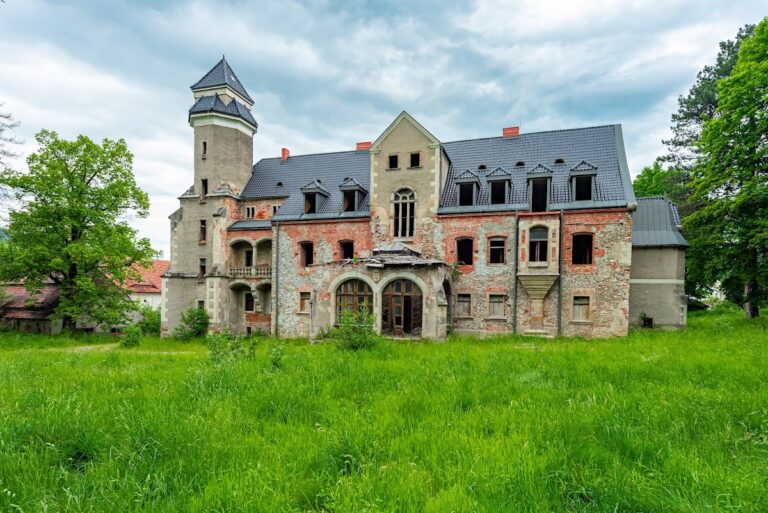
The manor erected in 1545 east or southeast of the castle was decorated with Renaissance stonework. Its principal portal and windows have fasciated surrounds, or bands of stone framing the openings. After repeated alterations, the manor became the building known as Płonina Palace.
The former knights’ hall later served as a grain store, reflecting the castle’s change from a residence to an economic complex. Four hook guns were positioned on the castle walls, where they were fired during important holidays or ceremonies.