Castle of the Order of St. John in Łagów: A Medieval Border Fortress in Poland


Site at a Glance
- Rating
- 4.6
- Popularity
- Low
- Country
- Poland
- Primary era
- Medieval
- Eras represented
- Medieval, Early Modern
- Civilizations
- Holy Roman Empire, Knights Hospitaller, Margraviate of Brandenburg
- Site type
- Military
- Remains
- Castle
On this page8 sections
History
The Castle of the Order of St. John in Łagów is a hilltop border fortress in Poland, in Łagów, whose oldest surviving parts date from the first half of the fourteenth century and whose principal construction belongs to the Gothic period. It stands in a site shaped by the frontier between Brandenburg and Poland, and later served as the administrative centre of an estate belonging to the Order of St. John.
Border fortress and Johannite commandery
An earlier border fortification existed here during the second half of the thirteenth century under the Ascanians, a German princely dynasty that ruled territories including Brandenburg. Built against Poland, it guarded the trade route running from Frankfurt an der Oder through Reppen and Schwiebus to Poznań.
Łagów became a pledge of the Order of St. John in 1347 and part of its property in 1350. The Order, also known as the Hospitallers, was a Christian military-religious institution that combined religious duties with military and political administration. After 1318, Łagów and Zielenzig formed one commandery, a regional administrative and economic unit led by a commander. The Łagów estate included 23 settlements, among them villages along the northern bank of the Pleiske, extending from the mouth of the Łagów stream toward Sandow.
A new castle was built after 1351. A commander of Łagów is mentioned in 1357, while Heinrich von Wedel is the first commander whose name is preserved, in 1372. In 1367, the Łagów convent consisted of seven knight brothers and one priest brother. During the threat posed by a Polish-Hussite army in 1433, Commander Balthasar von Schlieben changed sides. The Hussites were followers of the reform movement associated with the Bohemian religious reformer Jan Hus. Nicolaus von Colditz held the commandery in 1435, after previously serving at Tempelhof, and Liborius von Schlieben was commander from 1449 to 1458.
Diplomacy, Reformation, and war
The castle also had a diplomatic role. Brandenburg councillors met there in 1460, 1464, and 1467 while preparing negotiations with Poland. After the Reformation reached the Neumark in 1538, the Johannites of the Brandenburg bailiwick became Protestant. The Neumark was the part of historic Brandenburg east of the Oder River, while a bailiwick was a larger territorial division containing several commanderies and related establishments.
The change in religious and social arrangements affected the castle itself. Commanders now had families, and the interiors were remodeled to suit their household use. Andreas von Schlieben was commander around 1552, followed by Abraham von Grüneberg, who headed the commandery in 1570.
Swedish troops captured the castle in 1640 during the Thirty Years’ War, the seventeenth-century conflict that devastated much of central Europe through intertwined religious and political struggles. After the war, the castle passed to Brandenburg-Prussia. Christian Ludwig, Prince of Prussia, later became commendator of Łagów. He was also a lieutenant general, governor of the Principality of Halberstadt, and a highly decorated holder of the Order of the Black Eagle, the highest Prussian order of chivalry.
From commandery to landed estate
In 1710, Prince Carl Albrecht Friedrich of Prussia was admitted to the Order of St. John with the expectation that he would receive Łagów. He later followed his father, Prince Albrecht Friedrich of Prussia, in the investiture of the order’s master and in his installation at Sonnenburg, the historic German name for present-day Słońsk. Christian David von Sydow was among those designated as commendators of Łagów after 1731. From 1760 until his death in 1790, Lieutenant Colonel Friedrich Wilhelm von Pannwitz, lord of Schönfließ, held the office.
A royal edict dissolved the Order of St. John in 1810, and its properties were secularized. As the frontier moved farther east, the former border castle no longer served its original military purpose. It was granted as a fief, together with surrounding villages and the castle at Groß Gandern, to the von Klepzig family. Łagów then became part of a landed estate that continued until 1945.
Modern preservation and use
The castle remained privately owned during the nineteenth and early twentieth centuries. It is now owned by the municipality and leased for use as a hotel, restaurant, and conference facility. Renovation took place between 1964 and 1970. The building entered Poland’s heritage register under number 23 on 13 April 1951 and is recognized as a cultural-heritage monument of Poland.
Remains
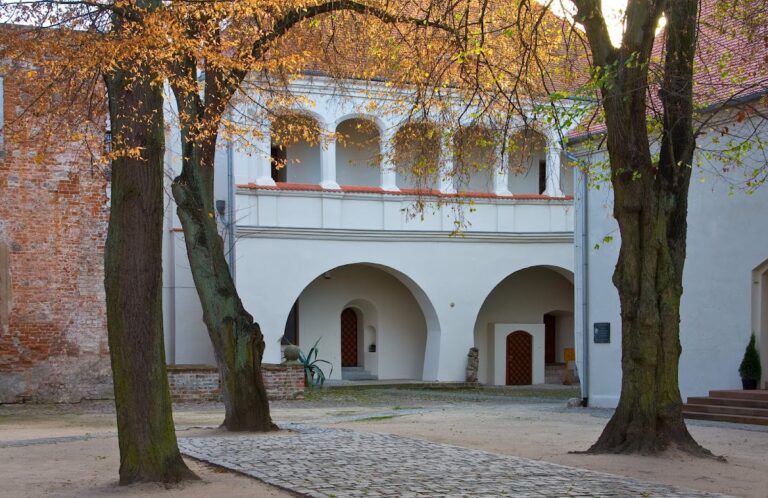
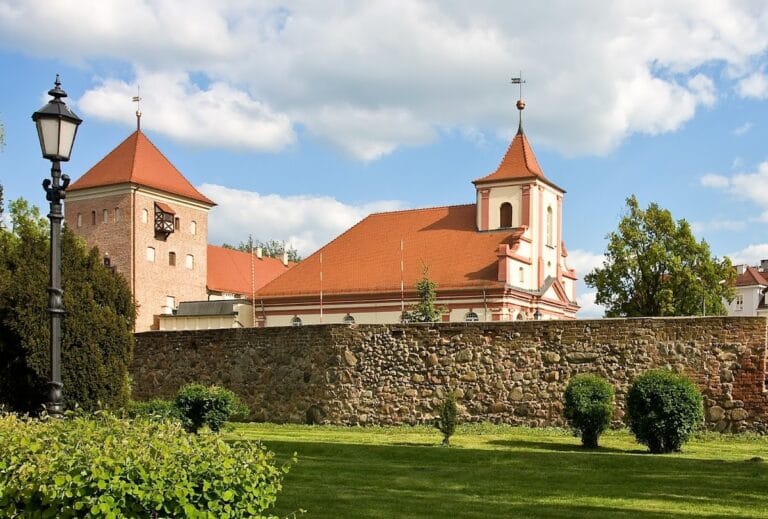
The castle stands on a castle hill beside the Łagów stream, on a peninsula between Lake Ciecz and Lake Łagowskie. The complex created after 1351 was arranged in two approximately equal rectangular areas. The eastern area contained the Order’s castle, while the western area served as an economic or service courtyard. The surviving complex combines Gothic perimeter walls with Renaissance and Baroque elements added or altered between the sixteenth and eighteenth centuries.
Castle complex and defensive structures
The main castle follows a quadrilateral plan. At one corner rises a 35-metre-high tower on a square base. This tower is a stołp, a fortified structure designed chiefly for defence and refuge and forming the strongest vertical element of a medieval castle. Gothic perimeter walls remain part of the complex, while substantial sections of the building survive within the later architectural layers.
Interior spaces
Inside the castle, a hall retains a Gothic vault supported by a single pillar. The knights’ hall contains a Baroque fireplace dated 1740, reflecting the alterations made after the Order’s commanders began maintaining family households. The preserved interiors are now incorporated into accommodation, restaurant, and conference uses.