Cistercian Monastery in Gościkowo-Paradyż: A Historic Monastic Complex in Poland


Site at a Glance
- Rating
- 4.7
- Popularity
- Low
- Country
- Poland
- Primary era
- Early Modern
- External website
- Open
- Eras represented
- Medieval, Early Modern
- Civilizations
- Polish–Lithuanian Commonwealth
- Site type
- Religious
- Remains
- Monastery
On this page16 sections
History
The Cistercian monastery in Gościkowo-Paradyż is a medieval monastic complex in Poland, founded in 1230 and developed through Gothic and later Baroque phases. It stands in the village of Gościkowo near Świebodzin, on the Paklica River, in the historic region of Greater Poland and today’s Lubusz Voivodeship. Mikołaj Bronisz, a Poznań voivode, established the settlement with the consent of Bishop Paweł of Poznań and Duke Władysław Odonic. Monks arrived from Lehnin around 1236, and the community gave the settlement the name Paradisus Sanctae Mariae, meaning “Paradise of Saint Mary,” later rendered in Polish as Paradyż.
Foundation and medieval expansion
The monastery was a daughter foundation of Lehnin and an indirect affiliation of Morimond within the Cistercian network. Its initial endowment consisted of nine villages from Bronisz’s hereditary lands. The Cistercians expanded their estate through farming, donations, and privileges. Bolesław the Pious and Przemysł I granted the monastery judicial immunity, and by the end of the thirteenth century its lands covered more than 16,000 hectares.
The community’s growth led to the foundation of a daughter monastery at Wieleń around 1278–1280. That house was later moved to Przemęt. At Gościkowo-Paradyż, intensive development continued until the end of the fourteenth century, while the fifteenth century brought particular cultural and intellectual activity. The abbey possessed a library regarded as one of the largest in Poland, and the Cistercian theologian Jakob of Paradies was associated with the community. He wrote dozens of works on mysticism, asceticism, and reform of the Church.
Reform, political control, and war
The monastery’s administration changed during the sixteenth century. In 1538, King Sigismund I the Old ordered that the office of abbot should be held only by Poles. Stanisław Wierzbiński became the first Polish abbot under this policy in 1558. Sigismund II Augustus later created an additional commendatory abbacy, an arrangement in which control of an abbey’s office and revenues could be separated from the community’s ordinary monastic leadership. After 1580, the monastery entered the Polish Cistercian province.
Economic difficulties and heavy debt affected the abbey toward the end of the sixteenth century. Its fortunes improved in the early seventeenth century as agricultural production became more effective and demand for food increased. This recovery was interrupted by the Thirty Years’ War, the major European conflict of 1618–1648 involving religious and political rivalries. Protestant Brandenburg and Swedish forces attacked the abbey, and a major fire in 1633 completed the wartime devastation.
Reconstruction and the Baroque transformation
King Władysław IV supported the rebuilding of the damaged abbey, a process that continued over a long period. Abbot Zygmunt Czyżowski commissioned an image of the Virgin and Child, while Abbot Jan Szczuka ordered a high altar that has since been lost and furnished the church. Another fire damaged parts of the abbey in 1722. Reconstruction was completed during the eighteenth century and gave the complex its Baroque character. This century was also the final period of the monastery’s development under the Cistercians.
The 1737 Concordat of Wschowa granted the kings of Poland the right to appoint commendatory abbots. After the Second Partition of Poland, the territory became part of Prussia, whose authorities confiscated most of the abbey’s estates. The monastery was finally dissolved in 1834. The monks then left the complex and did not return.
Educational use and modern religious life
In 1836, the former monastery became the seat of the Royal Teachers’ Seminary. The institution retained ownership of the former monastic estates until 1926, and its continuing educational use helped protect the buildings from destruction. During this period, the frescoes in the Chapel of the Holy Cross were covered with plaster; they were rediscovered in 1965. The organ was restored and the garments and crowns associated with the Paradyski Virgin were renewed between 1921 and 1936. A state secondary school operated at the complex from 1922, and shortly before the Second World War it also trained teachers for the Third Reich.
The school ceased operating when the Red Army entered the complex in 1945. The former monastic buildings were then used as warehouses, and the settlement returned to the name Gościkowo, although Paradyż remained a customary name for the area containing the abbey. The Salesians took over the buildings in 1947 and opened a boarding school for boys. In 1956, the Faculty of Philosophy of the Gorzów Diocesan Seminary began operating there, and the entire seminary moved to the complex five years later. Following the diocesan reorganization of 1992, it became the Higher Seminary of the Zielona Góra–Gorzów Diocese.
The complex now houses that diocesan seminary, which also functions as an external section of the Faculty of Theology of the University of Szczecin, as well as the Paradyż Museum. In 2017, the former Cistercian complex was designated a Polish Historic Monument. On 15 August 2020, it was established as the Sanctuary of Our Lady, Educator of Priestly Vocations. Since 2003, the monastery has also hosted the annual early-music festival Music in Paradise.
Remains
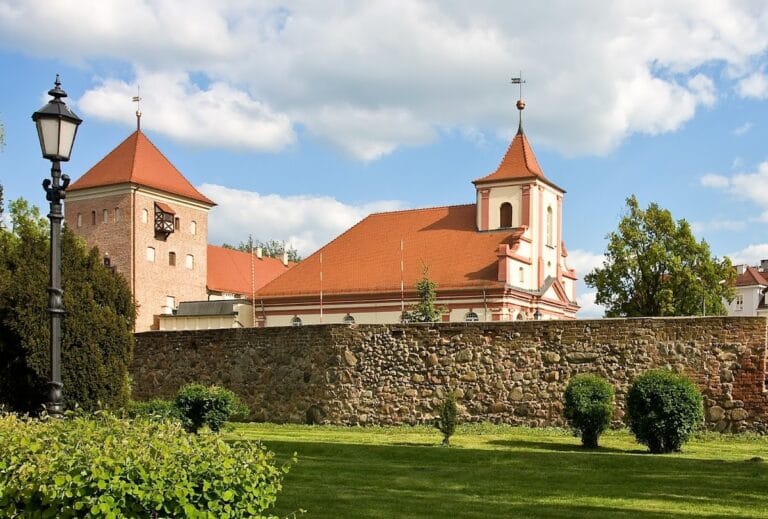
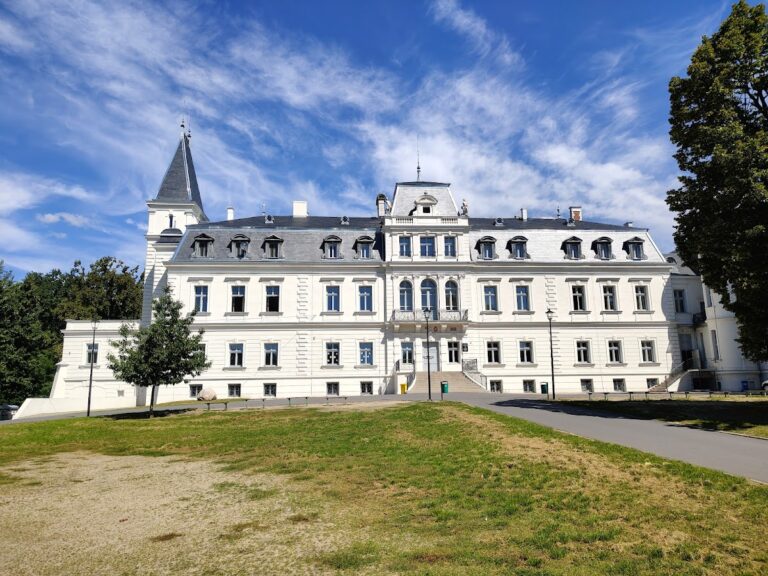
The surviving ensemble includes the Church of the Assumption of the Blessed Virgin Mary and Saint Martin, the monastery, former monastic gardens, and an eighteenth-century stone enclosure wall around the church and monastery. The buildings preserve evidence of the medieval foundation, the Gothic construction campaign, the destruction caused by fire and war, and the Baroque rebuilding of the eighteenth century.
The church
Construction of the church began around 1270–1290, and it was consecrated in 1397. Built in the Gothic style, it originally followed a cruciform plan. After the naves and part of the transept had been completed, the building was shortened by blocking the eastern arcades between the naves. The resulting church is a three-aisled basilica on a rectangular plan, with an ambulatory, a passage around the rear of the presbytery, circular chapels at the corners, and a porch between the towers. An eighteenth-century rebuilding transformed the interior into a Baroque space, probably under the direction of Karl Martin Franz, a royal court architect.
Baroque furnishings and devotional features
High altar
The church’s principal furnishing is a large Baroque high altar dated 1739 and produced in a workshop in Lubiąż. It contains Felix Scheffler’s painting of the Assumption of the Blessed Virgin Mary, figures of Saints Peter and Paul, and reliquaries holding the earthly remains of the ancient martyrs Saints Amantius, Cedonius, Damasus, Donatus, and Sevelianus. Several side altars are of comparable artistic value.
Marian image and foundation painting
A chapel contains a seventeenth-century copy of the San Luca image from Bologna, a Marian icon associated with the Basilica of San Luca. The painting depicts the Virgin and Child and is known as Our Lady of Paradies. Its inscription is a prayer attributed to Abbot Zygmunt Czyżowski: “Mother of God, remember me, ornament of Paradise, pray for us.” A foundation painting from around 1700 shows the donation of the monastery and a scene from the Battle of Legnica in 1241.
Organ and other church furnishings
A gilded perpetual lamp hangs at the centre of the nave. Abbot Marek Łętowski commissioned it, and it bears both the abbey’s coat of arms and the abbot’s personal arms. Tradition attributes its creation to King Władysław IV. Other furnishings include a Baroque organ case by Joachim Gottlon Peter, fragments of Gothic frescoes and vaults, and Classicist choir stalls in the presbytery decorated with images of Church dignitaries. The choir also bears a large emblem of Stanisław August Poniatowski with the Ciołek family arms, while epitaph slabs are set into the floor.
Monastery and gardens
Cloister building
The two-storey cloister building adjoins the church on its southern side and partly along its eastern side. It contains two courtyards. The smaller courtyard retains Gothic bays and fragments of wall polychromy. The chapter house, where the monastic community conducted formal business, occupied the eastern wing beside this courtyard, while the refectory, or communal dining hall, was in the southern wing.
Baroque courtyard and enclosure
The larger courtyard is Baroque in character. During the eighteenth century, tower-like structures resembling bastions, projecting defensive platforms, were added at three corners of the monastery building. These structures are covered with bell-shaped roofs. The church and monastery are enclosed by an eighteenth-century stone wall.
Gardens and statue
The former monastic gardens extend north and west of the monastery. They contain stone figures of Saints Florian, Bernard, Benedict, and Martin. In front of the church stands a Rococo statue of the Immaculate Mary surrounded by saints, dated 1755.
The Paradyż Museum
The Paradyż Museum preserves objects associated with the Cistercians of Paradyż. Its holdings include seventeenth- and eighteenth-century early printed books, a Torah, works by Thomas à Kempis, Piotr Skarga’s Annual Ecclesiastical History, and liturgical books such as the unique Lubusz Antiphoner and the so-called Lubusz Missal.
The collection also contains historic monstrances, liturgical vessels and vestments, a richly decorated Baroque processional cross, a gilded Baroque monstrance, and saints’ vestments and reliquaries from the monastery church collection. Among the paintings and other works are the coffin portrait of Augustyn Dobrowolski, an abbot of Paradyż, Scheffler’s painting of the Assumption of the Blessed Virgin Mary, a seventeenth-century Life of Saint Bernard of Clairvaux by an unknown painter, and the relief Hercules Christianus: The Last Judgment.